
Matthews International Faces Margin Pressure with Resilient Liquidity Amid Geopolitical Risks
Third-quarter results highlight operational execution challenges and portfolio shifts within a diversified industrial manufacturing context.
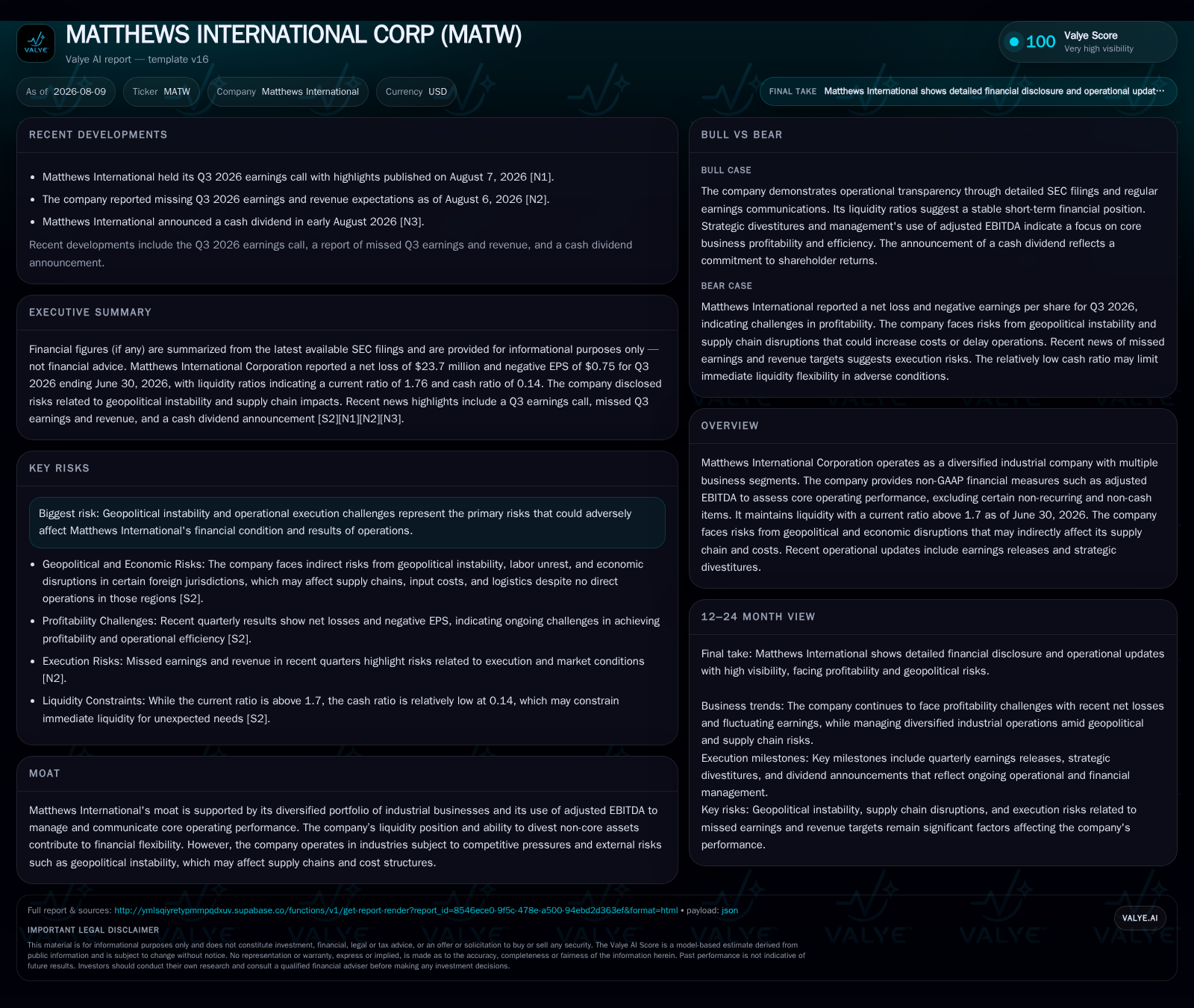
Matthews International's latest quarterly filing reveals softness in top-line growth and adjusted EBITDA, reflecting ongoing execution challenges and cost pressures typical for diversified industrial manufacturing firms. The company's diversified product portfolio and strategic divestitures support financial flexibility, but exposure to geopolitical instability and supply chain disruptions remain watchpoints. Strong liquidity with a current ratio near 1.8 cushions short-term risks while the firm navigates margin compression and industry cyclicality.
Recent Operating Update: Signs of Execution Headwinds
Matthews International reported Q3 fiscal 2026 results on August 7, revealing earnings and revenue figures below market estimates [S2][N2]. This bumpier quarter reflects ongoing challenges in translating diversified industrial demand into robust top-line growth during inflationary pressures. The earnings miss underscores the impact of operational execution issues common in complex manufacturing environments where capacity utilization and supply chain efficiency critically drive margins.
Despite these headwinds, Matthews reiterated its disciplined use of adjusted EBITDA as the key operating metric to gauge underlying profitability. This non-GAAP measure strips out acquisition-related costs, divestiture gains/losses, stock-based compensation, pension expenses, and other non-recurring charges that could distort core performance visibility [S1]. Such transparency on adjusted EBITDA aligns with industry-standard approaches employed by peers like Honeywell and 3M to isolate operating income quality from financing or strategic transaction noise.
Business Model: Diversified Industrial Manufacturing with Strategic Portfolio Focus
Matthews International operates multiple industrial segments producing an array of hardware products complemented by aftermarket parts, maintenance services, and sometimes technology licensing. The company's midstream value-chain positioning involves sourcing raw materials and components which it then assembles or fabricates into semi-custom or standard products distributed through OEMs or indirect channels.
Revenue generation hinges on a mix of product sales volumes (sensitive to capital spending trends), pricing via negotiated contracts especially for aftermarket services, and geographic diversification mitigating localized downturns. Pricing power tends to be moderate due to competitive pressures but enhanced by specialized engineering content or proprietary technologies embedded in certain product lines.
Margins are influenced by manufacturing operational efficiency, including capacity utilization rates and supply chain lead times impacting working capital needs. Capital expenditures primarily fund modernization initiatives to maintain competitiveness during technological advances. The balance between maintaining sufficient production capacity without excessive fixed-cost leverage is critical.
Strategic divestitures announced recently reflect management's intent to focus investment on higher-margin core segments while shedding less synergistic businesses that may constrain cash flow or dilute managerial attention [S3]. This approach can boost adjusted EBITDA margins if executed effectively but requires careful integration or separation processes.
Industry Structure and Competitive Position
The diversified industrial manufacturing space is characterized by consolidation among conglomerates balancing cyclical demand volatility through multiple business lines. Competitors such as Stanley Black & Decker and Illinois Tool Works offer analogous portfolios mixing tools, components, and industrial solutions.
Matthews holds strength from its product diversification which softens sensitivity to any one end market but faces margin pressure from raw material price fluctuations exacerbated by geopolitical uncertainties that disrupt global logistics networks. Its scale is moderate relative to largest peers but enhanced by focused vertical expertise in select product niches.
Supply chain resilience has become an increasingly prominent factor shaping competitive positioning as firms strive to mitigate unexpected cost hikes or delivery delays triggered by regional instability or labor unrest [S2]. Matthews’ current assertion of diversified supply sources provides some cushioning but does not eliminate risk entirely.
Growth Drivers
Key structural drivers supporting Matthews’ medium-term growth prospects include:
- Industrial Capital Spending: Infrastructure investments globally drive demand for durable industrial products; Matthews’ product mix caters to several such markets.
- Product Innovation: Launching new engineered solutions can command premium pricing and differentiate from commodity competitors.
- Emerging Market Expansion: Select exposure offers incremental volume upside but introduces complexity around regulatory compliance.
- Strategic Acquisitions/Divestitures: Portfolio optimization reallocates capital towards higher-return businesses enhancing overall profitability.
- Aftermarket Service Expansion: Consistent aftermarket revenue streams generate stable cash flow less correlated with capital spending cycles.
- Operational Efficiency Initiatives: Digitalization and automation improvements reduce costs improving adjusted EBITDA margins.
These factors require alignment across segments; extent of backlog growth or order intake increases will provide early indicators of demand sustainability.
Risks and Constraints
Geopolitical instability remains a salient risk despite no direct operations in conflict zones—spillover effects manifest through elevated transportation costs, supplier shortages, currency volatility, or new regulatory burdens imposed suddenly [S2].
Inflationary pressures on raw materials translate directly into cost structure expansion; ability to pass through these costs via pricing is inconsistent given competitive constraints.
Operational execution risks persist given multi-site manufacturing complexity; failure to improve throughput or contain labor/unrest disruptions could depress margins further. Additionally, integration risks associated with acquisitions or executing divestitures pose potential cash flow volatility.
Economic cyclicality inherent in industrial capital goods markets means downturns can sharply reduce order volumes impacting revenue visibility. Regulatory dynamics including trade policy shifts could impose additional compliance costs or restrict access to suppliers/customers.
Technological obsolescence risk requires ongoing R&D investment balancing immediate cost control against long-term competitiveness.
What to Watch Next
Market participants should monitor:
- Segment-level revenue growth trends for signs of recovery or further softening post-Q3 miss.
- Backlog changes indicating order momentum shifting directionally.
- Adjusted EBITDA margin trajectory revealing effectiveness of cost containment amidst inflation.
- Impact of recently completed divestitures on cash flow profiles and operating leverage.
- Announcements regarding capital expenditure adjustments aligned with modernization efforts.
- Updates on supply chain challenges stemming from geopolitical developments affecting input costs or lead times.
An improved operating cadence combined with successful portfolio reshaping would signal reacceleration potential; alternatively sustained margin erosion might prompt recalibrations in strategic priorities.
Financial Profile Discussion
As of June 30, 2026, Matthews International maintains a solid liquidity position evidenced by a current ratio of approximately 1.76 supported by current assets totaling around $484 million against current liabilities near $276 million [F1]. The firm holds about $37.6 million in cash equivalents providing operational flexibility amid ongoing external uncertainties.[F1]
However, total debt stands at roughly $559 million yielding net debt close to $522 million after accounting for cash reserves [F1]. This leverage level signals moderate reliance on external financing typical within diversified industrial firms investing steadily in capex while managing working capital needs.
Management’s use of adjusted EBITDA as a performance benchmark assists lenders and investors in evaluating core operating profitability separate from transitory items such as acquisition/divestiture expenses that can obscure underlying free cash flow generation capacity [S1]. Monitoring interest expense trends relative to adjusted EBITDA will be crucial for assessing debt servicing ability going forward.
Overall, the company’s liquidity profile supports short-term commitments though sustaining healthy earnings conversion into free cash flow remains pivotal for deleveraging over time given cyclical revenues.
This analysis is based solely on publicly available information per SEC filings dated through August 7, 2026 ([S1], [S2], [S3]) supplemented by recent market commentary ([N1], [N2]). It does not constitute investment advice but aims to provide an informed business perspective contextualized within the diversified industrial manufacturing sector landscape.
Disclaimer: This is research-only, informational analysis and not investment advice. It may include AI-generated interpretation and general industry context. Always verify important details using primary sources.

Comments