
Community Banking Reinforced: First Seacoast Bancorp’s Latest Quarterly Signals Path to Scale
The Q2 2026 report and merger announcement with Cambridge Financial mark a strategic inflection for First Seacoast Bancorp, aligning local community banking strengths with expanded scale and governance.
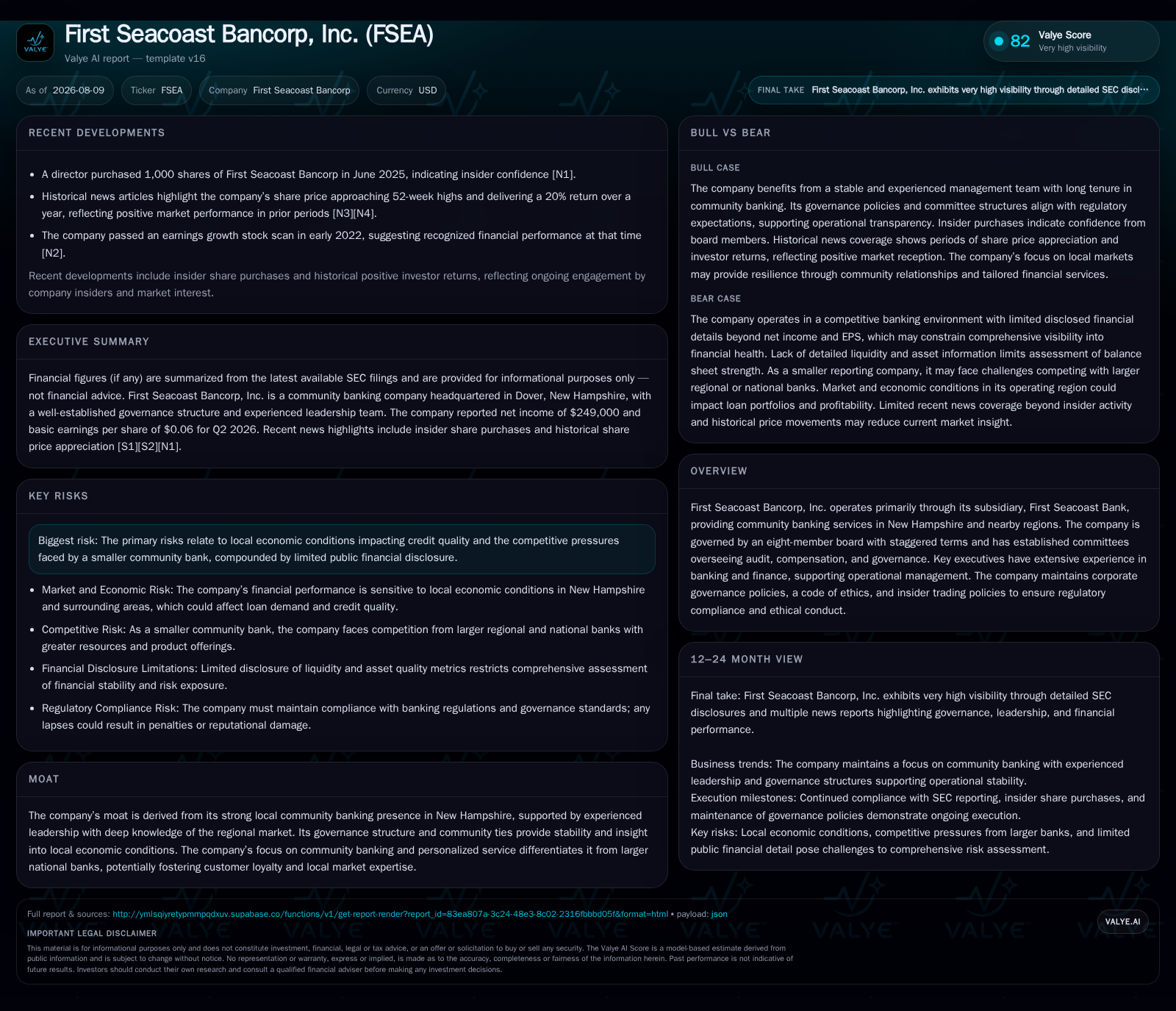
First Seacoast Bancorp's recent quarterly filing highlights solid core banking metrics amidst rising credit provisions, underpinned by its deep New Hampshire market knowledge. The May 2026 merger agreement with Cambridge Financial aims to resolve scale and competitive challenges typical for regional community banks, projecting enhanced deposit gathering and loan origination capacity. Governance maturity supports this transformative phase, while credit quality remains closely tied to local economic conditions. Key growth drivers include combined lending capabilities, fee income diversification, and digital service expansion, with risks centered on integration execution and regulatory compliance.
Merger Agreement Announcement Sets New Growth Framework for First Seacoast Bancorp
First Seacoast Bancorp’s latest quarterly filing dated August 7, 2026, coincides with the material announcement of a definitive merger agreement executed in early May 2026 with Cambridge Financial Group [S2][S13][S14]. Under the terms of the transaction, which anticipates closing in Q3 2026 subject to customary regulatory and stockholder approvals, each share of FSEA common stock will be converted to $17.25 cash per share without interest [S14]. This deal explicitly addresses the structural challenge faced by many smaller regional community banks such as First Seacoast — namely limitations imposed by scale that restrict growth potential and competitive positioning against larger regional players and non-bank lenders.
The merger amplifies First Seacoast’s New Hampshire franchise by combining it with Cambridge Savings Bank’s footprint while maintaining the entrenched community banking culture. Governance support is evidenced by voting agreements from directors and executives committed to approving the transaction at an upcoming stockholder meeting [S13]. The premium cash consideration reflects immediate value crystallization for shareholders amid a consolidating regional banking landscape where scale economies increasingly dictate access to technology investment and product breadth.
Net Interest Margin Stability Reflects Core Community Banking Strengths Amid Local Dynamics
Analyzing the most recent quarterly data reveals that First Seacoast has maintained a relatively stable net interest margin (NIM), a critical profitability driver for community banks predominantly reliant on lending income rather than non-interest sources [S2][S1]. This stability emerges despite increased loan loss provisions noted in the quarter, indicating prudent asset quality oversight in the face of cautious economic sentiment within their local markets.
This NIM resiliency aligns with industry patterns observed among comparable peers such as Eastern Bankshares and Camden National Corporation — regional banks serving New England markets with similar loan mix concentrations in residential mortgages and small business loans. The localized lending focus enables more precise risk pricing though simultaneously anchors profitability sensitivity to regional interest rate fluctuations and competitive pressures on deposit pricing.
Loan Portfolio Quality Underpins Credit Risk Management Strategy Before Consolidation
Credit quality metrics disclosed reinforce that First Seacoast manages its loan portfolio conservatively within the context of New Hampshire’s uneven local economic conditions [S1][S2][S9]. Incremental rises in non-performing loans (NPL) readings remain contained, supported by adequate loan loss provision reserves that buffer against potential stressed assets.
The company’s risk disclosures highlight concentrated exposure to sectors tied to local real estate and small-to-medium enterprises (SMEs), necessitating tight underwriting standards and vigilant monitoring pre-merger. Effective risk management not only preserves asset quality but sets foundational expectations for integrating Cambridge Financial’s loan book post-merger without unexpected credit deterioration.
Governance Depth Supports Strategic Execution in Regional Banking Merger Context
First Seacoast Bancorp operates under an eight-member board structured into three classes with staggered three-year terms, complemented by specialized committees overseeing audit, compensation, and governance functions [S1]. This governance maturity fosters stability during periods of operational change such as mergers.
Leadership includes seasoned banking executives experienced in both finance and commercial lending who oversee strategic initiatives including credit policies and compliance frameworks. Their stewardship presumably mitigates integration risks by ensuring adherence to regulatory expectations. Moreover, adopting robust insider trading policies and a clear code of ethics underscores a commitment to transparency valued by regulators overseeing bank consolidations.
Competitive Landscape and Peer Benchmarking Clarify First Seacoast’s Relative Positioning
In relation to peers like Eastern Bankshares, Camden National Corporation, and Bar Harbor Bankshares—who are illustrative examples drawn from industry research—First Seacoast shares many core attributes: strong regional ties, emphasis on personalized customer relationships, conservative balance-sheet management, and moderate branch network footprints.
Fee income diversification remains limited compared to larger regional players but is expected to materially benefit from scale gains post-merger via cross-selling opportunities in wealth management or ancillary loan servicing products.
Growth Drivers Pivot on Combination Synergies, Market Penetration, and Digital Adoption
The merger unlocks multiple growth avenues. Firstly, expanding the combined deposit base enhances liquidity flexibility enabling broader loan origination across consumer and commercial segments within New England’s concentrated geographic corridor [S13][S2][S1]
Secondly, synergistic cost reductions may be realized through branch network rationalization while sustaining customer reach vital for community trust. Thirdly, digital platform investments become feasible at greater scale aiming to attract younger customers whose banking preferences increasingly favor online channels—an important growth vector given demographic shifts in regional markets.
Moreover, internal risk management improvements gleaned from shared best practices between entities could further optimize loan loss provisioning tactics enhancing profitability durability.
Risks Center on Local Economic Sensitivity, Regulatory Compliance, and Integration Challenges
First Seacoast faces endemic risks characteristic of community banks closely tied to regional economic health: any downturns significantly affect credit quality leading to elevated NPLs or charge-offs [S9][S1][S2]. Loan concentration in New Hampshire SMEs heightens sensitivity to cyclical volatility or sector-specific disruptions.
Additional risks stem from executing an efficient merger integration amidst rigid regulatory scrutiny common in bank consolidations — encompassing capital adequacy maintenance under prescribed tier 1 standards alongside compliance with anti-money laundering (AML) laws or consumer protection statutes.
Competitive pressure from fintech innovators offering niche lending solutions also persists as a backdrop constraining rapid market share gains absent product innovation or differentiated delivery models post-merger.
"What to Watch": Milestones Defining Merger Completion and Post-Merger Operating Metrics Update
Critical near-term watchpoints include the fulfillment of customary closing conditions such as obtaining requisite approvals from regulators including the Federal Reserve as well as affirmative stockholder votes planned shortly after the public announcement [S13][S2].
Post-close integration success will depend heavily on timely consolidation of operational systems alongside alignment of credit policies ensuring no deterioration arises from legacy underwriting differences.
Subsequent quarterly reports should be scrutinized for updates on NIM trends reflecting asset-liability management efficacy post-merger expansion as well as detailed disclosure of cost synergies realized through branch consolidation or back-office centralization efforts.
Progression on digital platform rollout measured through user engagement metrics will further signal how well merged entities harness technology trends shaping modern community banking dynamics.
This analysis synthesizes public SEC filings as of August 2026 alongside industry context without providing investment advice or specific valuation judgments. It highlights how First Seacoast Bancorp is leveraging its strategic merger initiative coupled with solid operating discipline characteristic of its regional community banking niche.
Disclaimer: This is research-only, informational analysis and not investment advice. It may include AI-generated interpretation and general industry context. Always verify important details using primary sources.

Comments