
Kestrel Group’s Capital-Light Program Fuels Fee Growth Amid Run-Off Challenges
Exclusive carrier contracts underpin Kestrel’s specialty insurance platform while run-off portfolio volatility and client concentration shape near-term risks.
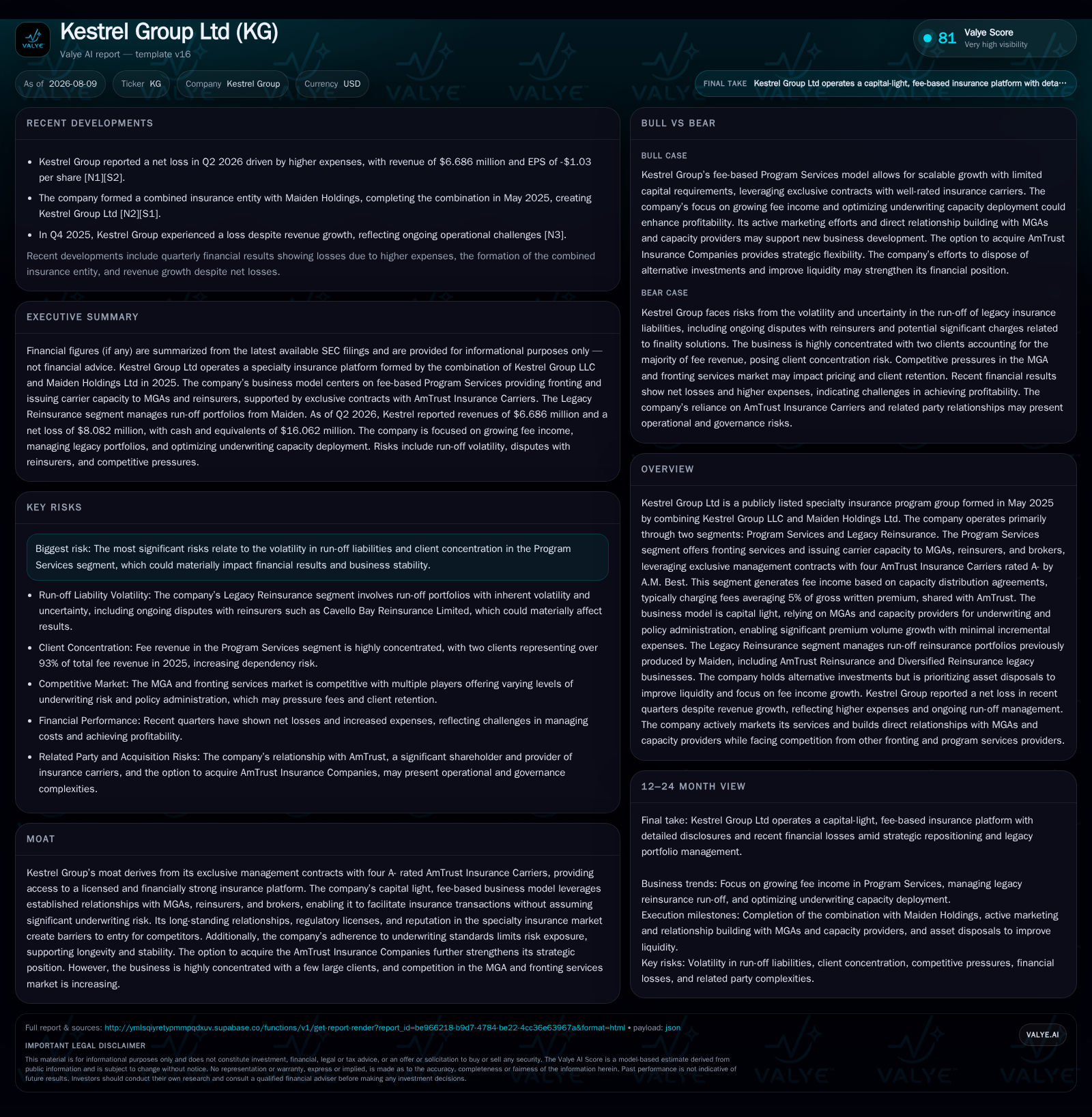
Kestrel Group Ltd operates a capital-light specialty insurance platform through exclusive management contracts with AmTrust Insurance Carriers, generating fee income by providing fronting services to MGAs, reinsurers, and brokers. The latest quarter showed fee income growth driven by $109.6 million in premium produced, but ongoing run-off liabilities and foreign currency effects weighed on underwriting results. Kestrel’s business model leverages strong regulatory licenses and a low-capital footprint to scale fee income, yet faces risks from client concentration and legacy reinsurance exposures. The company’s strategic option to acquire its capacity providers indicates potential vertical integration avenues to enhance returns.
Recent Operating Update: Q2 2026 Highlights
Kestrel Group Ltd's second quarter 2026 results reinforced its position as a specialty insurance platform leveraging exclusive management contracts with AmTrust Insurance Carriers. Program Services delivered $2.4 million in fee income on premiums produced of $109.6 million—evidence of growing MGA and broker activity leveraging Kestrel's fronting capacity arrangements [S3]. While these volumes signal healthy demand for specialized insurance programs, the company’s Legacy Reinsurance segment experienced negative underwriting developments amounting to $2.3 million in adverse prior period losses primarily due to foreign currency fluctuations on non-USD denominated reserves [S3]. This volatility illustrates the ongoing challenges managing run-off liabilities inherited from the former Maiden portfolio.
Quarterly general and administrative expenses rose to $10.5 million, including costs related to litigation and severance associated with shutting down international operations within the run-off segment, underscoring expense pressures facing Kestrel amidst its transition towards a predominantly fee-based model [S3]. Total shareholders' equity decreased modestly to $114 million at June 30, 2026, while net debt remained elevated at around $246 million reflecting senior notes funding prior acquisitions and legacy obligations [F1][S3].
Business Model Analysis: Capital Light Fronting Services With Run-off Management
Kestrel operates primarily through two segments: Program Services providing fronting arrangements and issuing carrier capacity through exclusive management contracts with four AmTrust carriers rated A- by A.M [S1][S3]. Best; and Legacy Reinsurance managing run-off insurance portfolios. This bifurcation enables Kestrel to generate fee income based on gross written premium (GWP) produced by MGAs or other intermediaries while retaining minimal underwriting risk exposure in its fee-based Program Services segment
In practice, Kestrel leverages these licensed insurance carriers as capacity providers, who underwrite policies issued by program clients (MGAs, reinsurers, brokers). The company receives contractual fees averaging about 5% of GWP under these agreements that it shares with AmTrust carriers—a monetization mechanism scaling directly with premium flows yet far less capital-intensive than traditional underwriting models [S1]. The capital-light nature means revenue growth largely depends on expanding client distribution networks rather than heavy balance sheet investment.
The Legacy Reinsurance segment covers prior periods' insurance runs-offs and alternative asset portfolios dating back before the combination with Maiden Holdings Ltd in May 2025 [S1]. These portfolios inherently carry residual underwriting risks that can produce volatile periodic results influenced by reserve adequacy assumptions and external factors such as foreign exchange rate movements evident in recent negative loss reserve developments reported [S3]. This legacy component acts as an earnings drag until fully resolved or monetized.
Industry Structure and Competitive Position
Kestrel operates within a specialized niche of the broader property and casualty insurance value chain focused on facilitating licensed insurance access through fronting arrangements—a service required by MGAs seeking capital deployment without maintaining their own licenses or capital reserves. Its competitive advantage rests crucially on the exclusivity of agreements with four A- rated AmTrust Insurance Carriers which provide both licensing authority and substantial underwriting capacity [S1]. This creates a significant moat given regulatory barriers restricting carrier licenses plus trust built over long-term contract exclusivity.
Peers in this space include entities like AmTrust Financial Services—whose historic provision of fronting services parallels aspects of Kestrel's approach—and former standalone program managers or reinsurers such as Maiden Holdings before combination. However, Kestrel differentiates itself through the combined scale from the recent merger and the option it holds for acquiring its capacity providers (AmTrust Insurance Companies), potentially consolidating underwriting control within its platform [S1]
Despite scale advantages, Kestrel faces significant client concentration risk typical among specialized program administrators relying heavily on few large MGAs or brokers for premium flow generation—a structural vulnerability that could lead to episodic commissions volatility or renegotiation risk if client relationships deteriorate [S1].
Growth Drivers
Fee revenue scalability arises principally from broadening MGA networks needing fronting capacity as specialty products continue gaining traction in U.S. property & casualty markets. Increasing regulatory complexity further incentivizes intermediaries toward outsourced fronting solutions offered by Kestrel's platform rather than holding costly licenses directly.
Selective deployment of additional underwriting capacity—whether via partnerships with existing AmTrust carriers or alternative reinsurance mechanisms—offers another lever for scaling premium production beyond organic partner growth; management is actively exploring these options aiming to optimize shareholder returns further while managing capital usage prudently [S1]
Recognition and utilization of remaining net operating loss carryforwards could improve GAAP profitability metrics over time if top-line fee income continues growing sustainably [S1], supporting reinvestment or debt reduction initiatives.
Risks and Constraints
Volatility from Legacy Reinsurance remains a key watchpoint: adverse reserve developments linked especially to loss reserve valuations affected by foreign currency moves have materially impacted recent quarters' underwriting results causing uncertainty around future cash flows from runoff assets/liabilities [S3]
High client concentration exacerbates operational risk since disruption or loss of key MGA customers could quickly reduce premium volumes flowing through Kestrel’s fronting arrangements limiting fee income expansion [S1]. Regulatory shifts impacting fronting arrangements or insurance licensing requirements may also affect operating flexibility or compliance costs.
The company carries notable leverage ($262 million total debt vs $16 million cash) inherited from historical operations posing fixed interest expense burdens that elevated spending levels exacerbate—consistent positive cash flow conversion at scale will be needed to ease this constraint and avoid rating agency pressure or refinancing risks over time [F1][S3][S11][S16]
Competitive pressures stem from other specialty program administrators offering alternative models or capital structures possibly eroding pricing power or market share in niche product segments; maintaining exclusivity with AmTrust affiliates remains critical for defensibility.
Key Indicators To Monitor Next
- Rate of premium growth produced by Program Services clients relative to prior quarters indicating success in expanding MGA/broker networks.
- Fee income margin versus gross written premium as an operating efficiency gauge.
- Development trends in reserved loss estimates within Legacy Reinsurance signaling stability or deterioration.
- Progress on expense reductions particularly legal/severance costs linked to run-off portfolio rationalization efforts.
- Timing, terms, or movement on the option exercise regarding acquisition of AmTrust Insurance Companies reflecting strategic platform integration opportunities.
- Evolution of leverage ratios as debt amortizes or refinances alongside liquidity buffer maintenance.
- Regulatory environment changes impacting fronting arrangements legality or financial strength requirements.
Financial Profile Discussion
At June 30, 2026, Kestrel’s total assets stood at approximately $920 million with shareholders’ equity at $114 million—down modestly from year-end levels—while total long-term debt was about $262 million leaving net debt close to $246 million after cash adjustments evidencing continued leverage consistent with legacy financing structures [F1][S3]. Liquidity includes cash equivalents near $16 million alongside restricted cash adding roughly another $10 million buffering operational needs.
The company recorded an overall loss influenced by adverse reserve developments offsetting gains from program fees reflecting uneven earnings visibility typical for combined new platform plus run-off entities undergoing transformation towards pure fee-based revenues [N1][S3][S2]. Ongoing investment losses totaling approximately half a million dollars during Q2 reflect market volatility influencing alternative asset values backing runoff reserves underscoring sensitivity to economic conditions impacting investment returns parallel to underwriting results [S3][F1].
Given fixed interest costs exceeding $19 million annually per earlier disclosures compounded by elevated operating expenses tied partly to legal matters—net profitability hinges critically on continued scaling of repeatable program fees alongside successful runoff portfolio resolution without unexpected adverse developments [S1][N1][F1]. Strategic focus remains firmly fixed on widening the capital-light platform revenue base improving return ratios while prudently managing legacy book erosion.
Disclaimer: This analysis is provided solely for informational purposes based on publicly filed company documents and industry knowledge frameworks without constituting investment advice or research views.
Disclaimer: This is research-only, informational analysis and not investment advice. It may include AI-generated interpretation and general industry context. Always verify important details using primary sources.

Comments