
First Citizens BancShares Scales Loan Growth with Diversified Credit Management and Deposit Funding
Operating metrics from Q2 2026 highlight First Citizens’ balance sheet expansion, credit quality controls, and funding mix optimization.
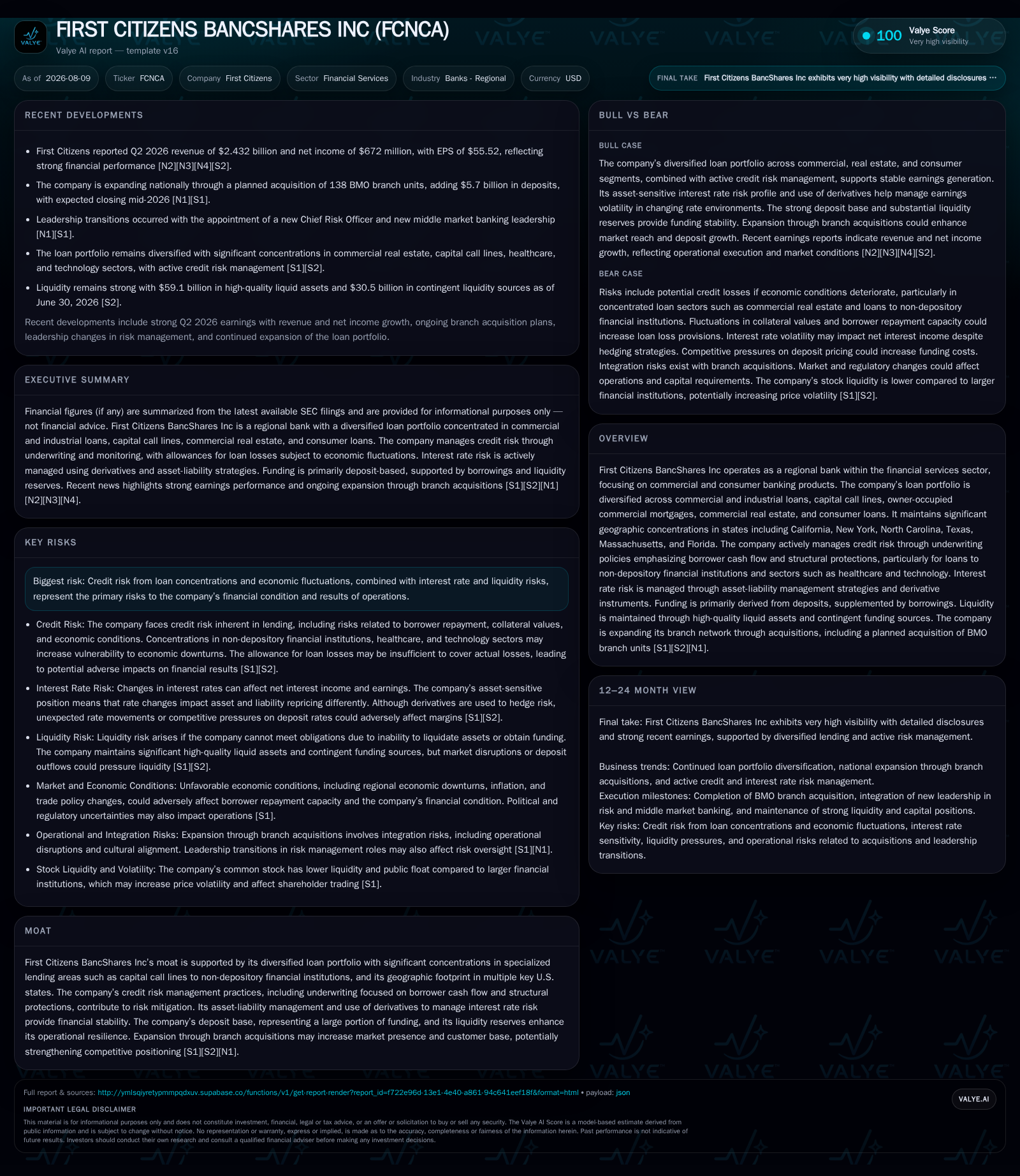
First Citizens BancShares Inc demonstrated ongoing loan portfolio growth and deposit base expansion in the second quarter of 2026, reflecting solid demand and effective asset-liability management. Concentrations remain significant in commercial real estate, capital call lines to non-depository financial institutions, and sectors like healthcare and technology, but underwriting focused on borrower cash flow and structural protections support credit quality. The bank’s funding mix has shifted favorably toward deposits, reducing reliance on borrowings and enhancing liquidity buffers. Regulatory compliance costs and interest rate environment remain watchpoints for sustaining margins and capital adequacy.
Recent Operating Update: Q2 2026 Highlights
First Citizens BancShares reported in its Q2 2026 filing that its commercial loan portfolio reached $124.5 billion as of June 30, marking continued growth supported by a diversified mix [S2]. Notably, the combined commercial real estate and owner-occupied commercial mortgage loans maintained a large share at $41.14 billion (33% of commercial loans), only slightly down from $41.44 billion at year-end 2025 [S2]. This stability indicates disciplined management around real estate concentrations amid sector sensitivities.
A major feature is the sustained exposure to capital call lines extended to non-depository financial institutions (NDFIs), representing roughly $34.2 billion or about 27% of total commercial loans [S2]. These loans benefit from rigorous underwriting that emphasizes borrower cash flow resilience and collateral structural protections—especially given their investor-backed nature—which mitigates direct credit risk despite concentrated exposure [S2].
Further reinforcing diversification, loans to clients in healthcare (including life sciences) and information technology sectors together comprise around 17% of the commercial loan book ($11.14 billion for healthcare; $10.39 billion for information industries) [S2]. The company’s credit strategy focuses on adequate repayment sources rather than collateral alone to manage risk in these dynamic sectors.
Meanwhile, deposits have expanded meaningfully to $173.43 billion at June 30, up approximately 7% since year-end 2025 [S14]. Importantly, deposits now constitute over 84% of the company’s funding base versus roughly 82% six months prior [S14]. This trend lessens reliance on borrowings—a critical move given ongoing interest rate volatility—and supports more stable net interest margins.
Indeed, total borrowings fell by about 11% to $32.19 billion at mid-year from $36.01 billion at December-end [S14]. This reduction primarily results from prepayments on sizable long-term fixed-rate debt instruments related to previous acquisition financing commitments [S21][S22]. Active liability management thus helps contain interest expense despite potential refinancing cost pressures.
Business Model Specifics: Diverse Commercial Lending Coupled with Strong Funding Mix
First Citizens operates principally as a regional bank specializing in multi-segment commercial lending complemented by consumer banking products [S23]. The bank’s revenue predominantly derives from net interest income generated through lending activities funded chiefly by customer deposits from retail and institutional clients [S23].
Within commercial lending, segments include traditional commercial & industrial loans backed by receivables or equipment as well as specialized products offered through its Global Fund Banking division such as capital call lines for private equity funds and venture capital investors—areas where First Citizens maintains a competitive niche thanks to its relationship-driven approach targeting non-depository financial institutions (NDFIs) [S23][S2].
The firm also serves sectors like healthcare, technology media & telecom (TMT), maritime financing, aerospace & defense leasing alongside offering factoring and supply chain finance solutions in select industries [S23]. By focusing underwriting rigorously on cash flow sustainability over collateral valuations—especially for CRE loans—the bank manages key credit risks inherent in these portfolios while maintaining conservative exposure preferences such as favoring owner-occupied properties when collateral reliance is necessary [S2].
Funding is largely deposit-dependent with incremental coverage by senior unsecured debt alongside secured advances against pledged collateral such as loans or securities [S24][S25]. The recent decline in borrowings demonstrates an intentional strategy to optimize the liability structure toward lower-cost deposits while preserving ample contingency borrowing capacity from federal facilities when needed [S14][S22].
Non-interest income streams—from fees related to loan servicing, leasing operations, derivative contracts used for asset-liability hedging as well as other advisory services—complement interest income but contribute moderately relative to net interest margins typical of regional banks broadly [S1][N1]. Operational efficiency gains continue through technology investments aimed at automating credit approvals and streamlining documentation processes[s.S1,S23].
Competitive Positioning within Regional Banking Context
In the regional banking landscape dominated by institutions like Regions Financial Corporation, Fifth Third Bancorp, and KeyCorp, First Citizens distinguishes itself through its focused loan portfolio niches—particularly capital call lines to NDFIs—which yield structurally protected credit profiles uncommon among peers. This specialization provides partial moat characteristics given these clientele require tailored lending solutions combined with asset-liability management expertise.
Moreover, its diversified geographic footprint across key U.S. states such as California, New York, North Carolina, Texas, Massachusetts, and Florida enhances franchise reach while avoiding overdependence on any single regional economy [S29]. Peer banks often face greater concentration risks tied more heavily to localized markets or narrower industry segments.
While peer regional banks also grapple with interest rate fluctuations affecting net interest margins (NIM), First Citizens’ strategy of shifting toward greater deposits reduces cost-of-funds pressure relative to institutions relying more heavily on wholesale funding alternatives [S14]. Its active liquidity measurement tools including stress testing frameworks ensure readiness against episodic funding shocks prevalent across the sector post recent economic turbulence.
Growth Drivers
Primary growth drivers identified include:
- Loan book expansion particularly within commercial finance niches levered by sophisticated underwriting frameworks emphasizing cash flow stability.
- Continued deposit base growth supported both organically via branch networkes and digital client onboarding strategies.
- Strategic share repurchases reflecting excess capital generation alongside measured dividend distributions aid long-term shareholder value creation [S12][N1].
- Incremental acquisitions such as branch expansion opportunities help broaden market penetration though are balanced against integration costs.
- Technology adoption fueling operational efficiency gains through better data infrastructure and automated workflows enhances scalability without commensurate cost increase risks.
- Interest rate environment which supports potential net interest margin improvement if deposit costs stabilize after recent hikes while loan yields remain resilient.
Risks / Watchpoints / Constraints
Risk factors with material potential impact include:
- Credit risk concentrations remain elevated notably in CRE portfolios which represent approximately one-third of commercial loans; adverse sector-specific economic cycles could prompt higher delinquency or loss severity even under current underwriting controls [S9,S20,S23].
- Dependence on funding from large uninsured deposits (~38%) presents liquidity risk especially if market confidence diminishes or during systemic stress episodes requiring rapid runoff mitigation plans [S14,S16,S24].
- Interest rate risk continues amid volatile macroeconomic policy landscapes; asset-liability mismatch could pressure net interest margins if deposit repricing lags or loan resets accelerate beyond expectations.[S21]
- Regulatory compliance costs continue rising due to enhanced prudential standards applicable for banks exceeding $100 billion assets threshold including stress testing/reporting demands that may constrain flexible capital deployment initiatives.[S6,S25]
- Operational risks such as cybersecurity threats require continual investment; despite no material incidents reported historically it remains an evolving threat vector warranting sustained vigilance.[S1]
- Increased competition from fintech lenders offering alternative credit solutions may pressure traditional relationship banking profit pools particularly among smaller business segments.
What to Watch Next
Key indicators to monitor going forward include:
- Quarterly updates on loan growth composition shifts especially within high concentration sectors like CRE and NDFI capital call lines.
- Changes in allowance for loan losses provisions signaling anticipated credit quality trends under evolving economic scenarios.[S2]
- Deposit inflows trajectory versus cost dynamics impacting net interest margin sustainability.
- Borrowing levels adjustments reflecting further prepayments or refinancing activities contributing to liability optimization.[S21,S22]
- Regulatory developments including Basel III Endgame implementation timeline which may affect capital buffer computations.[S25]
- Execution progress on share repurchase plans evidencing confident capital positioning without compromising liquidity resilience.[N1]
- Technological integration outcomes improving customer experience while controlling expenses provide longer-term operational leverage.
Financial Profile Discussion
The enterprise continues balancing return enhancement via significant share repurchase programs authorized through late 2026 while preserving regulatory capital buffers essential for sustaining growth flexibility within evolving prudential standards [S12][N1,N7]. Overall financial stewardship appears calibrated toward durable risk-adjusted profitability characteristic of solid regional bank franchises anchored by diverse customer relationships and multi-product offerings.
This analysis synthesizes publicly available regulatory filings dated up to August 7th, 2026 alongside complementary market disclosures without projecting forward-looking opinions or investment guidance. All numeric facts are cited directly from SEC documents or verified financial summaries per best available data points.
Disclaimer: This is research-only, informational analysis and not investment advice. It may include AI-generated interpretation and general industry context. Always verify important details using primary sources.

Comments