
Assured Guaranty Ltd Confronts Regulatory Capital Constraints Amid Earnings Volatility
Regulatory capital and dividend restrictions continue to shape Assured Guaranty’s operational flexibility and earnings profile as the company navigates complex insurance and investment dynamics.
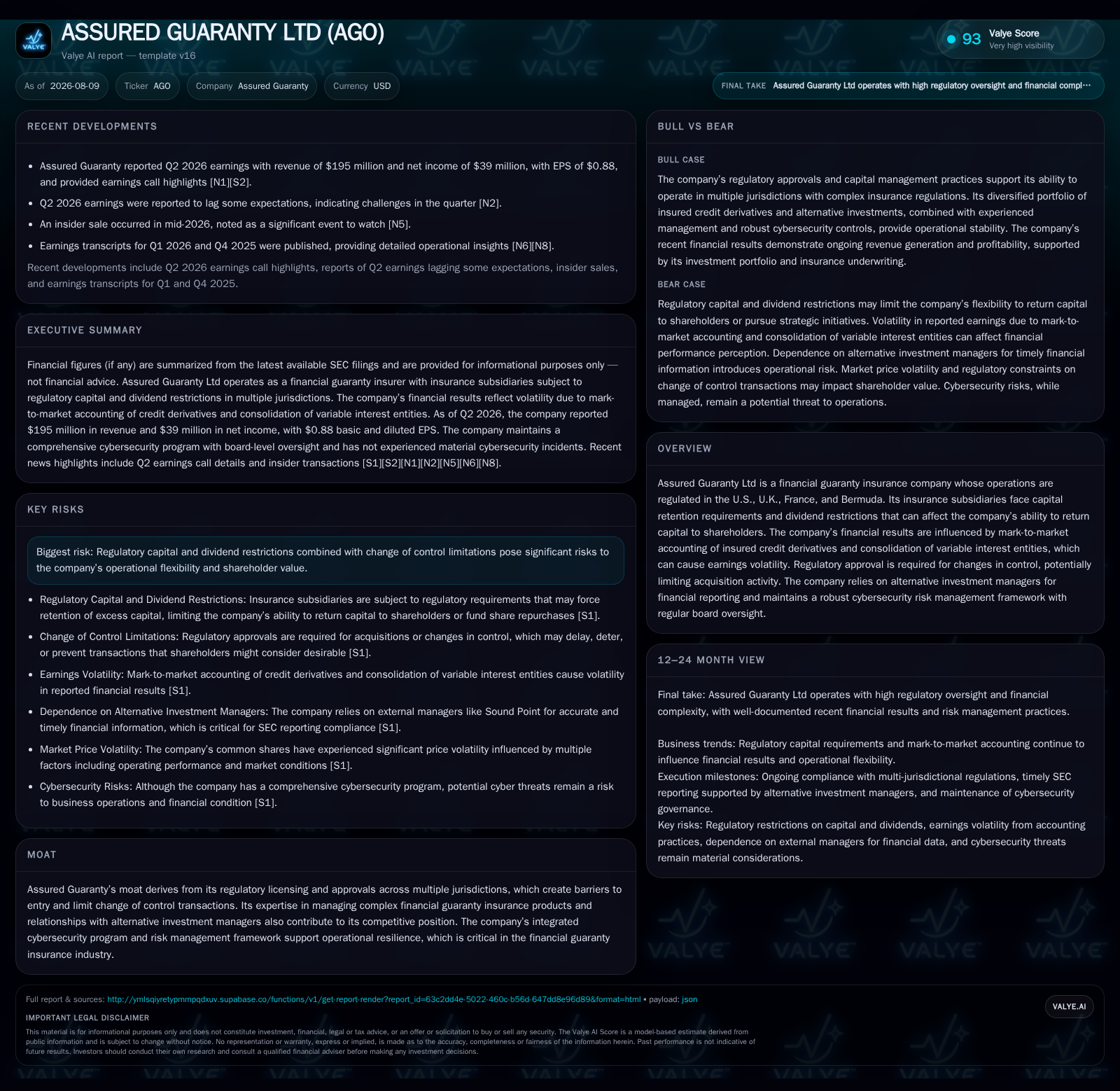
Assured Guaranty Ltd’s latest quarterly filing confirms persistent regulatory capital retention mandates across its U.S., U.K., France, and Bermuda insurance subsidiaries constrain the company’s ability to return excess capital to shareholders. This state of affairs, coupled with earnings volatility driven by mark-to-market accounting on insured credit derivatives and reliance on alternative investment managers, underscores inherent operational challenges. Change of control regulations further limit strategic acquisition activities. The firm’s broad regulatory licensing offers barriers to entry but also imposes significant operating complexities that demand vigilant asset-liability management and robust liquidity strategies.
Recent Operating Update
Assured Guaranty Ltd’s second quarter 2026 results reaffirm the continuing impact of stringent regulatory capital requirements across its insurance subsidiaries domiciled in key jurisdictions including the U.S., U.K., France, and Bermuda. These mandates require insurers under its ambit to hold substantial capital buffers beyond what the company internally deems necessary for supporting insured risks, constraining dividend flows to the holding entity and in turn curtailing capital returns to shareholders [S2],[S16]. No material changes were reported in the risk factor disclosures compared with the prior year-end filing, reinforcing a steady-state environment for these structural limitations [S23].
Earnings volatility persisted due to mark-to-market accounting impacts on its insured credit derivatives portfolio as well as adjustments from consolidating variable interest entities (VIEs), a feature typical for firms operating in financial guaranty insurance that complicates earnings predictability [S17]. The reliance on alternative investment managers such as Sound Point is notable; these external managers handle sizeable portions of Assured Guaranty’s invested capital but introduce operational dependencies regarding timely and accurate portfolio valuations which directly affect financial reporting cycles [S5],[S17].
In August 2026 investor communications, Assured Guaranty reiterated that change of control regulations applicable under insurance laws across multiple domiciles impose onerous pre-approval requirements for acquiring interests above 10%, thereby scaffolding shareholder voting limitations and creating potential barriers against unsolicited acquisitions or transactions that might otherwise be executed more freely in less regulated environments [S16]
Business Model
Assured Guaranty operates primarily as a financial guaranty insurer providing credit enhancement by guaranteeing the timely payment of principal and interest on various debt instruments issued by public finance entities and structured finance obligations. Revenue streams comprise gross written premiums from policies underwritten plus net earned premiums after reinsurance ceded. Investment income generated on statutory reserves and invested capital represents an important complementary revenue pillar.
The company’s underwriting philosophy hinges upon rigorous assessment of insured portfolio credit quality and careful exposure management relative to credit risk concentration limits mandated by regulators. Gross written premiums increase when new policies are issued or existing ones renewed; however, premium recognition follows timing standards tied to policy terms rather than instant cash receipt. Loss ratios measuring claims paid versus earned premiums, combined ratio incorporating expense trends, as well as claims reserves adequacy represent critical KPIs impacting profitability.
U.S., U.K., French, and Bermudian insurance subsidiary regulation heavily influences how much underwriting capacity can be deployed given capital adequacy rules. Capital surplus must be maintained above prescribed levels—any deficiency could restrict new business writes or trigger demands for additional reinsurance coverage or capital injections. Dividend restrictions curtail upstream cash flows impairing parent entity's flexibility to return value or invest elsewhere within the group [S1],[S16].
Investment activities are partly outsourced to selected alternative investment managers with specialized capabilities managing diverse asset classes including credit funds. This relationship allows Assured Guaranty to expand alternative investments but introduces reliance risks concerning fund transparency, valuation timeliness, and adherence to GAAP reporting standards required for consolidated financial statements filed with the SEC [S5].
Industry Structure & Competitive Position
The financial guaranty insurance industry operates within a highly regulated niche characterized by specialized licensing regimes enforcing prudential standards across jurisdictions where insurers operate. Assured Guaranty’s broad multinational presence creates a competency moat due to regulatory barriers that raise hurdles for new entrants or challengers without similar authorization.
Peers such as MBIA Inc. or Ambac Financial Group operate similarly as monoline financial guarantors focused on enhancing creditworthiness for municipal and structured finance debt issuers. However, differences arise based on geographic footprint breadth, product mix breadth (e.g., Assured’s annuity reinsurance platform), risk appetite measured by single risk limits versus aggregate exposures, and regulatory capital models used.
The regulatory environment also constrains market dynamics; for instance, change of control approvals can deter activist investors or hostile takeovers that might otherwise pressure incumbents’ strategy execution. Moreover, rating agency demands amplify pressure to maintain surplus levels well beyond statutory minimums impacting pricing power in underwriting new business due to cost-of-capital considerations.
Growth Drivers
Growth prospects revolve largely around expanding issuance volumes in public finance markets requiring credit enhancement amid volatile economic climates that elevate investor demand for insured products enhancing bond ratings. Regulatory reforms increasing transparency or imposing higher collateralization thresholds provide ancillary tailwinds incentivizing obligors toward insured solutions.
Further growth avenues include continuing roll-out of innovative credit derivative structures complemented by strategic alliances with alternative investment managers enabling diversification of invested asset types yielding higher returns relative to traditional fixed-income allocations.
International expansion remains a medium-term vector given Assured Guaranty's established licenses across various jurisdictions—selective market entry coupled with calibrated underwriting standards may unlock incremental premium inflows contingent upon local economic conditions.
Risks & Watchpoints
Assured Guaranty's core risks emanate from strict regulatory capital retention leading to sub-optimal capital deployment impacting shareholder returns. Earnings remain vulnerable to marked fluctuations driven by mark-to-market accounting affecting insured credit derivative valuations—a sensitivity heightened during periods of market dislocations.
Dependence on external alternative investment managers like Sound Point poses potential disruption risks should reporting delays or inaccuracies occur; such events could delay SEC filings or raise questions about asset valuations.
Change of control restrictions complicate potential M&A maneuvers limiting management's flexibility alongside deterring interested parties aiming for rapid ownership changes.
Operationally, asset-liability mismatches inherent in reinsurance contracts (for example, longevity risk in annuity reinsurance) require sophisticated hedging programs; failures here can depress earnings unexpectedly.
Legal exposures arising from litigation relating to insured obligations remain latent but material depending on outcomes affecting expected loss reserves.
Cybersecurity protocols are robust but must be continuously updated given potential exposure through third-party vendors accessing sensitive information—a recognized focus area overseen at board level [S1],.
What To Watch Next
Key milestones include monitoring quarterly earnings releases for volatility trends triggered by market moves impacting insured derivative valuations and investment portfolios. Updates regarding any shift in regulatory stances toward dividend distributions would materially affect cash flow profiles.
Tracking the performance data disclosure cadence from alternative investment managers remains critical given dependency for valuation inputs driving consolidated statements.
Potential announcements around strategic transactions navigating change of control approvals will bear scrutiny as they indicate management’s ability or intent toward inorganic growth paths under prevailing constraints.
Capital adequacy ratios published periodically provide insights into buffer sufficiency against underwriting expansion plans; rating agency commentary often correlates with such figures influencing cost of debt financing conditions.
This analysis is based solely on publicly available information including recent SEC filings up to August 7th, 2026, company disclosures, and relevant industry context without any forward-looking investment opinions or research views.
Disclaimer: This is research-only, informational analysis and not investment advice. It may include AI-generated interpretation and general industry context. Always verify important details using primary sources.

Comments