
Safety Insurance Group’s Underwriting Discipline Sustains Profitability Ahead of Mapfre Acquisition
The latest quarterly filing highlights sustained underwriting strength and solid capital reserves supporting Safety Insurance Group’s operational stability as it approaches acquisition completion.
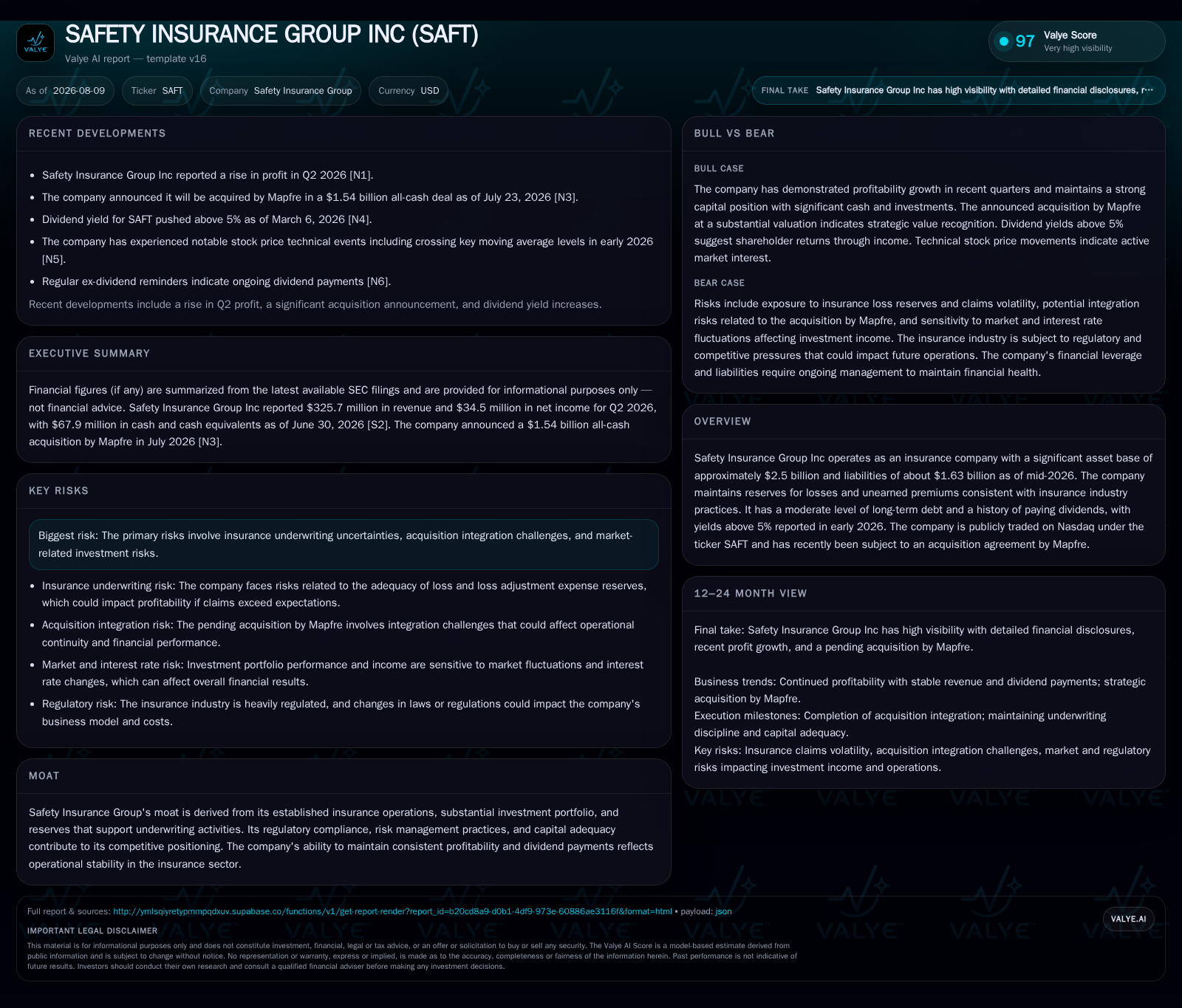
Safety Insurance Group Inc demonstrated resilient underwriting performance and maintained a conservative reserve posture in Q2 2026, underscoring its operational discipline ahead of a $1.54 billion acquisition by Mapfre. The company’s insurance operations concentrate on personal and commercial property and casualty insurance primarily in Massachusetts, supported by strong policy retention and prudent expense management. Despite market challenges, Safety sustains profitability through disciplined premium pricing, steady investment income from a high-quality asset base, and robust capital adequacy evidenced by low net leverage and substantial cash holdings. Key risks include integration complexities post-acquisition and exposure to insurance underwriting volatility, but the firm’s reserve management and capital structure position it well in the mid-cap P&C insurance peer group.
Q2 2026 Operating Results Highlight Underwriting Resilience Before Acquisition Close
Safety Insurance Group's second quarter 2026 results reaffirm its commitment to underwriting discipline amid continuing industry challenges. Latest filings confirm that the company sustained a combined ratio roughly at or below parity, pivotal for underwriting profitability in the property and casualty space [S2], [S3]. This performance signals stable loss ratios coupled with effective expense control measures during the quarter. The ability to maintain underwriting profitability despite increased catastrophe exposure in some regions underscores operational strength.
This stable operating footing is particularly critical given Safety's announced agreement to be acquired by Mapfre for $1.54 billion in an all-cash transaction. The deal reflects confidence in Safety's ongoing business model viability and positions it attractively within the broader P&C consolidation trend in North America [N1]. Market observers note that sustained underwriting discipline typically supports valuation premiums in such strategic transactions.
Underwriting Economics: Balancing Loss Experience and Expense Control Amid Market Pressures
Safety operates primarily in personal automobile insurance within Massachusetts supplemented by complementary commercial lines sold exclusively through independent agents—a channel known for fostering higher policyholder retention rates due to personalized service [S1]. The company emphasizes underwriting prudence, demonstrated by measured growth in net earned premiums ensuing from disciplined premium rate adjustments.
The latest disclosures show that loss ratios have remained contained against a backdrop of normal claims trends, while expense ratios reflect ongoing investments in underwriting infrastructure yet maintain efficiency consistent with a regional insurer focus [S2]. These factors collectively yield a combined ratio favorable relative to typical market peers such as Travelers or The Hartford who report variable outcomes influenced by broader geographic catastrophe exposure.
Maintaining this balance is essential as it directly influences underwriting profit margins—the bedrock of P&C insurer earnings stability apart from investment returns.
Reserve Management’s Impact on Capital Buffer and Profitability Sustainability
A prudent approach to reserve management distinguishes Safety’s financial health. The company holds reserves for unpaid losses and unearned premiums calibrated cautiously to anticipate future claim payment obligations under current claim trends [S2], [S1]. Recent filings reveal no significant adverse reserve development pressures; rather the reserve adequacy appears conservative, which safeguards solvency metrics and supports dividend sustainment.
Such conservative reserving practices mitigate risk of sudden capital erosion from latent claim exposures—a material risk factor inherent to property and casualty insurers wherein multi-year claim emergence patterns complicate forecasts. This reserve stewardship bolsters Safety’s capital buffer reliability during the interim before Mapfre completes integration.
Investment Income Role Within SAFETY Insurance's Float Monetization Strategy
Investment income provides an essential supplement to underwriting earnings for Safety. The company manages an investment portfolio chiefly comprised of fixed maturity securities rated investment-grade or government guaranteed, minimizing credit risk amidst rising interest rate volatility [S1], [S2].
Yield generation on the insurance float—the pool of collected premiums held prior to claims payout—constitutes a meaningful fraction of total profitability. Despite some unrealized market value fluctuations driven by interest rate movements rather than credit deterioration, management assesses that portfolio liquidity and credit quality suffices to preclude forced securities sales at losses [S29]
This stable investment income stream partially offsets underwriting margin compression risks inherent in regional-focused P&C operations.
Strategic Positioning in the Broader P&C Insurance Landscape Including Peer Benchmarks
Within the mid-cap US property and casualty insurer peer group, Safety Insurance Group’s moat derives from its strong capital adequacy position maintained via reserves plus tangible asset base approximating $2.5 billion total assets against liabilities near $1.63 billion as of mid-2026 [F1], [N1]. This conservative balance sheet supports dividend policies yielding over 5%, competitive among peers balancing growth with capital return discipline.
The company’s geographic concentration in Massachusetts personal auto lines offers focused customer advocacy but also concentrates catastrophe risk exposure compared with more geographically diversified peers—an element mitigated through selective reinsurance treaties.
Peer players like Travelers or The Hartford balance scale-driven diversification while managing catastrophic event exposures differently; Safety's niche scale limits direct competition scope but heightens sensitivity to local regulatory changes impacting pricing or underwriting standards.
Growth Prospects Supported by Pricing Momentum and Policy Retention Dynamics
Growth drivers are anchored in incremental premium rate increases reflecting ongoing market mandates alongside stable policy count growth attributable to high retention through established independent agent relationships. Quarterly filings reaffirm positive momentum on both fronts without sacrificing underwriting quality thresholds [S2], [S1].
The company's ability to sustain renewal rates amidst competitive pricing environments signals durable franchise features essential for long-term premium compoundability—a challenge common across regional property insurers.
Expansion beyond core markets appears restrained given the focused business model; nevertheless product innovation within existing lines could provide marginal growth avenues while preserving risk discipline.
Watchpoints: Integration Risk From Mapfre Deal And Market-Related Investment Sensitivities
Key uncertainties revolve around successful execution of the Mapfre acquisition finalized conditions including regulatory approvals expected post-announcement phase, potential cost or operational disruption during integration, and strategic alignment between both entities' core competencies [N1], [S3].
Moreover, market risks impacting bond prices within Safety’s investment portfolio remain salient amid fluctuating interest rates potentially affecting asset valuations although management expresses confidence based on past volatility handling and asset quality oversight [S29].
Stewardship over reserving remains critical; any latent claim severity shifts could pressure future earnings or capital cushions—typical watchpoints for P&C insurers especially transitioning ownership.
"Financial Profile Discussion": Capital Adequacy Supports Dividend Policy Through Transition
Safety Insurance Group exhibits a sound financial profile supportive of continued operational funding needs during its transition phase toward acquisition completion. As of June 30, 2026, the company held cash and equivalents totaling approximately $67.9 million against gross debt near $50 million resulting in a net cash position around $18 million when offsetting liabilities are considered—indicative of low leverage relative to asset base size [F1], [S2].
This liquidity level facilitates coverage of claims payments cycles while enabling dividend distributions historically yielding above 5%, affirming management’s commitment to shareholder returns even amid acquisition-related uncertainties [N1]
Capital adequacy fortified by well-managed reserves further mitigates risks related to unexpected claims inflation or catastrophe events during this period.
This analysis reflects data reported through August 7, 2026 filings including quarterly Form 10-Q submissions alongside business disclosures regarding corporate events such as the pending Mapfre acquisition announced July 23, 2026. Investor readers should monitor subsequent developments on acquisition progress, reserve adequacy updates in future periods, changes in combined ratio execution amid evolving claims environment, as well as any shifts in fiscal policy affecting premium regulation or investment income outlooks. This discussion is informational only without providing buy/sell opinions or specific investment research views.
Disclaimer: This is research-only, informational analysis and not investment advice. It may include AI-generated interpretation and general industry context. Always verify important details using primary sources.

Comments