
Packaging Corp of America Expands Scale with Greif Acquisition Amid Industry Volume Decline
PKG reports higher prices and volumes supported by Greif acquisition, offsetting industry shipment contraction and cost pressures.
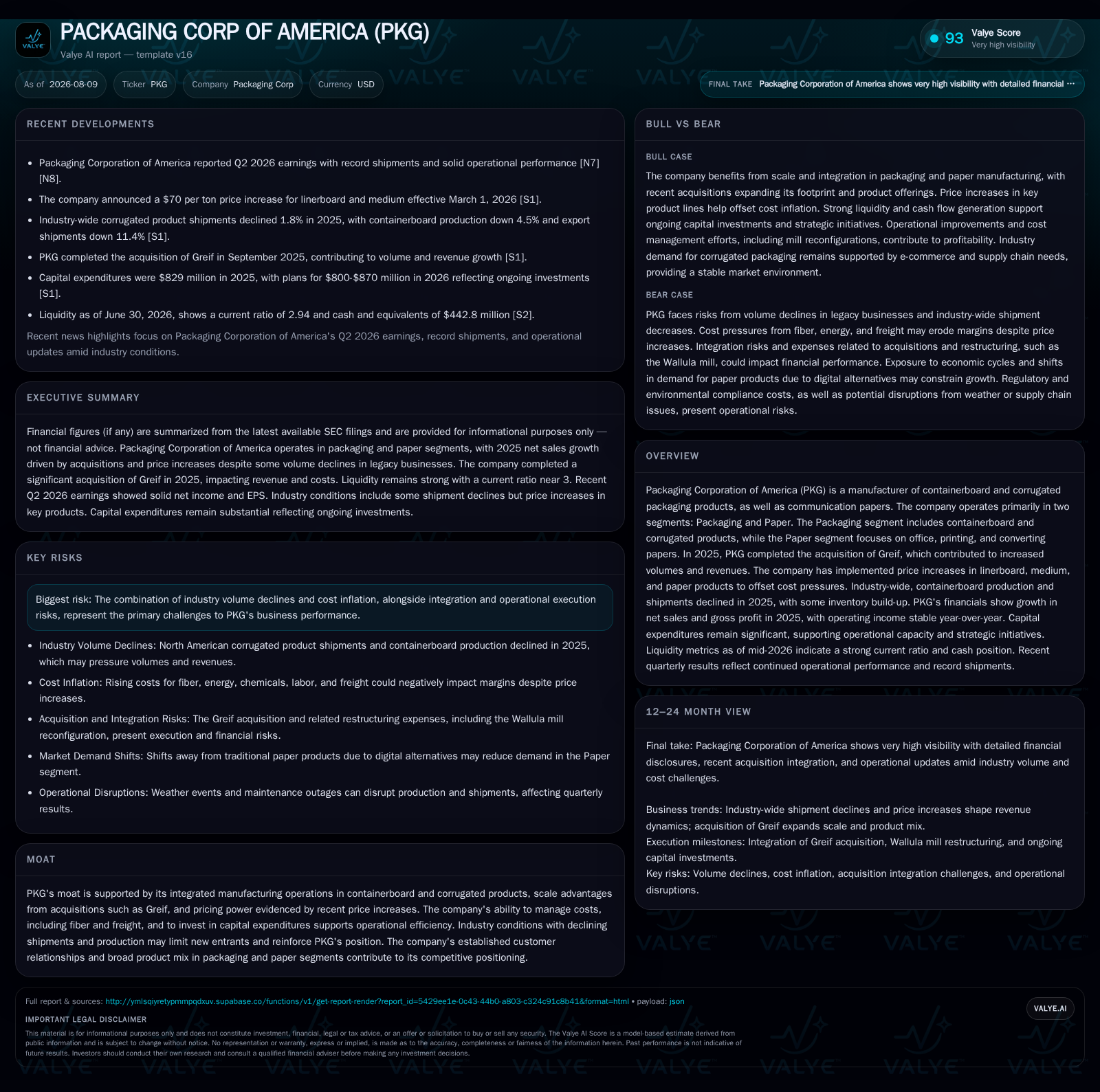
Packaging Corporation of America (PKG), a major North American containerboard and corrugated packaging manufacturer, demonstrated resilient revenue growth in 2025 driven by the $1.8 billion acquisition of Greif’s containerboard business. Despite industry-wide declines in containerboard production and corrugated shipments, PKG effectively executed price increases and expanded operating volumes through integration synergies. The company manages rising fiber, freight, and operating expenses while restructuring lower-margin assets like the Wallula mill. Going forward, pricing power amid cyclical volume headwinds and successful integration execution will be critical for sustained margin expansion.
Recent Operating Update
Packaging Corporation of America (PKG) disclosed results for the second quarter ended June 30, 2026 [S2]. The quarter benefited from incremental volume contributions from its recently acquired Greif containerboard business, alongside continuing implementation of prior price increases including a $70 per ton hike on linerboard and medium effective March 1, 2026 [S1]. Recorded shipment volumes in legacy corrugated products were flat year-over-year on a per-day basis, while total industry containerboard production remained weak with a reported decline of approximately 4.5% for full year 2025 [S1]. The company also completed the permanent shutdown of certain less efficient paper machine and pulping facilities at its Wallula mill during early 2026 [S1], restructuring that resulted in significant pre-tax charges but aims to streamline operations.
PKG's operating environment continues to be challenged by elevated fiber raw material costs, freight inflation, and increased maintenance outage days due to scheduled mill upgrades both for legacy operations and the integration of Greif assets [S1][S2]. Management highlighted expectations of ongoing inflationary pressures across labor, energy inputs including chemicals and wood pulp, as well as freight costs which collectively weigh on margins if not fully offset by pricing actions [S1]. Despite these headwinds, PKG reported an increase in packaging segment EBITDA excluding special items from $1.60 billion to $1.83 billion in 2025 primarily driven by pricing gains and acquired volume contributions [S12].
Business Model
PKG operates an integrated manufacturing platform spanning containerboard raw materials (linerboard and corrugating medium) production coupled with conversion into finished corrugated packaging products through a network of sheet feeder and corrugated plants. The company supplies packaging used broadly across food, beverage, industrial goods, fresh produce, meat packaging, plus retail-ready multi-color boxes designed for merchandising appeal [S1]. This vertical integration affords cost control over key inputs such as fiber utilization efficiency and logistical coordination from mills to converters.
Revenue is primarily generated through sales contracts with industrial customers including consumer packaged goods manufacturers and distributors who demand consistent quality and reliable supply chains amid expanding e-commerce fulfillment requirements. Pricing contracts often include index-linked provisions referencing publicly surveyed containerboard prices that adjust semi-annually or quarterly [S1], giving PKG flexibility to respond to cost inflation trends.
The Paper segment manufactures uncoated freesheet papers primarily sold into office printing and converting end markets but faces secular decline due to digital substitution [S1]. This segment is smaller relative to Packaging but offers specialty paper products with coatings or recycled content that command premium pricing.
Industry Structure and Competitive Position
PKG ranks as the third largest North American producer of containerboard products following peers such as International Paper and WestRock. The containerboard industry is characterized by significant capital intensity with barriers to entry arising from large scale mills required for competitive cost structures. The industry dynamics are highly sensitive to input cost volatility (particularly fiber), capacity utilization rates at mills which influence unit costs, as well as cyclical demand fluctuations tied closely to general economic activity affecting consumer goods shipments.
Market pricing is influenced heavily by interactions of supply-demand balances with producers coordinating capacity usage through planned outages or expansions alongside price signaling via trade publication index adjustments which contractually affect selling prices [S1]. Competitiveness also depends on quality differentiation in corrugated packaging design innovation—especially for retail visible display solutions—and logistics efficiency given freight represents a significant share of total delivered cost.
PKG's recent acquisition of Greif's containerboard assets expands its scale by approximately 800,000 tons annually with additional sheet feeder plants enhancing geographic reach across the U.S., strengthening its footprint against peers such as WestRock or Smurfit Kappa who compete globally but with meaningful North American exposure [S1]. The acquisition synergy realization hinges on integrating mill operations while maintaining product quality standards.
Growth Drivers
Primary growth vectors for PKG stem from:
- Expanding e-commerce penetration driving higher demand for corrugated shipping containers,
- Price increases implemented successfully to counterbalance cost inflation across fiber, energy inputs, labor, and freight,
- Scale benefits from strategic acquisitions exemplified by Greif transaction providing incremental volume without proportional fixed cost increase,
- Product mix enhancement towards higher-value added multi-color retail packaging formats,
- Operational improvements including capital expenditures aimed at improving mill efficiency reducing fiber consumption per ton output,
- Environmental sustainability initiatives catalyzing demand for recyclable packaging replacing plastic alternatives.
The company's announced capital investments exceeding $800 million in property plant & equipment during 2025 demonstrate commitment towards upgrading manufacturing capabilities facilitating future productivity gains amidst evolving market needs [S12]
Risks and Watchpoints
Key risks confronting PKG include:
- Raw material input cost volatility notably from fiber recovered content prices causing margin pressure if price recovery lags;
- Cyclicality in demand linked to macroeconomic softness resulting in volume softness especially visible in declining export shipments (-11.4% reported in 2025) [S1];
- Execution risk associated with integrating newly acquired Greif assets including absorption of initial downtime/outages required for operational alignment;
- Potential overcapacity scenarios within the North American containerboard industry could pressure pricing power;
- Environmental regulation compliance costs accelerating capital expense needs;
- Freight cost inflation exacerbating delivered costs given geographic dispersion;
- Long-term secular decline in paper segment driven by digital document storage reducing communication paper volumes.
Further price increase success will be critical alongside volume recovery signals such as improvement in legacy plant utilization rates beyond stable shipment levels reported so far [S2]. Monitoring maintenance outage schedules will also offer leading visibility into future capacity constraints impacting throughput.
What to Watch Next
Upcoming quarterly earnings disclosures should be scrutinized for:
- Volume trends distinguishing legacy vs acquired business units specifically looking for growth underpinned by improved market demand or pipeline wins;
- Realized average selling prices per ton across linerboard and corrugating medium segments before/after March 2026 price hike implementation;
- Cost trajectory patterns focusing on fiber raw material input per ton metrics and freight/logistics expense behaviors amidst broader inflation concerns;
- Capital expenditure outlays on reconfiguration projects such as Wallula impacting fixed overhead absorption rates;
- Integration progress updates highlighting system implementation success or transition service agreements exiting timelines related to Greif acquisition.
Overall margin development relative to prior quarters will signal whether pricing power continues counterbalancing inflationary pressures sustainably.
Financial Profile Discussion
PKG ended Q2 2026 with cash plus equivalents totaling approximately $443 million against total debt near $2.7 billion yielding a net debt position around $2.22 billion [F1]. The company holds strong liquidity reflected in a current ratio close to 2.94x which provides operational flexibility amid capital spending programs for mill modernization plus integration fees connected with the Greif deal [F1][S2].
Financing arrangements secured prior to closing include multiple term loans totaling over $1 billion alongside revolving credit facilities providing working capital access [S4][S5]. It does not constitute investment advice but offers an informed viewpoint grounded strictly in verified public disclosures.
Disclaimer: This is research-only, informational analysis and not investment advice. It may include AI-generated interpretation and general industry context. Always verify important details using primary sources.

Comments