
Savers Value Village Strengthens Local Sourcing and Operational Integration in Q2 2026
The largest for-profit thrift retailer boosts U.S. comparable sales and leverages proprietary technology to refine its integrated thrift model amidst modest Canadian growth.
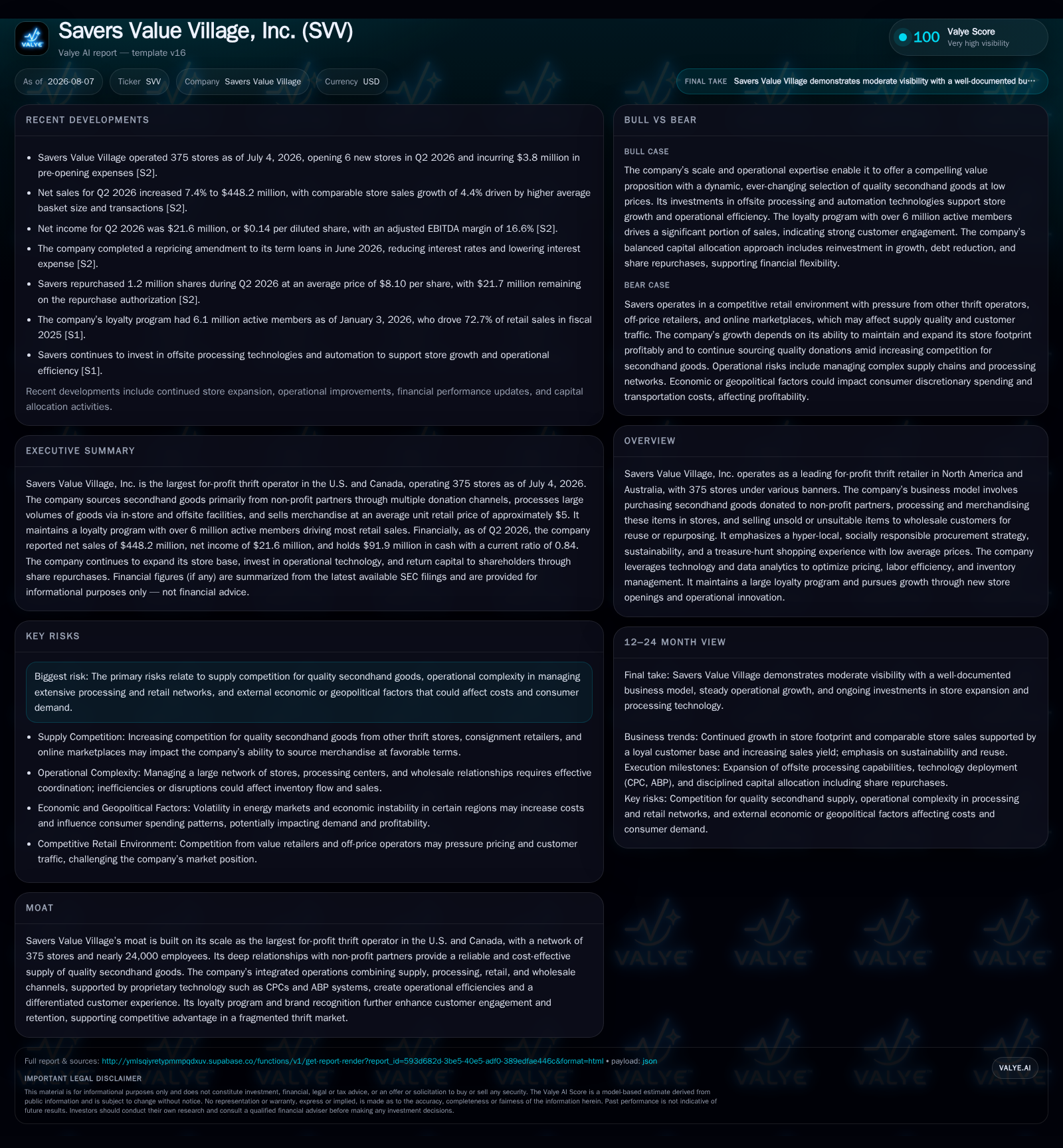
Savers Value Village reported solid second-quarter 2026 results, led by a 6.6% increase in U.S. comparable store sales and ongoing operational investments that enhance its proprietary integrated thrift retail model. The company operates 375 stores across North America and Australia, sourcing donated goods primarily through non-profit partnerships with three procurement channels, emphasizing local sourcing and sustainability. Loyal customers enrolled in its Super Savers Club drive most retail sales, aligning with its low average unit retail price of approximately $5. Risks remain around competition for quality donated goods and operational complexity. Savers is progressing on growth through new store openings, enhanced supply mix, and data-driven pricing optimization while maintaining steady liquidity despite substantial debt.
Recent Operating Update
Business Model Analysis
Savers operates the largest for-profit thrift chain by store count across the United States, Canada, and Australia with a total footprint of 375 stores as of July 2026 [S2]. Its business model centers on sourcing donated secondhand goods through contractual arrangements with approximately three procurement models: onsite donations at community donation centers adjacent to stores (OSDs), GreenDrop collection sites (branded donation locations), and delivered supply processing [S1]. The emphasis on onsite donations and GreenDrop accounts for roughly 78% of total pounds processed, reflecting management's strategy to garner higher-quality donated goods exhibiting favorable cost characteristics [S1].
Post-acquisition from nonprofit partners (NPPs) who receive contracted compensation from Savers based on donated item volumes rather than sales proceeds directly at retail [S1], these goods undergo rigorous sorting and conditioning at strategically located supply and processing centers before being merchandised in Savers' stores or sold wholesale if unsellable at retail.
Revenue mechanics rely heavily on volume-weighted procurement costs from NPPs combined with average unit retail pricing near $5 [S1]. Margins pivot substantially on efficient inventory turnover rates achieved through rich assortment variety supporting the 'treasure-hunt' consumer experience—a known behavioral driver compelling frequent visits typical among thrifters.
Wholesale resale acts as an important secondary revenue stream monetizing items unsold or unsuitable for direct consumer sale but viable for recycling or repurposing via external buyers such as textile recyclers or small business owners [S1]. This vertical integration along supply-processing-retail-wholesale layers differentiates Savers from traditional discount retailers which often lack control over upstream donation sourcing or downstream wholesale channels.
Operational advancements have featured investments in technology solutions targeting pricing optimization algorithms coordinated with local demand signals alongside labor cost efficiencies without compromising customer service standards [S1]. These efforts create dynamic pricing capabilities enhancing margin capture opportunities amid fluctuating environment costs.
Industry Structure & Competitive Positioning
The for-profit thrift retail sector remains fragmented with significant presence from entities such as Goodwill Industries International operating non-profit models competing alongside traditional discount retailers like Dollar General and emerging players focused on online resale marketplaces.
Savers’ scale—marked by a workforce approximating 24,000 team members—and its integrated approach involving tightly connected sourcing-processing-retail-wholesale functions carve out an operational moat that limits peer replication especially given proprietary systems like CPCs (Central Processing Centers) and ABP (Automated Buying Programs) mentioned historically [S1]. These infrastructure elements reinforce operational efficiencies that competitors with less integration struggle to match.
Furthermore, sustainability trends bolstering circular economy concepts provide demand tailwinds unique to the textile reuse industry which e-commerce counterparts partially address but cannot fully replicate given lack of physical footprint creating sensory consumer experiences intrinsic to treasure-hunt shopping.
Growth Drivers
Several vectors underpin ongoing expansion prospects for Savers:
- Store Expansion: Growing physical store count beyond current total of 375 under diverse regional banners allows deeper market penetration providing access to incremental donated goods while enhancing brand visibility [S2].
- Loyalty Program Engagement: Leveraging data analytics to enhance member retention rates supports elevated percentage of revenue from high-value shoppers driving repeat visit frequency [S1].
- Supply Mix Optimization: Strategic shift towards greater reliance on OSDs+GreenDrop sources favors higher quality input stock reducing markdown risks and boosting gross margins [S1].
- Technology Integration: Enhancing real-time pricing tools and labor efficiency systems supports stronger inventory turnover metrics consistent with discount retail KPIs.
- Wholesale Market Dynamics: Refining resale relationships optimizes monetization of residual inventory while limiting waste aligns with sustainability goals adding reputational capital.
Risks and Watchpoints
Key risks remain relevant for Savers’ operating context:
- Competition for Donated Goods: Market pressures from other thrift operators or emerging digital resale platforms may constrict availability or escalate cost basis for secondhand inputs impacting gross margin leverage.
- Operational Complexity: Managing decentralized donation streams combined with multifaceted processing logistics across three countries creates execution risk that can scale disproportionately if not managed.
- Labor Market Fluctuations: Staffing shortages or wage inflation impact lean store upkeep or processing throughput critical to maintaining low prices while meeting shopper expectations.
- Consumer Discretionary Spending Variability: Perceptions about thrift shopping fluctuate cyclically altering traffic patterns particularly under macroeconomic uncertainty leading sometimes to inconsistent comparable sales trends.
- Wholesale Demand Volatility: Secondary markets for textile waste are susceptible to commodity fiber price swings which can affect revenue stability from resale channels.
- Regulatory & Data Privacy Compliance: Operating cross-border necessitates agile adherence to evolving statutes governing environmental claims data handling elevating compliance costs.
What To Watch Next
Investors should monitor forthcoming quarterly filings for:
- Updated comparable store sales trends segmented by geography revealing market-specific momentum shifts.
- Active loyalty program engagement levels including percentage contribution to overall retail sales indicating stickiness trajectory.
- Progress towards announced new store openings signaling capability extensions into attractive markets.
- Margin evolution linked to changes in supply mix favoring higher proportions of contractual lower-cost OSD/GreenDrop inputs.
- Operating income trajectories illustrating success or challenges from implemented pricing optimization efforts amidst inflationary pressures.
- Wholesale sales volume shifts reflecting end-market conditions impacting leftover inventory monetization effectiveness.
Financial Profile Discussion
At quarter end July 4, 2026, Savers held $91.9 million in cash and equivalents [F1]. Current assets stood at $205 million versus current liabilities near $244 million yielding a current ratio of approximately 0.84—a liquidity posture typical for asset-light retail operators dependent largely on revolving credit facilities rather than cash reserves alone [F1]. Total debt was approximately $730 million as of early 2026, with net debt around $638 million [F1].
Capital allocation remains balanced with continued reinvestment in technology platforms alongside share repurchase authorizations totaling up to $50 million extending through late 2027 supporting shareholder returns without jeopardizing liquidity profiles [S2]
This analysis reflects publicly filed SEC disclosures through August 2026 combined with industry knowledge concerning the global for-profit thrift retail sector derived from value chain structure, competitive dynamics, customer behavior patterns, and financial metrics pivotal within this space. It aims solely to provide an informed perspective on Savers Value Village’s recent developments, business positioning, growth outlook, risks, and financial standing without offering investment advice or research views.
Disclaimer: This is research-only, informational analysis and not investment advice. It may include AI-generated interpretation and general industry context. Always verify important details using primary sources.

Comments