
Grayscale Horizen Trust Navigates Persistent Valuation Dislocations Amid Regulatory Ambiguity
The August 2026 quarterly filing highlights ongoing challenges in aligning Grayscale Horizen Trust’s share price with underlying asset value due to structural constraints and regulatory uncertainties impacting investor confidence and liquidity.
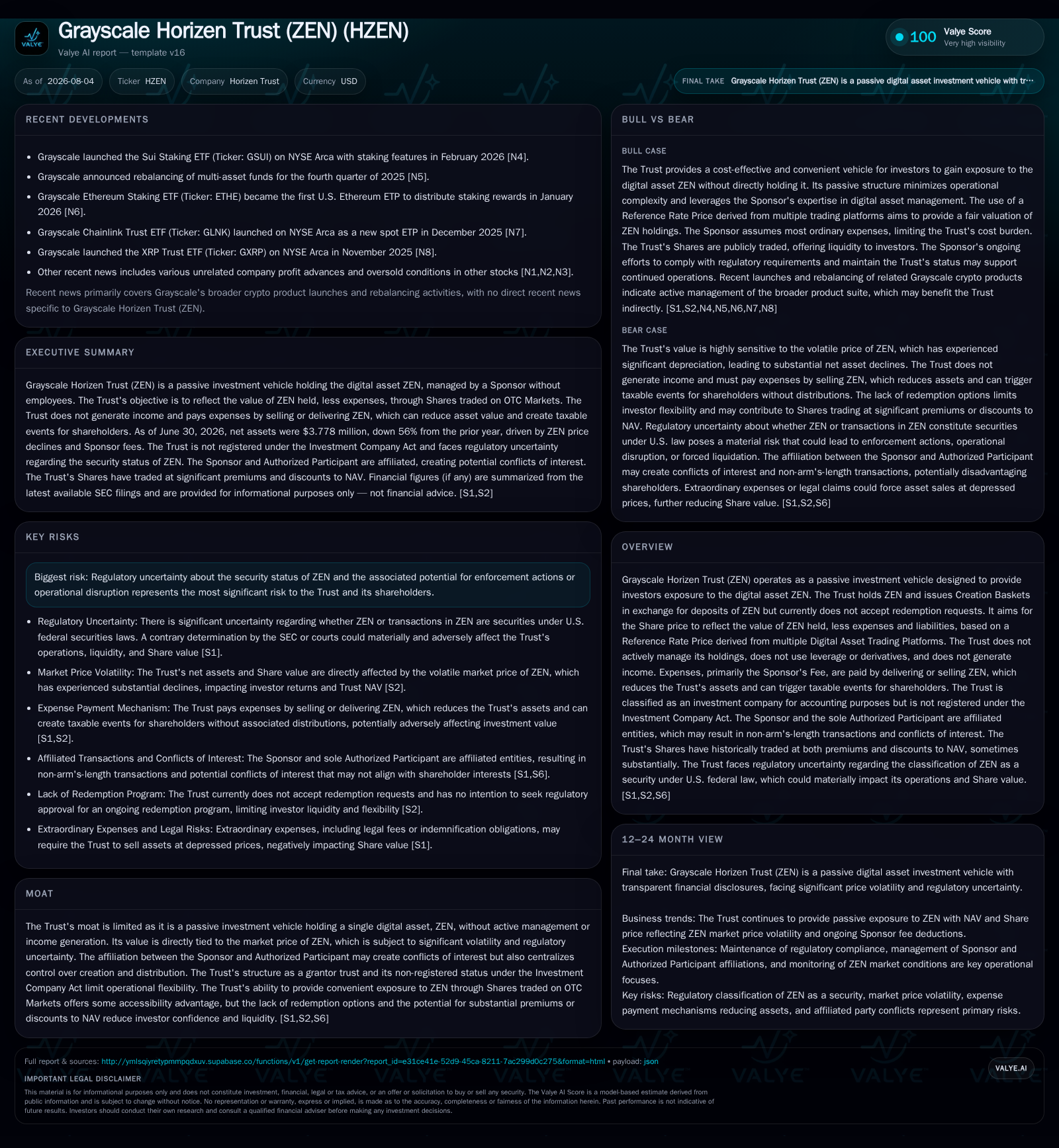
Grayscale Horizen Trust (HZEN) remains a passive investment vehicle offering exposure exclusively to the ZEN cryptocurrency. The latest 10-Q confirms that shares continue to trade on OTC Markets at substantial premiums or discounts relative to net asset value (NAV), driven by the absence of a redemption mechanism and reliance on creation baskets for share issuance. Management fees paid in-kind reduce assets and trigger taxable events for shareholders, complicating after-tax returns. Regulatory uncertainty about whether ZEN qualifies as a security persists as a key risk, with potential enforcement actions threatening operational viability. These dynamics cap growth potential despite broader institutional interest in digital assets, underscoring structural and regulatory factors that investors must monitor closely.
Latest Quarterly Filing Highlights Continued Premium/Discount Volatility
The August 4, 2026, 10-Q filing [S2] reiterates that Grayscale Horizen Trust’s shares continue to trade on OTC Markets at prices frequently diverging substantially from the Trust’s net asset value per share (NAV). This persistent premium/discount phenomenon stems largely from the Trust’s structural design which permits share creation via deposits of ZEN by an Authorized Participant but does not currently allow redemptions. Without redemptions, traditional arbitrage mechanisms that tether share prices closely to NAV are ineffective, leaving secondary market pricing subject to speculative forces and liquidity imbalances.
For investors seeking indirect exposure to the underlying ZEN cryptocurrency, this disconnect means market prices may not accurately reflect intrinsic asset values, adding execution risk and complicating valuation. This dynamic mirrors challenges historically faced by similar digital asset trusts like Grayscale Bitcoin Trust (GBTC), where limitations on redemption have led to wide trading discounts relative to NAV.
Passive Grantor Trust Structure Defines Investor Exposure
As detailed in the November 25, 2025 annual report [S1], the Grayscale Horizen Trust is structured as a passive grantor trust holding only ZEN cryptocurrency. The Trust does not engage in active trading strategies, leverage use, or derivative transactions. Instead, it aims solely to track the value of ZEN through shares representing indirect ownership interests.
Management fees are assessed periodically and paid through in-kind transfers or sales of ZEN directly from Trust holdings to the Sponsor or Authorized Participant. This fee payment method reduces the total assets under management over time unless offset by new creations. Notably, these in-kind fee payments create taxable events for shareholders without accompanying cash distributions, imposing a tax liability burden that can detract from after-tax returns.
This passive model contrasts with actively managed funds or ETFs where managers might employ income generation or hedging strategies. Instead, investors receive pure price exposure to ZEN with inherent risks linked tightly to cryptocurrency volatility.
Creation Baskets Without Redemption Limit Liquidity and Arbitrage
The issuance of new shares occurs exclusively through creation baskets accepted from a sole Authorized Participant depositing blocks of ZEN into the Trust [S2]. While this mechanism allows share count and AUM growth when demand exists, the absence of any redemption rights prevents balancing flows that would otherwise help maintain share price alignment with NAV.
Consequently, secondary market participants face asymmetric liquidity conditions where premium or discount levels can persist unchecked due to limited arbitrage opportunities. This illiquidity penalizes institutional-grade investors who require transparent pricing with narrow bid-ask spreads anchored around NAV.
Fee Payments Dilute Assets and Create Tax Complexity
Management fees charged by the Sponsor reduce Trust assets through periodic in-kind sales or deliveries of ZEN regardless of market conditions [S1]. If these transactions occur during periods of depressed ZEN prices caused by volatility or low liquidity, they exacerbate NAV dilution beyond pure expense impact.
Moreover, because the Trust is treated as a grantor trust for U.S. federal income tax purposes, each such transfer constitutes a taxable event for shareholders without generating cash flow [S1]. Investors thus bear tax liabilities arising from fees embedded within their holdings—an important consideration when comparing expected returns against direct digital asset ownership or other fund structures that pay expenses from income.
Understanding these mechanics is essential for assessing net investment outcomes over time.
Regulatory Uncertainty Remains a Material Operational Risk
A critical ongoing risk is regulatory ambiguity concerning whether ZEN qualifies as a security under U.S. federal law [S1,S4]. The SEC continues efforts under initiatives like "Project Crypto" to clarify digital asset classifications [S19], but legal tests such as Howey remain interpretative.
While current Sponsor assessments based on external counsel conclude that ZEN is not a security [S1,S4], this determination is not definitive nor binding. An adverse ruling could compel operational changes including possible dissolution or restructuring under more onerous investment company regulations.
Such developments would likely cause immediate material value impairment for both ZEN and HZEN shares due to forced liquidation or halted operations, emphasizing policy-driven tail risks beyond typical market volatility.
Concentrated Authorized Participant Role Limits Market Efficiency
With only one Authorized Participant responsible for creation basket issuance and no redemption mechanism available [S1,S2], operational control is centralized. While simplifying logistics, this concentration heightens counterparty risk and restricts competitive arbitrage activity necessary for efficient price discovery.
In contrast, exchange-traded funds (ETFs) typically feature multiple authorized participants facilitating both creations and redemptions, enabling rapid correction of mispricing through arbitrage trades. HZEN’s structure inherently limits such mechanisms, contributing directly to observed premium/discount variability in secondary trading.
Additionally, overlapping roles between Sponsor and Authorized Participant may raise conflict-of-interest concerns during volatile periods further constraining transparency.
Growth Drivers Are Present but Constrained by Structural Design and Policy Risks
Broader industry trends support growing institutional interest in regulated vehicles providing digital asset exposure as part of diversified portfolios. Enhanced custody solutions and evolving regulatory frameworks globally underpin steady adoption momentum generally favorable for trusts like HZEN.
However, growth scalability is capped by fundamental design limitations inherent in grantor-trust status combined with lack of redeemability—factors that negatively affect liquidity profiles relative to newer cryptocurrency ETFs offering redemption rights that promote fair-value trading bands.
Disclaimer: This is research-only, informational analysis and not investment advice. It may include AI-generated interpretation and general industry context. Always verify important details using primary sources.

Comments