
Upstart Holdings Advances AI Model Innovation to Sustain Credit Marketplace Growth
Upstart’s Q2 2026 filing reveals ongoing AI improvements and diversified capital strategies supporting scaled loan originations amid evolving macroeconomic pressures.
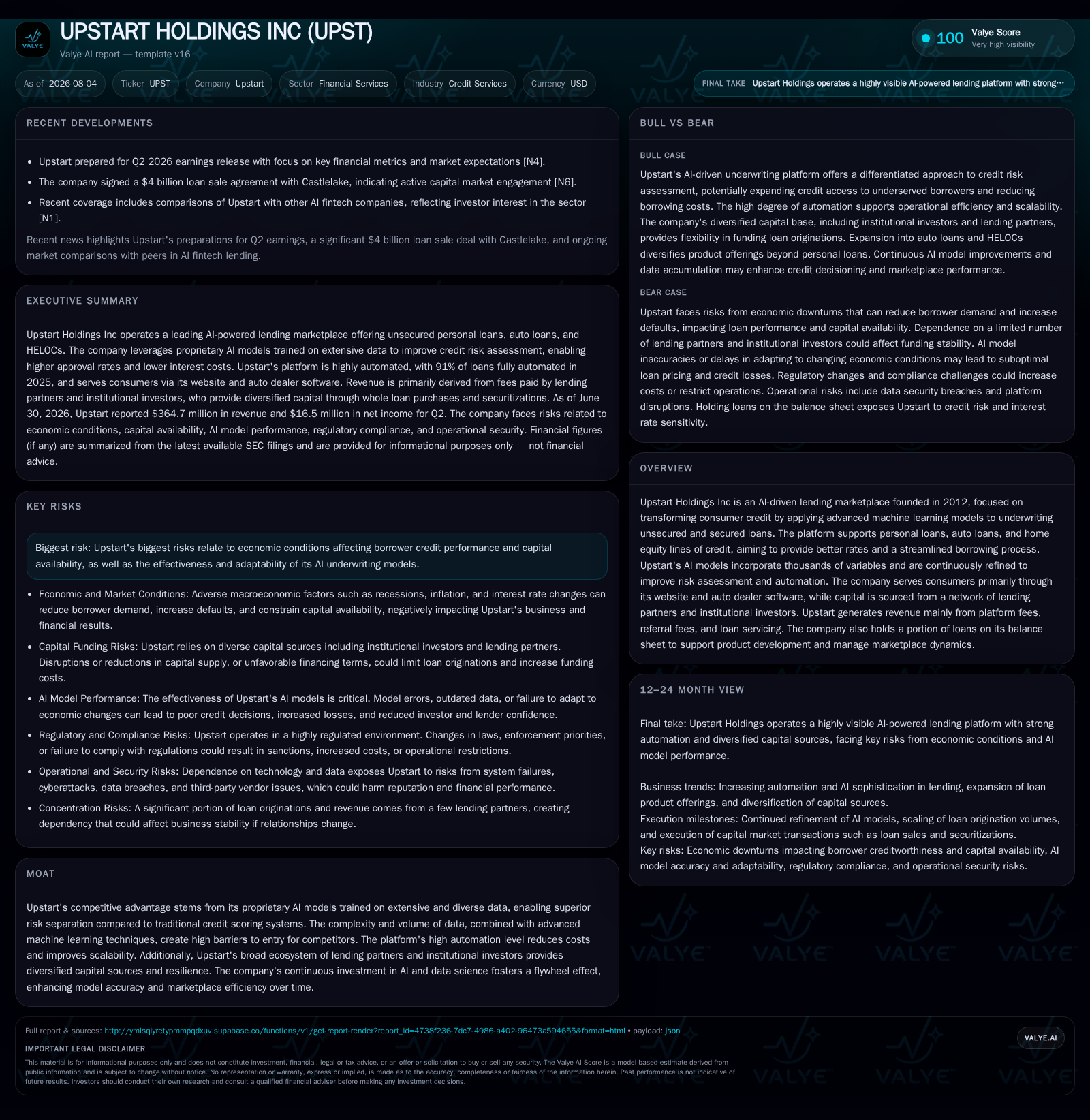
In its latest quarterly report, Upstart Holdings emphasized enhancements in its proprietary AI underwriting models that underpin improved risk assessment and automation rates. The company continues to expand its diversified funding sources, including institutional investors and securitization programs, preserving liquidity and growth capacity as economic uncertainties rise. Loan origination volumes and approval rates reflect competitive positioning in an increasingly digital credit marketplace. However, risks from credit cycle volatility, capital availability, and reliance on key lending partners remain key watchpoints for sustaining momentum.
Q2 Operational Advances Reinforcing AI-Powered Underwriting Precision
Upstart Holdings' Q2 2026 filing underscores continuous innovation in its proprietary AI underwriting platform, reinforcing its competitive advantage in risk separation — the firm's ability to differentiate borrower credit quality more accurately than traditional systems. The company reports improvements in its machine learning models that handle tens of thousands of variables across unsecured personal loans, auto loans, and home equity lines of credit (HELOCs), leading to elevated automation rates where over 90% of loans required no manual intervention in prior periods [S2][S1]. This high degree of automation not only enhances processing efficiency but also supports scalable growth by reducing costs per loan originated. These enhancements signal reinforcement of the core underwriting flywheel effect: better data leads to improved predictions, which attract higher-quality consumers and capital partners. Tracking approval rate shifts alongside loss metrics will be revealing indicators of model effectiveness retention through volatile credit cycles.
Capital Market Engagements Shaping Funding Flexibility and Growth Capacity
Funding diversity remains critical in Upstart’s marketplace model connecting borrowers to lending partners—including banks and credit unions—and institutional investors who acquire loans or securities. Regulatory constraints such as Regulation RR obligate Upstart to retain portions of credit risk post-securitization, which it manages with risk retention financing facilities. This layered capital structure balances liquidity needs with cost efficiency but introduces sensitivity to capital market fluctuations that could increase funding costs or reduce availability. Maintaining seamless access across these vehicles is pivotal for sustaining origination volumes without excessive reliance on balance sheet funding.
Marketplace Dynamics: Loan Origination Trends and Consumer Approval Behavior
The second quarter maintained solid loan origination levels supported by direct consumer application flows through upstart.com and expanding penetration of auto loan originations facilitated via integrated dealer finance software [S2][S1]. Although specific volume figures are undisclosed here, management commentary highlights stable borrower demand despite broader tightening economic conditions impacting discretionary borrowing. Approval metrics likely reflect a calibrated balancing act: preserving inclusivity through AI-enhanced risk segmentation while managing charge-off exposure prudently under tightening credit conditions. This nuanced underwriting agility is essential amid competition from other technology-driven marketplaces like LendingClub and SoFi—both known for their online platforms—and fintech lenders such as Affirm emphasizing alternative data use.
Risk Separation Effectiveness Amid Evolving Economic Conditions
Upstart’s AI models face ongoing pressure from macroeconomic uncertainties typical of the U.S. consumer lending context. Borrower behaviors vary with interest rate shifts and employment fluctuations, impacting delinquencies especially for unsecured products historically viewed as higher risk [S15][S26]. Upstart’s embedding of real-time macro calibrations into models aims to adapt approval thresholds dynamically—potentially insulating portfolio performance by modifying risk appetite responsively to emerging trends. Despite these mitigations, inherent model risk persists: degradation if training datasets lag evolving borrower profiles or economic shocks remain unmodeled could dampen credit outcomes and investor confidence. Monitoring loss provisions alongside approvals will clarify whether model adaptations sustain historic performance advantages.
Competitive Positioning Within a Technology-Driven Lending Ecosystem
The firm’s moat rests primarily on the sophistication and breadth of its AI-driven underwriting compared to legacy FICO score-reliant lenders who employ simpler rules-based approvals. This positions Upstart favorably against peers like Affirm or Avant which also deploy alternative data but potentially lack comparable scale or longitudinal datasets fostering nuanced predictive accuracy [S1]. Additionally, the marketplace revenue model—revenue generated from platform fees paid by lending partners plus referral fees—benefits from increased transaction flow driven by improved AI scoring efficiency. Unlike traditional banks constrained by regulatory frameworks around deposit-taking or balance sheet lending limits, Upstart leverages partnerships with banks but operates with greater agility in pricing risk dynamically while expanding product breadth.
Expansion Opportunities Through New Products and Channel Diversification
The company advances into adjacent secured credit segments such as HELOCs while continuing significant investments in auto financing through enhanced dealer software deployment—pivotal given auto loans’ secured nature potentially appealing more during economic downturns due to collateralization mitigating lender risk [S1][S2]. These expansions diversify revenue away from unsecured personal loans which historically dominated volume but carry elevated credit risk concentrations under stress scenarios. New product lines can also incrementally increase average loan sizes and enrich fee income streams if managed within prudent risk frameworks. However, product mix evolution requires balancing margin impacts since secured products generally command lower yields than unsecured counterparts.
Key Risks: Macroeconomic, Model, Capital Access, and Partner Concentration Challenges
Notwithstanding strength derived from AI innovation and capital diversification, inherent risks remain pronounced. Principal threats include sustained economic weakness curbing borrower approvability or heightening charge-offs beyond modeled expectations; fluctuating institutional investor appetite potentially constraining marketplace liquidity; concentration risks stemming from reliance on a limited number of lending partners responsible for substantial origination volume; and model obsolescence risks if rapid economic shifts outpace retraining cycles [S2][S27][S22]. Managing these risks demands vigilant KPI monitoring—including approval rates, loss ratios, funding cost trends—and robust contingency planning such as scaling balance sheet holdings or adjusting pricing algorithms.
Monitoring Indicators: What To Watch In Upcoming Quarters for Demand and Credit Quality
Key metrics signaling directional health include loan origination volume trajectories that confirm durable demand resilience; sequential changes in approval rates reflecting ongoing underwriting calibration; loss provision trends evidencing portfolio quality under real-time stress; plus successful renewal or expansion of institutional capital agreements underpinning liquidity [S3][S2]. Additionally, adoption milestones related to new product launches (e.g., HELOCs) or channel expansions (auto dealership software rollouts) provide forward visibility into long-term diversification strategy execution.
Financial Profile Discussion: Balancing Growth Investment with Sustainable Profitability
Liquidity stands robust with approximately $456 million cash and cash equivalents at June 30, 2026, offering operational flexibility for continued investment in core AI R&D initiatives while buffering capital market volatility impacts on funding costs [F1]. Although historically achieving profitability intermittently—with operating income positive during recent annual periods—the company recognizes the need to manage expenses carefully amidst ongoing investments required both for technological advancement and regulatory compliance intensity linked to pending national bank charter applications [F1][S17]. These developments may introduce incremental operational costs even as they promise strategic advantages in lowering funding costs long term. Overall financial stewardship appears aligned with sustaining growth ambitions conditioned on prudent risk controls.
This analysis draws exclusively on Upstart Holdings’ latest publicly available SEC filings without speculative forward-looking assumptions. It contextualizes operational metrics within the dynamics typical of technology-enabled lending marketplaces navigating evolving macroeconomic landscapes.
Disclaimer: This is research-only, informational analysis and not investment advice. It may include AI-generated interpretation and general industry context. Always verify important details using primary sources.

Comments