
Quanta Services Expands Backlog and Margins on Acquisitions and Infrastructure Demand
Q2 2026 results reflect strong revenue growth driven by acquisitions and sustained demand in electric and underground infrastructure sectors.
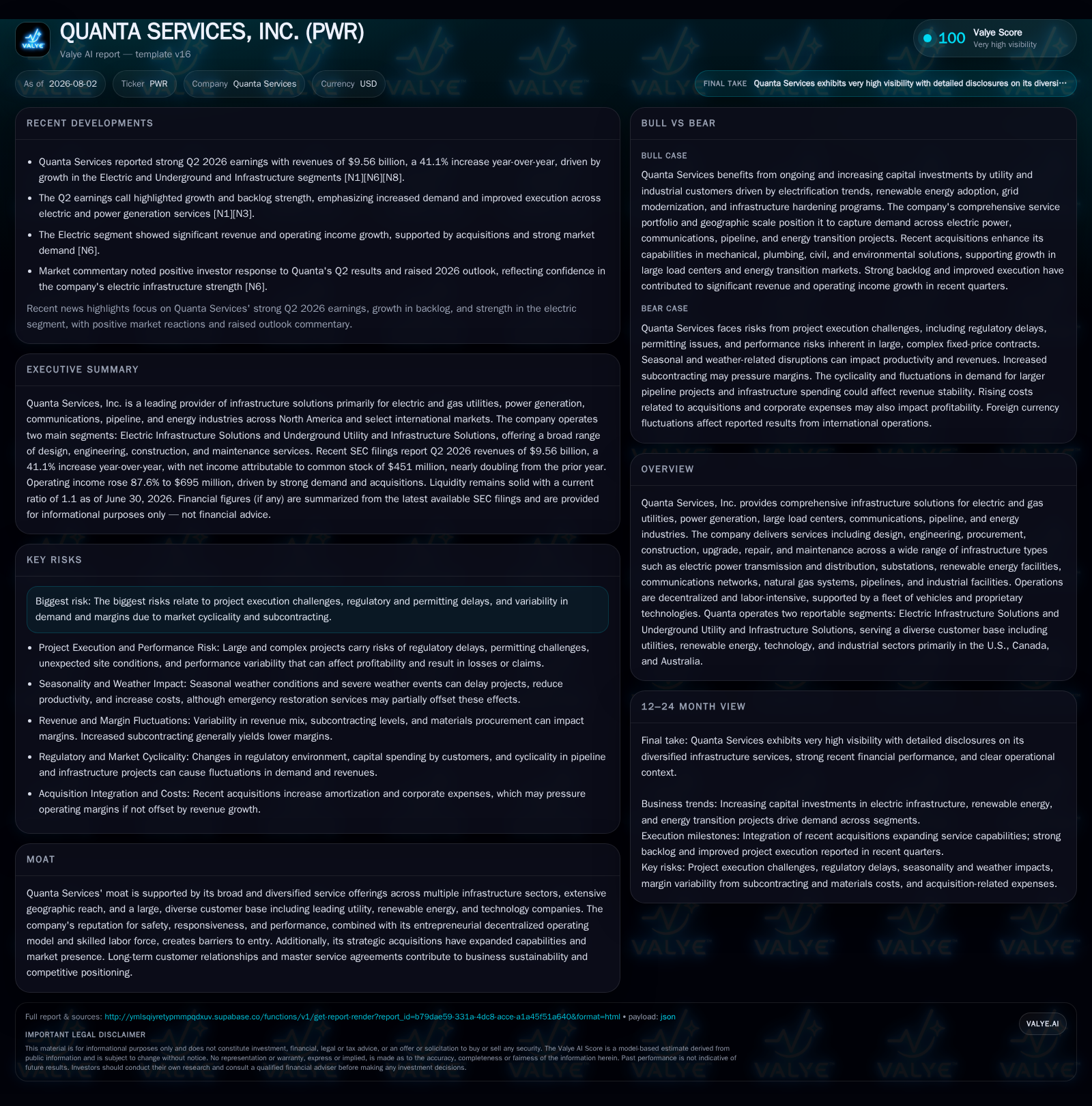
Quanta Services reported a robust second quarter of 2026, with revenues rising 41% year-over-year to $9.56 billion, primarily fueled by acquisitions and increased activity in its Electric and Underground Infrastructure segments. Operating income nearly doubled due to better fixed cost absorption from acquired businesses and favorable project mix. The company's backlog saw healthy growth, supported by solid awards and long-term master service agreements, underpinning future revenue visibility. Seasonality and weather remain material operational factors, while the company maintains a strong liquidity position with low net debt to support ongoing capital requirements.
Recent Operating Update
m revenue conversion.
Business Model Overview
Quanta Services operates as a leading provider of infrastructure design, engineering, construction, upgrade, repair, and maintenance services primarily for electric power transmission and distribution (T&D), substations, renewable energy facilities (including wind, solar, battery storage), gas utility systems, pipelines, communications networks, large load centers like data centers and manufacturing facilities, as well as downstream industrial equipment [S1]. Its decentralized operational model relies on skilled craft labor supported by an extensive fleet of owned and leased specialized equipment. Revenue arises via a combination of fixed-price contracts — common for larger projects involving higher complexities such as transmission line construction or pipeline integrity upgrades — as well as cost-plus or time-and-material contracts often used for regular maintenance or emergency restoration services [S1].
The company’s client base spans investor-owned utilities (constituting about 70% of revenues), energy developers (solar/wind/gas), technology firms managing hyperscaler data centers or communication infrastructure (around 13% of revenues), and industrial customers owning oil refineries or pipelines [S4][S5]. Quanta secures its business through strategic alliances, preferred service provider relationships, MSAs that facilitate streamlined contracting for recurring services without volume commitments but generally with negotiated rates and terms [S4]. These arrangements aim to smooth demand variability inherent in capital-spending-driven sectors.
In addition to organic growth driven by expanding infrastructure spending—fueled by grid modernization mandates and clean energy transition policies—the company pursues strategic acquisitions that broaden its service portfolio geographically and technologically as witnessed recently with multiple bolt-on deals integrated into the Electric segment [S23].
Industry Structure and Competitive Position
Quanta operates within the labor-intensive, asset-supported sector of energy infrastructure services characterized by significant project-based work influenced by seasonal weather patterns—cold or wet conditions can delay field activities—regulatory permitting timelines, customer capital budget cycles, and fluctuations in spot versus contracted work demand [S1][S2]. Key competitors comprise diversified infrastructure service providers such as MYR Group and MasTec offering overlapping services but often less scale or geographic breadth compared to Quanta's expansive footprint across the United States, Canada, Australia, and select international markets.
The competitive edge derives from Quanta’s reputation for safety leadership—a top-tier safety incident rate is critical given the hazardous nature of utility infrastructure work—responsiveness to customer needs enabled by entrepreneurial decentralized operating companies framework, extensive fleet management capabilities enhancing equipment utilization rates, technological competencies including manufacturing certain critical components like power transformers in-house [S1][S23]. Long-term relationships secured via MSAs bolster resilience against cyclical market downturns although pricing competition remains intense especially on fixed-price contracts where volume discounts can pressure margins.
Growth Drivers
Several secular trends underpin Quanta’s growth outlook:
- Renewable Energy Infrastructure: Accelerated deployments of wind farms, solar arrays, battery storage platforms require substantial grid interconnection upgrades handled extensively within Quanta’s Electric segment [S1].
- Grid Modernization & Hardening: Utilities are investing heavily in transmission upgrades to enhance reliability against climate-induced severe weather events which increase demand for both capital projects and emergency restoration services—a higher-margin business line due to premium pricing under urgent conditions [S1][S2].
- Natural Gas Pipeline Expansion & Integrity: Despite challenges permitting new pipelines fostering demand for life extension integrity services focused on existing assets supports Underground Infrastructure solutions [S1].
- Technology Sector Infrastructure: Growth in hyperscale data center build-outs aligns with Quanta’s offerings on electrical/mechanical infrastructure for large load centers enabling diversification beyond traditional utilities [S4][S5].
- Strategic Acquisitions: As demonstrated recently with multiple acquisitions complementing core capabilities especially within civil/mechanical trades expands addressable markets while enhancing scale economies [S24].
Monitoring project backlog value trends and MSA renewal rates alongside latest contract awards will provide leading signals on revenue sustainability amid macro uncertainties.
Risks and Watchpoints
Quanta faces operational risks typical of its industry pillar:
- Project Execution Risk: Large complex projects involving considerable engineering or difficult terrain may incur delays or cost overruns impacting margins and cash flows.
- Seasonality & Weather Dependency: Harsh winters constrain field productivity in northern US regions; wet seasons similarly disrupt schedules affecting quarterly performance volatility [S2].
- Regulatory/Permitting Delays: Slower approval processes can defer commercial pipelines or renewable connection projects impacting near-term workload.
- Labor Market Pressures: Skilled labor shortages amid wage inflation risk raise operating costs; productive headcount management will be key.
- Competitive Pricing Pressure: High competition particularly on fixed-price contracts could compress gross margins if not appropriately managed.
- Customer Capital Spending Variability: Utilities’ capital budgets fluctuate based on economic conditions/policy changes affecting pipeline for projects.
- Subcontractor Development: Subcontractors may evolve into direct competitors over time putting pressure on contract win rates.
Monitoring changes in bid success ratios, equipment utilization improvements reflecting efficient deployment of assets during peak seasonality quarters are critical execution KPIs.
What to Watch Next
Key upcoming milestones include further integration results from recent acquisition activity impacting margin trajectories; quarterly updates on backlog composition differentiating between fixed-price performance obligations versus MSA-derived non-fixed backlog; indicators from major customers regarding shifts in capital spending plans related to grid modernization funding allocations; seasonal influence on Q3 revenue progression given summer is typically a peak period ahead of winter quarters noted for lower productivity [S2]; progress against expanding technology sector client base supporting diversification efforts; potential regulatory developments impacting pipeline permitting timelines; announcements regarding fleet expansion capex revealing future capacity investments aligned with demand forecasts.
Financial Profile Discussion
As of June 30, 2026, Quanta reported cash and equivalents totaling approximately $506 million [F1]. Current assets stood at about $11.9 billion against current liabilities near $10.8 billion, implying a current ratio of approximately 1.1x [F1]. The company’s reported total debt was approximately $144 million (best-effort point) [F1]. This balance sheet position supports ongoing funding requirements tied to working capital fluctuations—often seasonal—and capital expenditures targeted toward fleet enhancement aligning with forecasted demand spikes during more favorable weather windows [S26]. The company also expanded its senior credit facility revolving commitments from $2.80 billion to $2.98 billion with maturity extended through July 2031 providing ample liquidity runway for acquisitions or opportunistic market moves [S26][S9]. Despite growing intangible amortization linked mainly to recent acquisitions impacting non-cash charges on P&L, operating income leverage from scale effects has contributed substantially to double-digit earnings growth both sequentially and annually [S24]. Continued stringent control over days sales outstanding (DSO) which improved modestly from last year's comparable quarter supports cash conversion efficiency critical for funding operations without excess reliance on external financing [S6].
Overall financial flexibility combined with enhanced scale provides a resilient platform enabling Quanta Services to capitalize on multiyear structural investments needed across energy transition sectors while managing typical sector cyclicality inherent in project-based contracting.
Disclaimer: This report is prepared for informational purposes based solely on publicly available filings and news sources without endorsing any investment strategy or decision.
Disclaimer: This is research-only, informational analysis and not investment advice. It may include AI-generated interpretation and general industry context. Always verify important details using primary sources.

Comments