
River Financial Navigates Regional Banking with Conservative Lending and Core Deposit Stability
River Financial Corp operates a regional bank emphasizing localized service, deposit-driven funding, and conservative credit in Alabama and Florida.
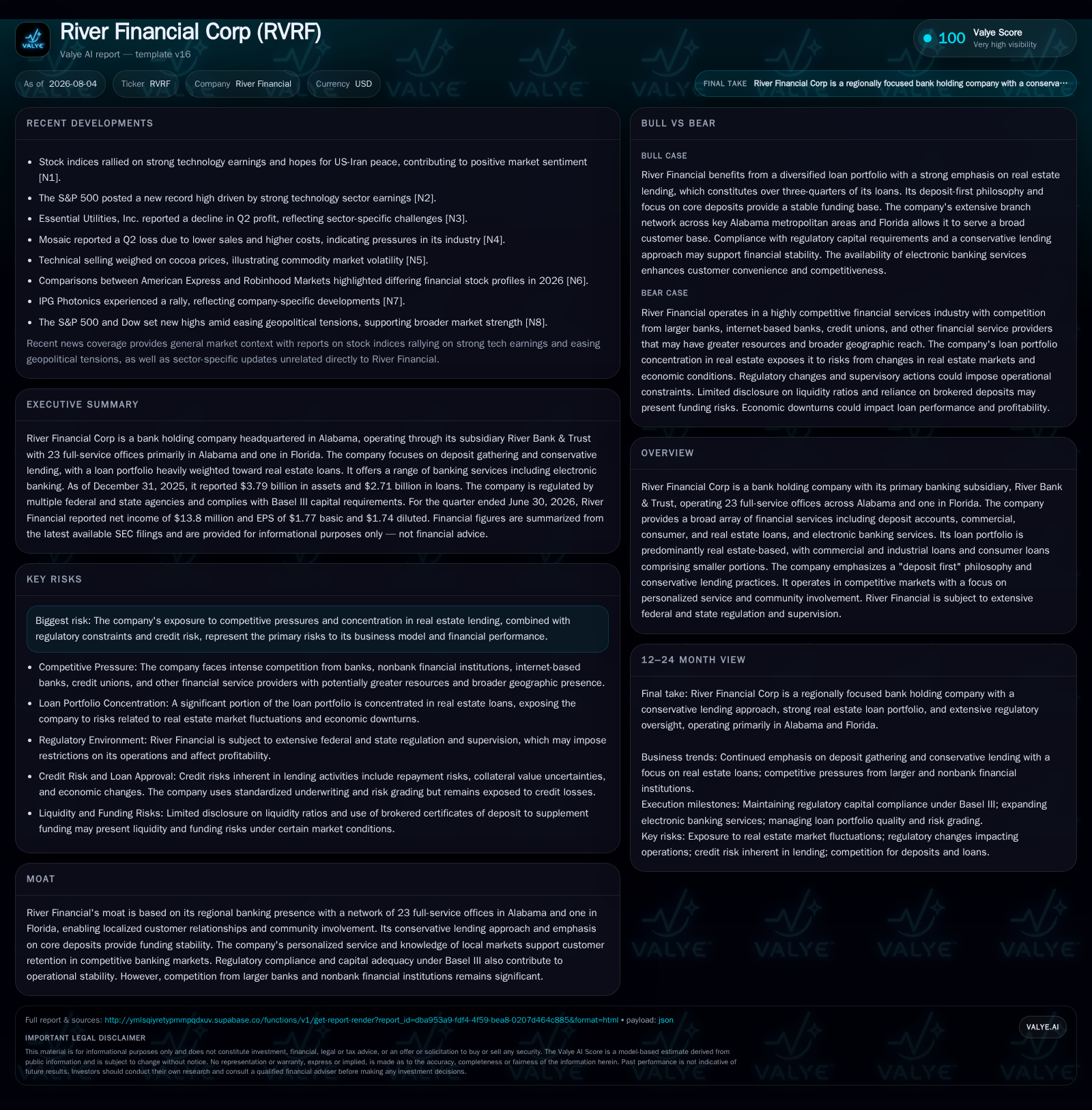
River Financial Corp, a bank holding company with 24 offices primarily in Alabama, reported stable balance sheet metrics in its latest quarterly filing ending June 30, 2026. The company’s business model centers on originating predominantly real estate-backed loans funded largely through core deposits, supporting a conservative lending stance that emphasizes risk mitigation. Despite regulatory and competitive challenges typical of regional banks in its markets, River Financial leverages strong local market knowledge and community engagement to compete against larger national and nonbank lenders. Going forward, key performance indicators to monitor include loan portfolio growth—particularly commercial real estate exposure—net interest margin stability amid interest rate shifts, core deposit trends, and capital adequacy compliance under Basel III.
Recent Operating Update
River Financial Corp’s most recent quarterly filing dated August 4, 2026 ([S2]) verifies sustained execution of its "deposit first" funding philosophy into mid-2026. This approach prioritizes attracting low-cost core deposits such as demand deposit accounts (checking) to fund loan growth while maintaining liquidity stability. A July 16 event filing ([S3]) reiterated the company’s steady financial condition as of June 30, emphasizing stable loan origination volumes with no material change in credit quality indicators. These near-term disclosures support continuity in the company’s conservative operating posture rather than signaling any material strategic shifts.
Business Model Analysis
As a bank holding company headquartered in Prattville, AL with River Bank & Trust as its wholly owned subsidiary, River Financial focuses on retail and commercial banking services tailored to communities primarily across Alabama plus one office in Destin, Florida ([S1]). The firm operates a network of 23 full-service banking offices located in key metropolitan areas such as Montgomery, Auburn-Opelika, Birmingham, Huntsville, and Mobile. This geographic presence allows River Financial to leverage local market understanding in underwriting decisions and customer relationships.
Loan origination activities concentrate mainly on real estate lending: roughly 77% of the loan book consists of residential mortgages (including owner-occupied) and commercial real estate loans ([S11]). The remaining portfolio includes commercial & industrial (C&I) loans (16%) secured typically by collateral like equipment or accounts receivable and consumer loans (2%), often installment-based for durable goods or vehicles ([S4],[S11]). Significantly, home equity lines of credit constitute about 5.9% of loans offering flexibility but controlled risk through variable-rate structures.
Underwriting practices emphasize risk mitigation: credit officers employ borrower cash flow analysis alongside collateral valuation to limit loan-to-value (LTV) ratios especially for C&I lending. Short maturities are favored for construction-related exposures (less than two years), reducing duration risk ([S7]). Customer familiarity through localized banking models enables conservative credit decisions supported by management oversight via loan committees for larger credits ([S8]). These controls form a key part of the firm’s credit risk management framework.
Fee income supplements interest revenue via mortgage origination fees from residential loan sales into the secondary market as well as service charges tied to electronic banking products such as online bill pay or remote deposit capture ([S21],[S8]). While these noninterest revenues support diversified earnings streams they remain secondary relative to core lending spreads.
Compliance with stringent regulatory capital standards is integral. River Financial maintains Common Equity Tier 1 (CET1), Tier 1 Capital ratio, and total capital ratios comfortably exceeding Basel III minima along with a capital conservation buffer—a prudent buffer enhancing operational resilience during macroeconomic stresses ([S6],[S15]). These strong risk-based capital positions reduce downside solvency risks common among smaller regional banking peers.
Industry Structure and Competitive Position
River Financial functions within the regional banking sector characterized by extensive federal-state regulatory regimes including supervision by the FDIC and State Banking Authorities ([S14],). It competes against larger regional banks such as Regions Financial Corporation or Fifth Third Bancorp that offer scale advantages but may lack localized agility. Additionally, fintech lenders introduce alternative credit products challenging traditional margins especially within consumer segments.
The bank’s strength lies in its personalized service ethos delivering community-tailored financial solutions that differentiate it from larger institutions potentially constrained by standardized product offerings ([S8]). Branch density across multiple Alabama MSAs enables effective outreach reflected in diversified deposit gathering channels including growing electronic banking capabilities—a crucial driver given evolving consumer expectations towards digital access ().
Nonetheless, lane competitive pressures remain significant from both national banks leveraging scale pricing power and nonbank entrants offering streamlined digital lending platforms. To offset these challenges River Financial’s emphasis on relationship-driven banking fosters customer loyalty reducing attrition rates relative to peers more reliant on transactional banking models.
Growth Drivers
River Financial’s prospects hinge firstly on local economic expansions within its geographic footprint—the multiple Alabama MSAs have shown steady population growth supporting residential real estate demand which directly feeds mortgage originations (). Likewise commercial real estate development linked to business expansions fuels demand for term loans where River’s long-standing market knowledge provides underwriting discipline without excessive risk-taking.
Incremental expansion of loan production offices—already established in Tuscaloosa and Destin—indicates cautious market penetration enabling specialized origination efforts without full branch infrastructure overheads ([S1]). Credit risk management effectiveness will be crucial hence vigilance over nonperforming loan ratios and timely provisioning must be observed quarterly.
Interest rate fluctuations affect net interest margin since asset yields are partially variable while many deposit accounts offer rates sticky upwards; rapid rate changes could compress margins especially if deposit repricing lags loan yield adjustments ()
Competition risks persist with potential customer migration towards fintech platforms or larger banks offering broader product ecosystems undermining retention efforts despite local embeddedness ([S8]). Also technological investment demands for electronic banking must be balanced against efficiency considerations given limited scale compared to digital-native competitors.
Regulatory costs continue rising post-Dodd-Frank with ongoing demands for expanded compliance infrastructure which could pressure operating expenses disproportionately relative to revenue growth if not managed proactively ([S26]). Any significant regulatory amendments could further restrict business activities or increase capital requirements impacting ROE.
What To Watch Next
Key future milestones include quarterly updates on:
- Loan loss provisions signaling credit quality shifts particularly among construction/nonresidential CRE exposures,
- Nonperforming asset trends closely monitored for early distress alerts,
- Net interest margin trajectory reflecting responsiveness to evolving interest rates,
- Core deposit growth rates validating successful funding mix maintenance,
- Fee income contributions evidencing diversification progress,
- Capital ratios confirming continued Basel III compliance under current stress tests,
- Any announcements related to branch network expansion or new market entries beyond existing offices documented at fiscal year-end [S2][S3]
Tracking these operating markers will clarify whether River Financial sustains its conservative yet growth-oriented banking franchise while navigating sector-specific cyclical pressures.
Financial Profile Discussion
Capital adequacy is robust with Basel III compliant ratios covering minimum thresholds ensuring ability to absorb losses without threatening solvency or triggering regulatory restrictions on dividends or operations.[S6][S15] Efficiency ratio trends are not explicitly disclosed recently but would be an important measure moving forward reflecting operating cost control relative to income generation.
Disclaimer: This report is an objective analysis based solely on public filings including SEC documents dated through August 4, 2026. It is designed solely for informational purposes without providing investment advice or research views.
Disclaimer: This is research-only, informational analysis and not investment advice. It may include AI-generated interpretation and general industry context. Always verify important details using primary sources.

Comments