
Bank First Corp Leverages Strategic Acquisitions and Digital Innovation to Sustain Community Banking Edge
Bank First Corp’s Q2 filings reveal steady credit management, integration progress from recent acquisitions, and ongoing digital investments as core to its community banking moat.
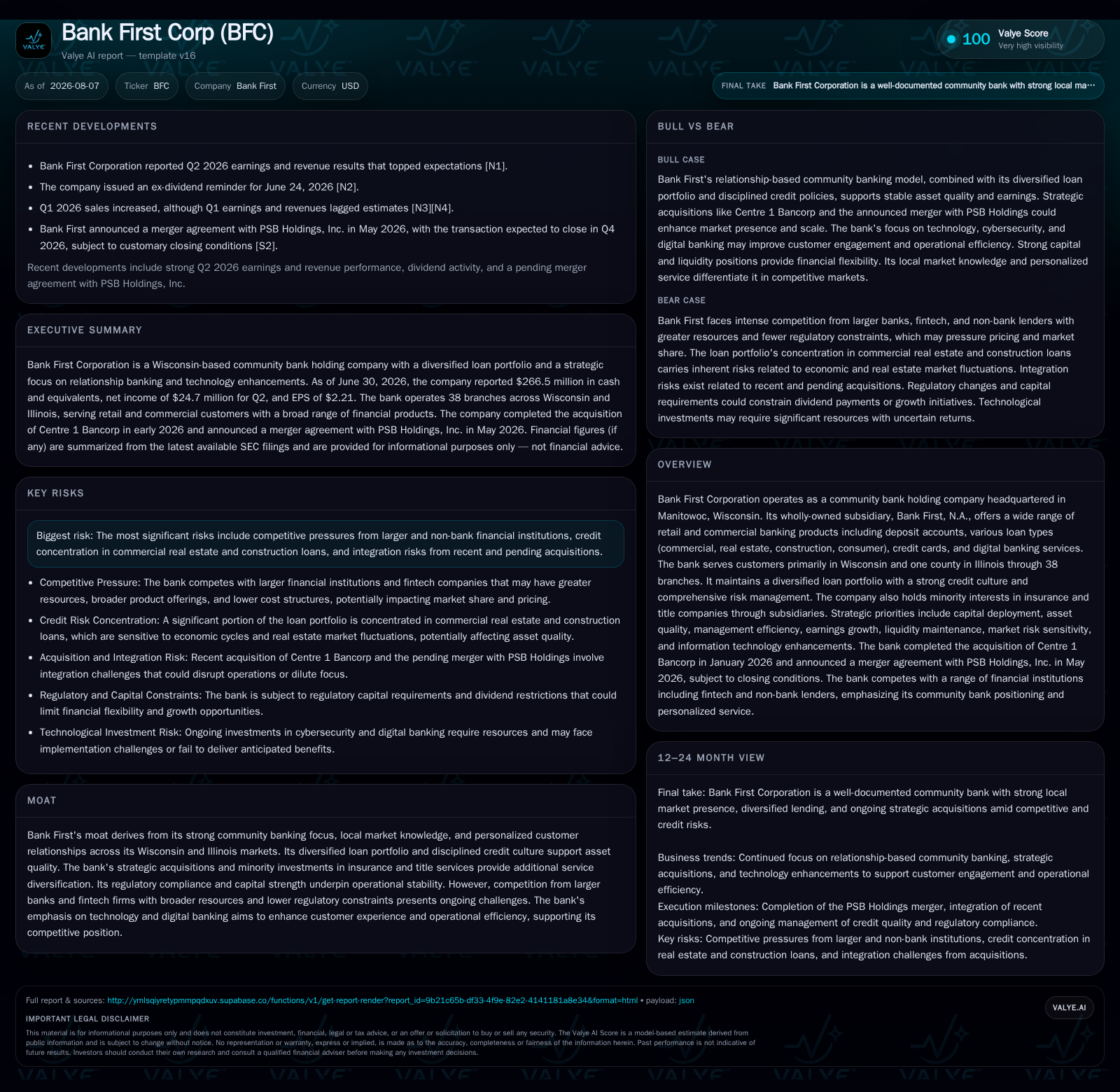
In its latest quarter ending June 30, 2026, Bank First Corporation demonstrated stable credit quality despite concentration risks in commercial real estate and construction loans, advancing integration from the Centre 1 Bancorp acquisition completed earlier in the year. The bank’s business model continues to hinge on net interest margin from a diversified loan portfolio serving primarily Wisconsin and Illinois markets, complemented by fee income and minority stakes in insurance and title services. Investment in digital banking infrastructure aims to enhance customer engagement amidst competitive pressure from larger regional banks and fintech disruptors. Capital adequacy remains solid, supporting continued loan growth and strategic acquisitions without undue leverage.
Q2 Results Pinpoint Integration Momentum and Stable Credit Fundamentals
In the quarter ended June 30, 2026, Bank First Corporation reaffirmed stable asset quality anchored by disciplined credit risk management even as commercial real estate (CRE) and construction loans represent notable portfolio concentrations. Its filing indicates a low non-performing loan ratio consistent with prior periods despite these sector exposures, underscoring effective underwriting criteria that limit loan-to-value ratios generally below 85% for construction projects and owner-occupied commercial properties [S1][S2]. The bank also disclosed continued progress integrating the Centre 1 Bancorp acquisition completed on January 1, 2026. This inorganic growth has augmented its branch footprint across Wisconsin counties and one Illinois county without significant disruption to earnings or credit trends so far [S2][N1]. Successful integration is pivotal because cost synergy realization timelines remain a key factor in improving efficiency ratios post-merger.
How Bank First Delivers Value Through Community Banking Revenue Mechanics
Bank First operates a classic regional community bank business model focused on net interest margin (NIM) generated by a diversified loan portfolio weighted toward commercial real estate (approximately half the portfolio), residential mortgages, construction finance, commercial & industrial lending, and consumer installment loans [S1]. These loans are primarily made to local businesses and consumers within defined Wisconsin-Illinois markets served via a network of 38 branches. Revenue streams are supplemented by fee income derived from deposit account services—encompassing checking, savings, money market products—and by minority interests in ancillary service providers: namely Ansay & Associates insurance (40% ownership) through subsidiary TVG Holdings, Inc., and a smaller stake in Generations Title LLC (5.88%) [S1]. This diversification mitigates reliance on net interest income alone while leveraging cross-selling opportunities embedded within established customer relationships.
The stability of funding is underpinned by consistent deposit growth sourced largely through branch relationships but increasingly supported by digital channels that enhance customer retention. The bank's conservative internal lending limits at roughly 80% of legal maximums further buttress asset quality assurances [S14][S23]. These operational levers confirm that sustained NIM compression would present a material challenge to profitability given the fixed-cost nature of maintaining branch infrastructure alongside digital platform investments.
Local Markets Shape Bank First's Competitive Landscape in Wisconsin-Illinois Corridor
Bank First’s competitive environment centers on localized market dominance within seventeen Wisconsin counties plus one Illinois county where it ranks among top-three deposit holders in seven counties according to FDIC data as of mid-2025 [S10]. Such granular market penetration supports high relationship loyalty driven by personalized service—a characteristic moat for community banks controlling small-town markets. However, this position is challenged both by larger regional peers like Associated Banc-Corp or First Midwest Bancorp that offer scale advantages including broader product suites and more extensive branch or ATM networks.
Moreover, fintech companies advancing digital-only or embedded banking platforms circumvent traditional branch-based models by offering convenience-oriented user experiences with lower overhead structures. Non-bank lenders also carry regulatory advantages absent for traditional banks. As a result, Bank First must balance the retention of its core customer base reliant on face-to-face touchpoints with affordable investments in scalable technology — no small task given limited resource pools compared to national-tier competitors [S24]
Digital Banking Investment Fuels Customer Engagement in Branch-Light Era
A strategic pillar articulated in the company’s recent filings is the prioritization of information technology upgrades aimed at delivering enhanced digital banking services—online platforms enabling mobile deposits, bill payments, loan applications—and backend process automation to improve operational efficiency [S1][S2]. This investment reflects recognition that customer preferences are shifting rapidly toward digital-first interactions even within traditional community bank clientele.
Senior management emphasizes ongoing enhancement of cybersecurity defenses coordinated through dedicated risk officers reporting directly to the board’s audit committee—a structure indicative of heightened regulatory expectations around information security [S1]. Further IT initiatives also seek to convert voluminous transaction data into actionable insights that can support tailored product offerings or risk profiling.
Confirmation metrics will include measured increases in active digital users relative to branch transactions combined with contained cost-to-income ratios over time as automation reduces manual processing expenses.
Growth Prospects Anchored in Strategic Acquisitions and Loan Portfolio Expansion
The completed merger with Centre 1 Bancorp early in the year materially enhances Bank First’s geographic reach within its target Wisconsin-Illinois corridor while increasing total assets beyond $4.5 billion as of end-2025 [S1]. This acquisition adds scale for more efficient operations but presents typical integration execution risks including cultural melding and legacy system consolidation that must be managed vigilantly.
Organic growth continues through selective expansion of commercial loans—particularly smaller middle-market segments—and consumer products supported by robust underwriting standards designed to mitigate concentration risks. Ongoing diligence focuses on maintaining prudent loan-to-deposit ratios conducive to balanced funding profiles; this is particularly critical given prevailing interest rate volatility that impacts both deposit beta sensitivity and yield curves on adjustable-rate lending portfolios.
The company’s capital deployment strategy reflects these growth ambitions balanced against regulatory capital requirements documented under CAMELS frameworks with CET1 ratios comfortably exceeding well-capitalized thresholds permitting dividend payouts without restrictions [S5][S9].
Watchpoints: Credit Concentrations, Regulatory Complexity, Competitive Innovation Risks
Despite sound credit risk management policies embedding conservative collateral valuations and cash flow analyses—especially regarding CRE and construction areas—the absolute size of these concentrations warrants close scrutiny if adverse economic conditions emerge regionally or nationally impacting property values or borrower cash flows [S8][S15]. Additionally, regulatory complexities surrounding capital buffers constrain aggressive capital redeployment as banks must maintain adequate CET1 alongside Tier 1 levels preventing overextension.
Cybersecurity threats remain top priority given increasing attack surface related to digitalization efforts; Bank First maintains an Information Security Officer role integrated at board-level oversight ensuring timely responses aligned with risk tolerance thresholds [S1]. Finally, encroachment by fintech competitors possessing lower cost bases could erode market share or apply pricing pressures necessitating sustained innovation cycles.
Careful tracking of any deterioration in non-performing assets' ratios or sudden shifts in funding costs will be necessary early warning signals challenging growth assumptions.
What To Monitor: Next Milestones In Capital Deployment And Asset Quality Metrics
Investors should monitor forthcoming quarterly updates for clarity on how synergies realized post-Centre acquisition translate into improved cost efficiencies measured through efficiency ratios compared sequentially across quarters after deal close-date baselines. Likewise crucial will be observed trajectories for loan loss provisions vis-à-vis actual charge-offs evidencing asset quality resilience amid sectoral concentration exposure. Deposit trends following quarter-end provide signals of funding stability especially if competitive landscape pressures intensify.
Digital adoption statistics published or discussed during earnings calls can serve as intermediate milestones confirming technology spend efficacy relative to customer engagement gains.
Any updated management guidance released during upcoming investor communications will be pivotal for validating forward profitability assumptions amidst evolving macroeconomic risks.
Financial Profile Discussion: Capital Adequacy Supports Growth Amid Industry Headwinds
As of June 30, 2026, Bank First maintains approximately $266.5 million in cash and equivalents with negligible reported long-term debt—data points implying strong net liquidity supporting daily operations as well as opportunities for opportunistic deployment into loan originations or bolt-on acquisitions without excessive leverage strain [F1]. Regulatory disclosures affirm capitalization comfortably above well-capitalized standards with CET1 buffers aligned with supervisory expectations allowing full dividend flexibility absent extraordinary events [S5][S9]. Such capital strength anchors confidence amid tighter industry-wide regulatory scrutiny governing stress testing implementation linked to CECL accounting transitions imposed previously.
This analysis synthesizes current public SEC filings from August 7, 2026 (10-Q), earlier annual disclosures (10-K), recent event filings (8-K), and contemporaneous news reports to provide an evidence-based evaluation of Bank First Corporation's operational performance and strategic trajectory without offering investment advice.
Disclaimer: This is research-only, informational analysis and not investment advice. It may include AI-generated interpretation and general industry context. Always verify important details using primary sources.

Comments