
Transocean’s Ultra-Deepwater Fleet Strengthens Contract Backlog Amid Industry Tailwinds and Regulatory Scrutiny
Transocean leverages its specialized fleet and a $1 billion Equinor contract to solidify revenue visibility despite regulatory and operational risks.
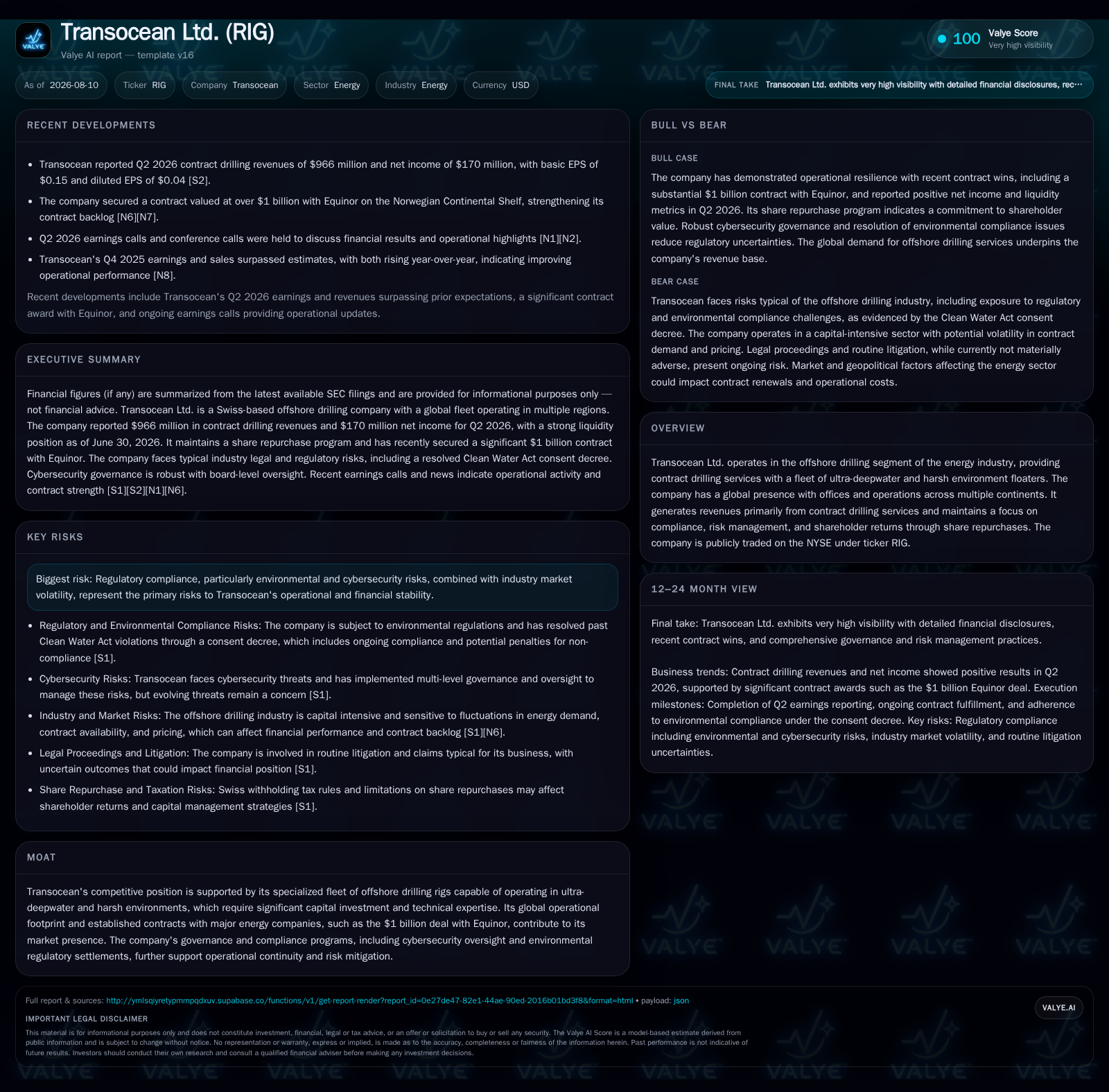
Transocean Ltd. reported a solid second quarter anchored by its ultra-deepwater drillships and harsh environment semisubmersibles fleet. Recent contract wins, including a $1 billion agreement with Equinor, underpin near-term revenue visibility and highlight the company's competitive moat rooted in technical expertise and specialized assets. However, market volatility, regulatory compliance—particularly environmental and cybersecurity risks—and the capital-intensive nature of offshore drilling remain key challenges. The company’s financial profile shows steady liquidity but high leverage consistent with industry norms. Transocean’s ability to maintain rig utilization and dayrates, while managing operational and compliance risks, will be crucial for sustaining profitability and growth.
Recent Operating Update
Transocean Ltd.’s latest quarterly report filed August 7, 2026, reaffirms its position as a leading provider of offshore contract drilling services through ownership or partial interests in 27 mobile offshore drilling units—comprising 20 ultra-deepwater drillships and seven harsh environment semisubmersibles [S2]. This fleet mix underscores the company’s specialization in technically challenging drilling operations that command premium pricing due to the capital intensity and expertise required.
Notably, Transocean continues adapting to evolving accounting standards with no anticipated material impact on its consolidated financials or operational disclosures in forthcoming quarterly filings starting Q1 2028 [S2]. This signals stable applied financial policies despite ongoing complexity in revenue recognition across long-term drilling contracts.
A critical near-term highlight is the formalization of the over $1 billion contract award from Equinor for operations on the Norwegian Continental Shelf announced earlier this year [N6][N13]. This contract demonstrates strong customer confidence in Transocean’s capability to operate in harsh North Sea conditions and significantly boosts backlog visibility beyond current quarter earnings
Together with the fleet status reports submitted alongside recent SEC filings [S3], these developments reinforce Transocean’s revenue foundation during an upstream oil and gas environment recovering from cyclic market stress.
Business Model Overview
Transocean generates revenue primarily through long-term dayrate contracts where payments are tied to rig utilization rather than direct resource volumes produced. Its customers are predominantly large oil and gas exploration & production (E&P) companies requiring ultra-deepwater wellbore drilling capabilities that many competitors cannot economically match. This model necessitates significant upfront capital expenditure (CapEx) for building or acquiring technologically advanced rigs suitable for harsh environments.
Contracts typically define performance obligations satisfied over time, aligning revenue recognition with active service provision periods rather than discrete milestones—an approach reflective of sustained rig deployment [S2]. Margins depend on maintaining high rig utilization rates, securing favorable dayrates through differentiated fleet assets, minimizing operational downtime, and containing operating expenditures (OpEx) such as maintenance.
The company’s strategic focus involves continuous fleet modernization balanced against rigorous safety standards to reduce incident frequency—a key factor given regulatory enforcement sensitivity around offshore operations. Additionally, Transocean’s global operational footprint spanning North America, Europe (notably Norway), South America, Asia, Africa, and Australia offers diversified exposure but also increases complexity due to varying geopolitical risks and regulatory regimes.
Industry Structure and Competitive Position
Operating within the offshore oil & gas drilling services sector places Transocean among peers such as Noble Corporation and Diamond Offshore Drilling—both specializing in deepwater drilling solutions. In this capital-intensive segment characterized by long contract tenors and stringent environmental compliance requirements, scale and technological differentiation are crucial competitive moats.
Transocean’s fleet of ultra-deepwater drillships commands higher average dayrates relative to semisubmersible rigs due to enhanced versatility in deeper waters. Its investment in harsh environment units also positions it favourably for premium contracts demanding specialized rigs capable of operating under extreme climatic conditions.
Compared with peers who may have smaller or less modernized fleets, Transocean benefits from established relationships with major energy producers—as exemplified by its sizeable Equinor deal—which can support renewal probabilities and limit pricing pressure.
Monitoring contract renewal trends post completion of existing agreements alongside dayrate pricing movements will offer critical insight into future margin sustainability.
What To Watch Next
Key milestones that will shed light on Transocean’s trajectory include:
- Quarterly updates on rig utilization rates disaggregated by fleet type will help assess revenue momentum linked to customer demand cycles.
- Progress reports regarding mobilization timelines for contracted rigs under new deals like the Equinor arrangement will indicate execution efficiency.
- Financial disclosures of margins achieved on recent contracts relative to historical averages will reflect pricing power amid competitive dynamics.
- Any developments pertaining to environmental litigation outcomes or cybersecurity incidents could materially affect risk profiles.
- Capital expenditure announcements focused on refurbishments or expansions of the rig fleet will signal commitment to sustaining technological advantages.
- Renewals or extensions of major customer contracts beyond current backlog horizons will serve as barometers of ongoing client trust.
Financial Profile Discussion
Transocean's balance sheet as of June 30, 2026 shows cash & equivalents totaling approximately $509 million against total debt nearing $5.11 billion—a net debt position around $4.6 billion reflective of heavy investment commitments typical within offshore drilling [F1][S2]. Despite this leverage, a current ratio of approximately 1.59 indicates sufficient short-term asset coverage over liabilities providing moderate liquidity cushion [F1].
Interest expense levels remain manageable aided by credit facilities indexed to Term SOFR plus negotiated margins ranging from 0.375% up to 1%, depending on credit ratings—a structure supporting cost-effective borrowing within a challenging sector landscape [S2]. Scheduled principal repayments are monitored carefully against available cash balances per secured credit facility terms to avoid early maturity triggers [S2].
In comparison with peers such as Noble Corporation or Diamond Offshore Drilling—who face similar capital deployment imperatives—Transocean maintains competitive leverage ratios enabled by sizable backlog commitments but must vigilantly manage refinancing risk particularly under possible commodity price shocks or regulatory expenditure uncertainty.
This analysis is based solely on publicly available information as cited herein including SEC filings up to August 7, 2026 ([S1],[S2],[S3]), company facts datasets ([F1]), and supplementary financial news sources (). It does not constitute investment advice but aims to provide a comprehensive industry-aligned perspective grounded in verified data.
Disclaimer: This is research-only, informational analysis and not investment advice. It may include AI-generated interpretation and general industry context. Always verify important details using primary sources.

Comments