
Spectrum Brands Advances Pet Care and Home & Garden Growth Despite Personal Care Headwinds
Q3 2026 results highlight segment disparities, tariff impacts, and transformation efforts shaping Spectrum Brands’ operating outlook.
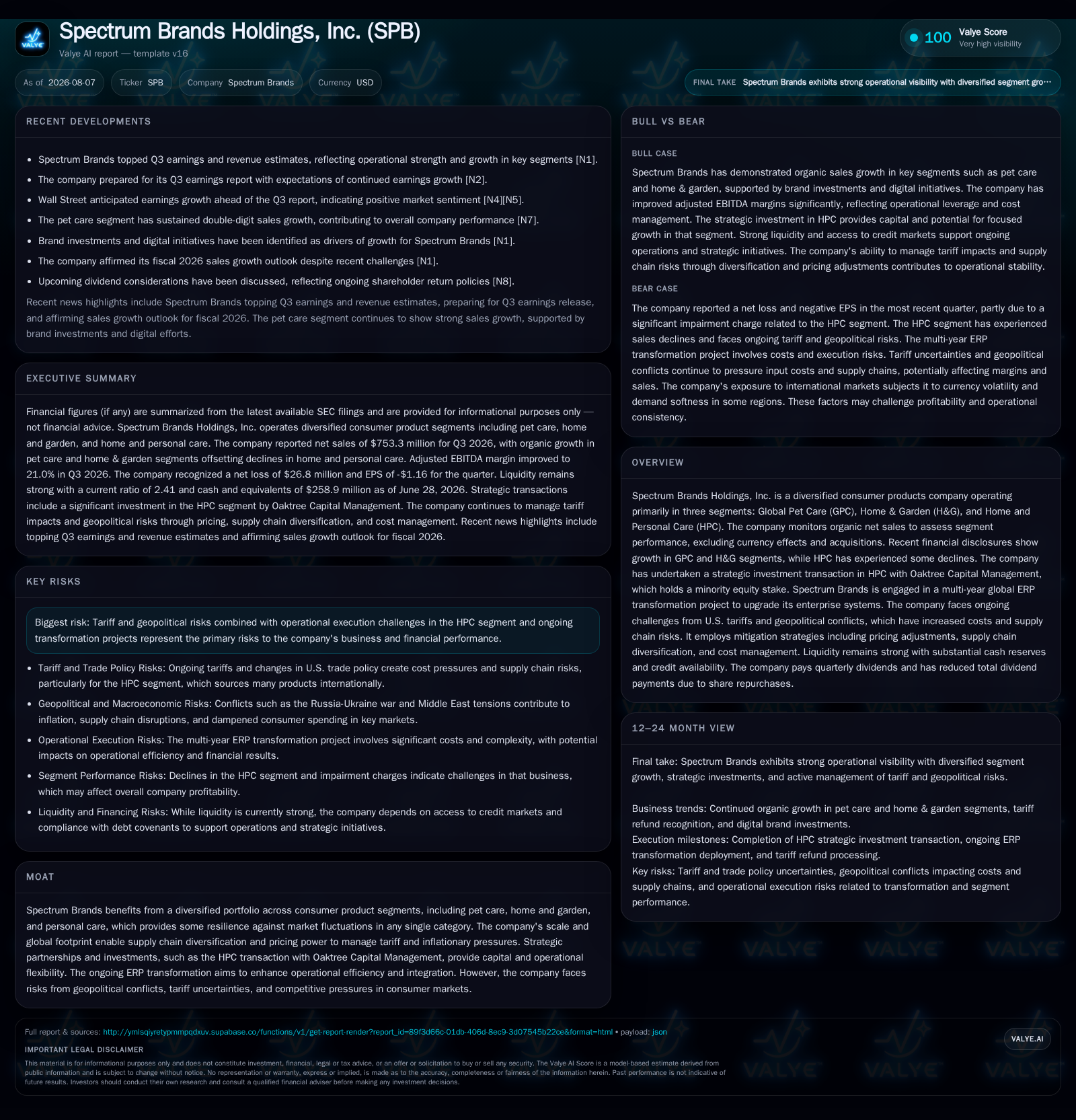
In Q3 2026, Spectrum Brands Holdings, Inc. delivered a solid operating performance driven by strong organic net sales growth in its Global Pet Care (GPC) and Home & Garden (H&G) segments, while its Home and Personal Care (HPC) segment faced revenue declines amid tariff and geopolitical challenges. The company is leveraging strategic minority investments and an extensive ERP transformation to enhance operational efficiency and resilience. However, ongoing supply chain risks and competitive consumer markets continue to pressure its personal care business. Monitoring segment-level organic growth and ERP milestones will be crucial for assessing the sustainability of recovery efforts.
Recent Operating Update
Management flagged that tariffs imposed by the U.S., alongside geopolitical conflicts disrupting raw material availability and logistics, have increased input costs particularly for HPC products. To mitigate these impacts, Spectrum has been implementing pricing strategies and expanding supply chain diversification efforts which are beginning to stabilize margins but have yet to fully offset inflationary effects [S2]. Additionally, the company disclosed a strategic minority equity investment transaction with Oaktree Capital Management in the HPC segment, enabling capital inflow while supporting operational turnaround initiatives [S1], [S3].
An important part of management’s longer-term strategy is the ongoing multi-year global Enterprise Resource Planning (ERP) transformation aimed at upgrading technology infrastructure across all segments. This initiative targets tighter operational integration, streamlined inventory management, and improved data analytics capabilities to enhance decision-making speed and cost control [S1]. However, large-scale ERP deployments carry execution risks that warrant monitoring given their complexity.
Business Model
Spectrum Brands operates as a diversified consumer products company spanning three core segments: Global Pet Care (GPC), Home & Garden (H&G), and Home and Personal Care (HPC). Its revenue generation hinges on designing, marketing, manufacturing, and distributing branded products primarily through wholesale distribution channels complemented by retail partnerships including mass merchandisers specialty stores, and e-commerce platforms [S1]. The company measures performance via organic net sales—a metric adjusted for currency fluctuations and excluding acquisitions—to isolate underlying operational momentum [S2].
Margins are influenced by product mix dynamics within each segment alongside factors like promotional intensity, channel distribution shifts toward higher-margin e-commerce versus wholesale bulk sales, inventory turnover efficiency, as well as raw material cost volatility driven partly by tariffs [S2], [N11]. The diversified brand portfolio across these three categories helps buffer against demand shocks or competitive pressures concentrated in a single category. For example, faster growth in pet care and home improvement offsets softness experienced in personal care.
Pricing power varies notably across segments; pet care commands relatively stable pricing due to strong brand loyalty among consumers spending on premium pet nutrition or accessories whereas HPC faces more elastic demand subject to retailer promotional programs and competitive private label pressures. Thus, HPC’s margin profile is inherently more volatile limiting operational leverage especially under cost inflation scenarios.
The involvement of Oaktree Capital Management as a minority investor in HPC introduces new capital resources paired with governance support expected to accelerate turnaround actions including portfolio rationalization or potential innovation investments [S3]. Moreover, active supply chain diversification—geographically spreading sourcing away from high-tariff regions—aims at reducing exposure to geopolitical risk while shortening lead times.
Industry Structure and Competitive Position
Spectrum Brands operates within the diversified consumer products industry characterized by mature markets where scale brands compete on innovation quality distribution breadth, price competitiveness plus marketing effectiveness. Its peers include broadly diversified firms such as Newell Brands or Helen of Troy which similarly balance varying segment concentrations between pet care specialty products home goods or personal care items.
Compared with these peers, Spectrum’s strength lies in its balanced segment exposure combining two fast-growing categories —pet care benefiting from secular increases in pet ownership trends—and home & garden riding on sustained home improvement activity [N1], [N11]. However it trails some competitors regarding personal care scale resulting in lower pricing leverage over private labels or niche specialty brands.
The complex global supply chains servicing this industry face heightened risks from trade policy uncertainty particularly U.S.-China tariffs affecting raw material input costs such as plastics or chemicals used extensively across all three segments. Companies’ ability to pass through these costs without sacrificing volume or market share directly influences adjusted EBITDA margins.
A key differential factor is successful deployment of ERP systems that unify information flow from procurement production to sales enabling leaner inventories faster new-product introductions better promotional planning which peers without modernized platforms find challenging under tightening economic conditions.
Growth Drivers
Spectrum's primary sources of growth lie rooted in several secular consumer behavior patterns coupled with strategic initiatives:
- Pet Ownership Expansion: The GPC segment capitalizes on increasing pet adoption rates globally alongside premiumization trends where consumers demand higher-quality food or wellness products driving organic sales growth.
- Home Improvement Trends: Rising consumer spending on home renovation fuels H&G demand buoyed by innovation in garden tools pest control outdoor furniture categories reflected in double-digit segment sales growth this quarter.
- E-Commerce Channel Growth: Shifting channel mix toward direct online sales yields higher margins from reduced intermediaries providing volume uplifts when executed effectively.
- Brand Investments: Reinforcing brand equity via marketing campaigns digital engagement programs enhances customer retention limiting promotional discount dependency improving sell-through rates.
- ERP Transformation: Operational efficiency gains from enterprise system improvements reduce inventory carrying costs accelerate time-to-market for new launches thus supporting top-line growth sustainability.
- Strategic Capital Infusion: The minority stake acquired by Oaktree Capital provides funds earmarked for innovation or restructuring enabling faster response to competitive challenges particularly in HPC.
New product launches within pet care nutrition formulas or H&G smart gardening tools represent tactical levers that if successful could further drive incremental sales beyond prevailing category secular demands.
Risks and Watchpoints
Several key risks could inhibit Spectrum’s ability to sustain recent momentum:
- Tariff & Geopolitical Risk: Continued or expanded trade tensions could inflate COGS further pressuring gross margins unless mitigated by price actions or supply diversification that may dampen volume or elevate logistics expenses.
- ERP Implementation Execution: Delays budget overruns or functional setbacks during this major IT upgrade could disrupt operations or divert management attention leading to suboptimal cost savings realization impacting EBITDA margin trajectory.
- HPC Segment Volatility: Intense competition from private labels discount retailers limits pricing power; combined with tariff cost burdens creates margin compression potential leading to earnings variability.
- Consumer Demand Shifts: Changes in preferences away from legacy brands due to health trends lifestyle changes require continual innovation investment; failure here risks eroding market share.
- Channel Mix Complexity: Balancing wholesale large retail accounts versus emerging e-commerce channels remains challenging especially ensuring inventory turns align with retailer expectations without excess promotional giveaways diluting margins.
- Raw Material Price Fluctuations: Commodity cost spikes add unpredictability affecting profitability if not passed through effectively;
- Currency Exchange Rate Exposure: Sales outside the U.S. subject to forex volatility complicate financial comparability requiring prudent hedging policies.
Monitoring adjustments in promotional intensity alongside sell-through rates per channel provides insight into pricing power efficacy as well as inventory health signaling consumer reception trends early.
What To Watch Next
Key forthcoming milestones include:
- Sequential quarterly organic net sales comparisons across all three segments focusing on HPC recovery signs amid tariff headwind easing.
- Adjusted EBITDA margin trends elucidating operating leverage gains particularly post partial ERP rollout phases.
- Updates on supply chain diversification progress measured through lead times reduction supplier count expansion aiding cost containment.
- Additional capital partnerships or asset rationalizations primarily targeting underperforming HPC units revealing management’s strategic commitment fidelity.
- New product launch announcements feeding into innovation pipeline vitality tracking sustained consumer engagement levels beyond traditional legacy portfolios.
Taken together these indicators will clarify whether internal transformation efforts plus external market conditions will enable durable volume gains translating into profitable earnings progression consistent with industry peer benchmarks.
Financial Profile Discussion
As of June 28, 2026, Spectrum Brands held approximately $259 million in cash and equivalents against current liabilities of $622 million, yielding a current ratio near 2.41 times indicative of reasonable short-term liquidity coverage relative to working capital needs [F1]. Adjusted EBITDA margins remain the preferred metric for evaluating underlying profitability excluding non-core charges; however, specific recent margin figures were not detailed within the filing excerpts accessed so close observation of future disclosures is warranted particularly given cost inflation pressures noted [S2]. Effective capital allocation balancing debt amortization, funding long-term ERP investments, and selective brand portfolio enhancements will be critical to sustaining financial health enabling competitive agility amid operational headwinds currently faced by the company.
Disclaimer: This is research-only, informational analysis and not investment advice. It may include AI-generated interpretation and general industry context. Always verify important details using primary sources.

Comments