
Host Hotels & Resorts Strengthens Earnings on RevPAR Growth Amid Rising Operating Costs
Luxury lodging REIT reports solid Q2 2026 performance with robust room rate increases despite margin pressures from wage inflation.
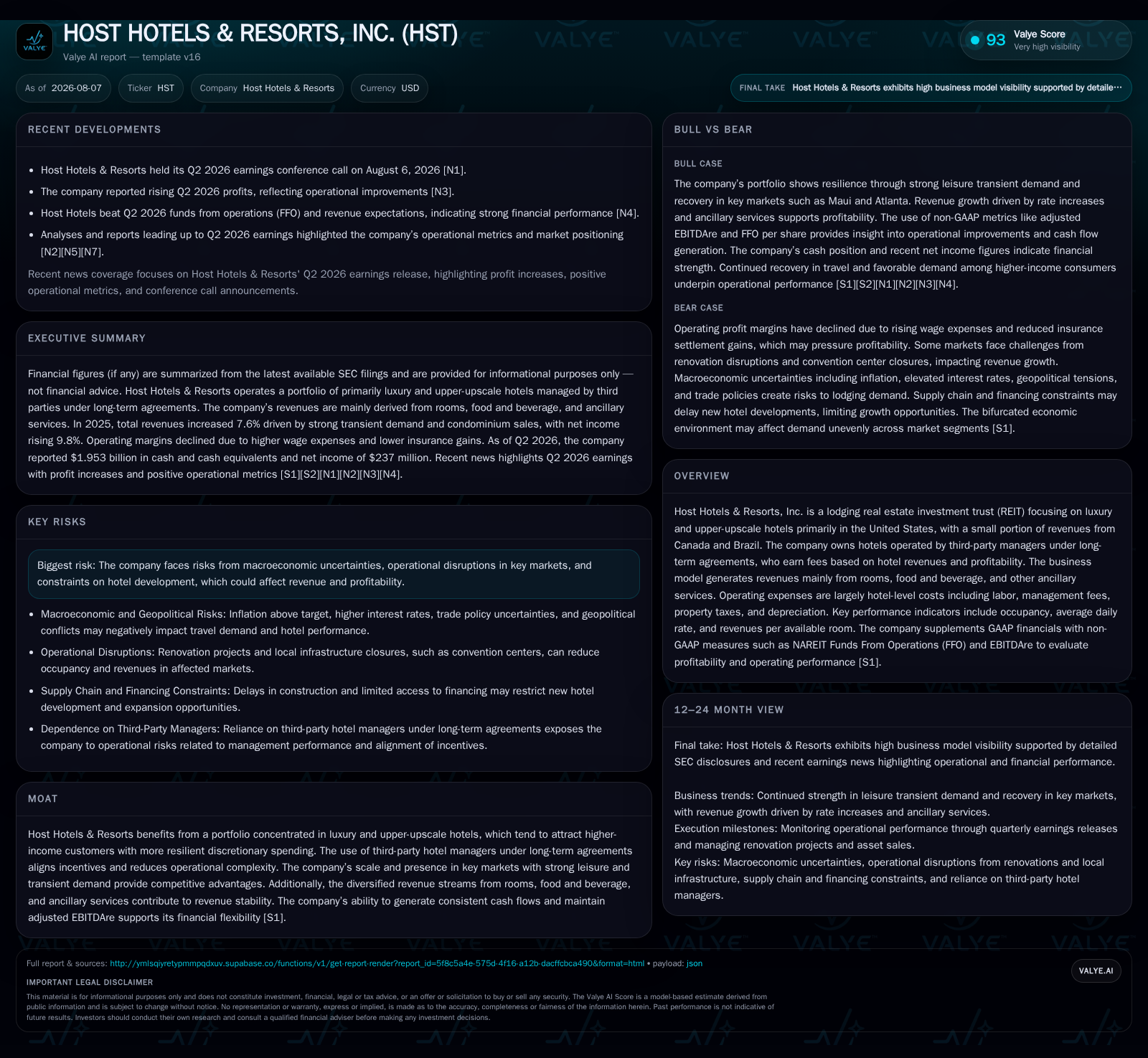
Host Hotels & Resorts, Inc. (HST) posted a strong Q2 2026 operating update with favorable trends in key lodging metrics such as occupancy and RevPAR, underpinning improvements in revenue and Funds From Operations (FFO). The company’s portfolio, concentrated in luxury and upper-upscale hotels primarily across U.S. markets, leverages third-party management agreements driving stable fee income and cash flow. Rising labor expenses and other operating costs exerted pressure on margins, yet adjusted EBITDAre showed moderate growth compared to prior periods. The REIT’s capital structure remains leveraged but supported by healthy liquidity. Looking ahead, recovery in transient travel demand and ancillary revenue growth are critical drivers, while macroeconomic uncertainties and labor cost inflation pose ongoing risks.
Recent Operating Update
Host Hotels & Resorts released its Q2 2026 results via an 8-K filing dated August 5 [S3] and a subsequent 10-Q on August 7 [S2], reporting robust operating momentum across its portfolio of luxury and upper-upscale hotels. The company's key performance indicators — notably occupancy rates and Average Daily Rate (ADR) — showed sustained improvement compared to prior quarters. This translated into higher Revenue Per Available Room (RevPAR), the critical metric that drives hotel revenue generation.
The portfolio's RevPAR growth reflected both rate increases driven by strong transient demand segments and recovery progress following prior disruptions such as wildfires impacting the Maui market. Additionally, food & beverage revenues increased alongside rooms revenue, supported by group events and outlet operations at hotels [S1]. These trends contributed to total hotel revenues that constitute approximately 98% of company-wide income.
Operating expenses climbed during the quarter primarily due to upward wage pressures linked to labor market tightness intrinsic to the hospitality sector, as well as elevated service delivery standards [S2]. Despite these cost headwinds squeezing hotel-level operating margins modestly—evidenced by a slight decline in comparable hotel EBITDA margin—the company reported improved adjusted EBITDAre overall, indicating that top-line strength offset much of the margin compression.
Management fees from third-party operators under long-term contracts constituted an important revenue component [S1]. Base fees tied to gross hotel revenues plus incentive fees linked to profitability align operator incentives with owners’ financial objectives. These contractual structures help stabilize Host Hotels' cash flows even as operational volatility affects individual hotel earnings
Business Model Overview
Host Hotels & Resorts operates principally as a lodging real estate investment trust (REIT) owning predominantly luxury and upper-upscale hotels across North America—primarily the United States with select assets in Canada and Brazil [S1]. The REIT owns the real estate but outsources daily operations to established third-party hotel managers through long-term agreements that detail compensation based on revenue tiers and profitability targets.
Revenue generation centers around three streams: rooms rentals (60% of hotel revenues), food & beverage sales (30%), and ancillary services including resort fees, parking, spas, entertainment (~10%) [S1]. This diversified revenue mix tempers volatility associated with dependence solely on room sales. Occupancy rates drive volumes for rooms-related sales while ADR reflects pricing power—and both contribute directly to RevPAR.
Operating expenses happen at the property level encompassing labor (notably significant in housekeeping, food service, front desk), utilities, management fees paid to operators (base plus incentive structures), property taxes, maintenance capex for upkeep or renovations, depreciation, among others [S1]. These cost elements are sensitive to local labor market dynamics and can rise sharply with inflationary pressures or competitive service differentiation requirements.
Financially, Host monitors non-GAAP measures tailored for REIT analysis including Funds From Operations (FFO) which adjusts GAAP net income by excluding non-cash items like depreciation on real estate assets — providing a clearer picture of cash-generating capability [S1]. Adjusted EBITDAre further refines profitability by excluding gains/losses on asset sales or insurance settlements.
Industry Structure and Competitive Positioning
Lodging REITs specializing in upscale segments dwell near the capital-intensive end of real estate investment due to high asset valuations coupled with substantial operational complexity requiring experienced third-party managers. Host Hotels competes alongside peers such as Park Hotels & Resorts and Sunstone Hotel Investors who share similar portfolios concentrated in premium brands.
The company's scale—owning over 70 luxury urban hotels—and geographic diversification anchor its competitive advantage. Locations span gateway cities with sustained leisure tourism appeal (e.g., New York City, Maui) as well as business convention hubs benefiting from transient corporate travelers [S1]. The reliance on third-party operators allows Host Hotels to focus on asset allocation and financing strategy while leveraging specialist operational capabilities.
Pricing power stems from brand affiliation (many properties operate under Marriott, Ritz-Carlton flags), location desirability, event calendars influencing demand spikes, and limited new supply in constrained urban markets. This supports upward pressure on ADRs even amid cyclical economic fluctuations. Ancillary services further differentiate offerings creating multiple avenues for revenue per guest beyond rooms alone.
Growth Drivers
Host Hotels’ near-term growth depends heavily on sustained economic expansion fueling increased business travel expenditure alongside leisure travel recovery post-pandemic disruptions. Particularly supportive are transient bookings—the pay-as-you-go segment less prone to cancellations than group bookings—driving average daily rates higher [S1][S2]
Portfolio optimization through selective acquisitions (e.g., recent full-year contributions from properties like the 1 Hotel Nashville) enhances scale economies [S1]. Strategic dispositions also enable redeployment into higher-return assets or debt reduction.
Renovation-led repositioning at key hotels can unlock pricing power uplift though temporarily dampening occupancy during refurbishment phases—as observed at Austin markets previously impacted by convention center closure plans [S9]. Enhancements in management contracts that boost incentive fee earnings tied closely to EBITDA margins provide incremental upside revenue streams.
Expansion of ancillary revenues such as resort fees or F&B offerings taps into better monetization per guest stay which augments resilience against pure room-rate fluctuations. Additionally technological improvements—upgrading booking platforms or guest service experiences—increase direct bookings reducing dependence on third-party distribution channels which carry commission costs.
Risks and Constraints
Host Hotels faces inherent sector cyclicality exposed to broader macroeconomic trends including GDP growth rates which influence both business travel budgets and discretionary leisure spending [S1]. Periods of recession pose risks of reduced occupancy and downward pressure on ADRs.
Labor cost inflation remains a salient concern given hospitality's high-touch nature; increasing wages compress margins absent commensurate rate hikes or efficiency gains. Furthermore regulatory risks—such as environmental compliance or ADA-related litigation—impose additional operating expenditures or capital investments [S1].
Dependence on third-party managers introduces counterparty risk; misalignment or performance shortfalls at operating firms could impact net operating incomes shared with Host Hotels. Also geopolitical events or travel restrictions can disproportionately disrupt international inbound flows affecting key coastal urban properties.
Competition from alternative lodging platforms like Airbnb poses longer-term structural headwinds altering traveler preferences especially among younger demographics seeking novel experiences or lower-priced accommodations.
Capital allocation is constrained by considerable leverage levels—approximately $5.14 billion in total debt against $1.95 billion cash balances as of mid-2026—which limits financial flexibility if adverse conditions persist [F1]. Interest rate volatility influences refinancing costs necessitating prudent debt management.
What to Watch Next
Investors should closely track quarterly occupancy trends across major metro areas along with ADR trajectories given their determinative role on RevPAR growth—a barometer for top-line momentum [S2].
Monitoring contributions from incentive management fees will illuminate how well operators convert gross revenues into profitability aligned with Host's returns. Insights into capital expenditure pacing will reveal the company's commitment toward asset rejuvenation versus preserving dividend capacity.
Updates regarding macroeconomic conditions impacting corporate travel budgets amidst ongoing geopolitical tensions remain critical due diligence factors influencing medium-term demand sustainability.
Any announcements about balance sheet refinancings or changes in dividend distribution policy will also merit attention given interest expense implications within a rising rate context.
Financial Profile Discussion
As of June 30, 2026, Host Hotels held $1.95 billion in cash and equivalents providing liquidity support amid sector volatility [F1]. Total indebtedness stood near $5.14 billion as of December 31, 2025 [F1], resulting in net debt approximating $3.19 billion when accounting for available cash balances.
Debt covenants impose operational constraints limiting additional borrowing without satisfying leverage thresholds or coverage ratios which tempers expansion flexibility but aligns with prudent risk management protocols given industry cyclicality [S7]. Planned capital expenditures include renewal investments critical for maintaining brand standards yet require careful balancing against available free cash flow sustaining dividends and corporate costs.
In sum, Host Hotels navigates complex capital demands inherent to luxury lodging assets leveraging its scale advantages while propping up liquidity buffers essential amid unpredictable macro-travel dynamics.
This analysis synthesizes SEC disclosures through August 7, 2026; no speculative forecasts have been included beyond explicit company communications. It aims to provide an informed view of Host Hotels & Resorts’ operational performance within the lodging REIT sector framework without offering investment advice.
Disclaimer: This is research-only, informational analysis and not investment advice. It may include AI-generated interpretation and general industry context. Always verify important details using primary sources.

Comments