
Greenlight Capital Re Strengthens Position with A-Rating and Diverse Growth Channels
Greenlight Capital Re reported improved underwriting income and enhanced capital strength in Q2 2026, leveraging a multi-line portfolio and strategic investments amid mixed reinsurance market dynamics.
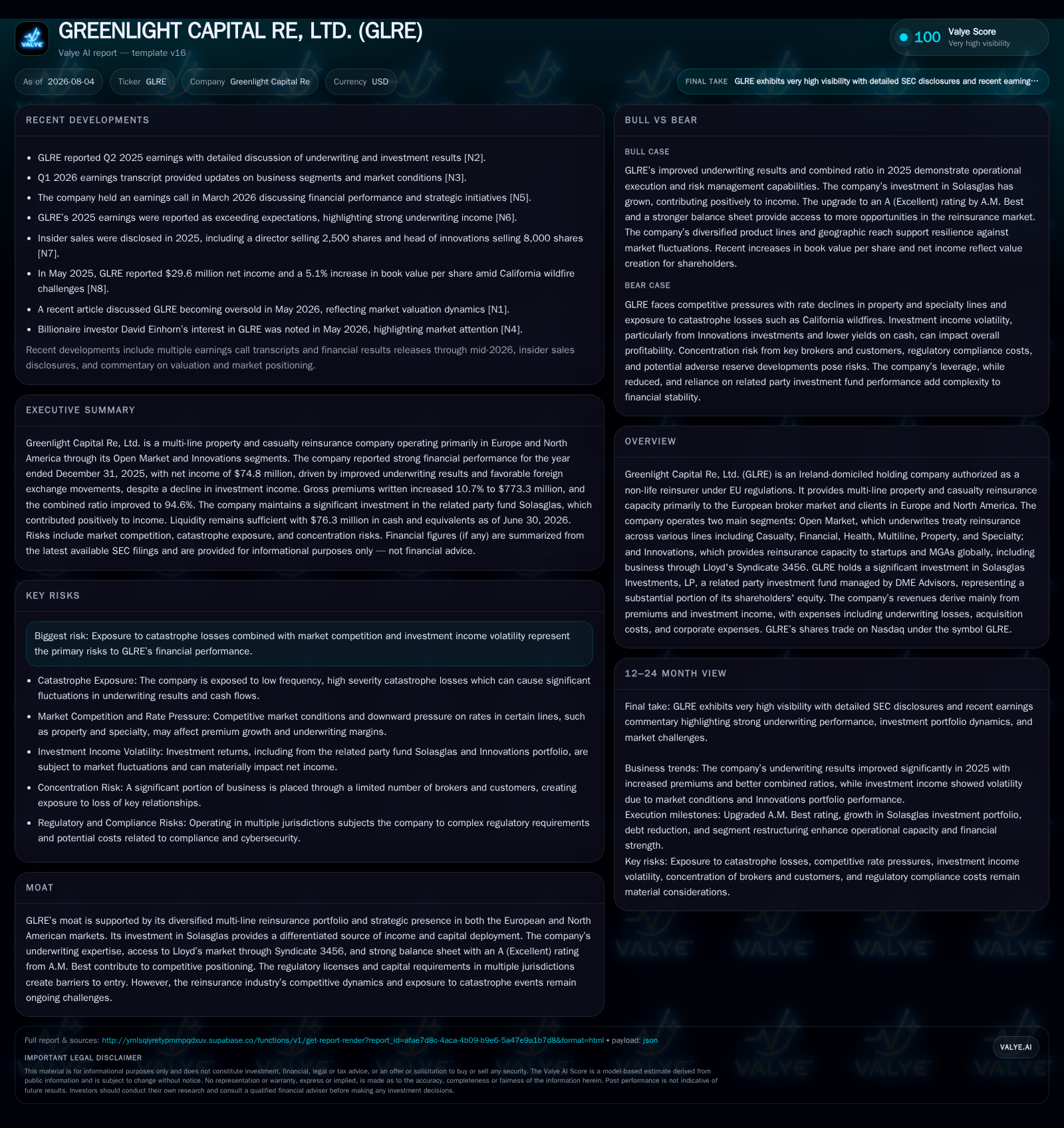
In its latest quarterly filing dated August 4, 2026, Greenlight Capital Re demonstrated resilient underwriting performance with net underwriting income turning positive alongside ongoing competitive pressures in property and casualty reinsurance segments. The company’s dual-segment model—comprising Open Market multi-line treaty reinsurance across Europe and North America and an Innovations unit focused on MGAs and startups through Lloyd’s Syndicate 3456—delivers diversified revenue streams that mitigate risk volatility. Notably, the recent upgrade to an A (Excellent) rating by A.M. Best underscores strengthened capital adequacy supporting growth initiatives. Looking ahead, the company faces typical industry challenges including catastrophe loss unpredictability and investment income fluctuations, while strategic capital deployment and pricing discipline remain key focus areas.
Quarterly Operating Review: Underwriting Results and Market Dynamics Shift
g trends [S1]. The combined ratio improvements underline GLRE’s execution capability amid intensifying competition within European broker markets where it operates primarily.
Diverse Underwriting Portfolio Drives Risk-Adjusted Revenue Streams
GLRE’s business model features two distinct segments that together foster diversification across risk types, geographies, and distribution channels. The Open Market segment provides multi-line treaty reinsurance products primarily in property and casualty lines including Casualty, Financial, Health, Multiline, Property, and Specialty risks delivered mainly into the European broker market with spillover capacity servicing North American clients [S1]. Revenues here arise from gross premiums written under reinsurance treaties negotiated with cedents who transfer portions of their insurance risks.
Complementing this foundation is the Innovations segment which underwrites specialized risks for emerging MGAs and startups worldwide via Lloyd’s Syndicate 3456. This syndicate-in-a-box model offers GLRE a foothold into alternative distribution models gaining market traction across specialty segments marked by rapid innovation demand. The Lloyd’s platform confers access advantages including capital efficiency and established operating infrastructure crucial for serving MGAs who often require bespoke facultative or programmatic solutions at scale.
Together these segments generate revenues from traditional underwriting profits supplemented by investment income chiefly from GLRE’s significant interest in Solasglas Investments LP—a related party investment fund managed by DME Advisors, itself an affiliate of Chairman David Einhorn [S1]. This affiliation ensures alignment between investment strategy and insurance liabilities while providing a differentiated source of earnings beyond pure premium leverage effects
Competitive Moat Enhanced by Elevated A.M. Best Rating and Multi-Jurisdictional Licenses
The company’s recent upgrade to an "A (Excellent)" rating from A.M. Best serves as a key competitive differentiator enhancing its capacity to secure larger premium volumes in a market where creditworthiness heavily influences cedent counterparty choices. This rating reflects not only current capital adequacy but also the firm’s consistent execution profile across underwriting cycles supported by robust risk management controls [S2][S1]. Regulatory licenses held in Ireland (GLIL) underpin European market access; meanwhile, subsidiary entities domiciled in the U.K., Cayman Islands, and the U.S.—including Greenlight Re Corporate Member Ltd.—support participation in global risk exchange platforms like Lloyd’s syndicates.
These multilayered jurisdictional approvals function as natural barriers against new entrants lacking similar capital buffers or compliance frameworks while enabling retrocession strategies that optimize balance sheet usage without sacrificing growth ambitions.
Growth Catalysts: Leveraging Innovation Segment and Lloyd’s Platform Access
Growth momentum for GLRE hinges on expanding its footprint within the growing MGA channel globally alongside leveraging proprietary data analytics capabilities embedded within its Innovations segment. With rising demand for specialty coverages—such as cyber liability, parametric products linked to climate risks, or novel casualty subclasses—the company’s Syndicate 3456 offers scalable underwriting solutions tailored to emergent client needs beyond vanilla treaty reinsurance.
The January 2026 renewal cycles evidenced more robust opportunities for sustaining rate framework integrity in Innovations despite overall market softness elsewhere [S1]. Additionally, GLRE notes increasing effectiveness from retrocession facilities that enhance its ability to adjust portfolio exposures dynamically while preserving capital ratios critical under Solvency II regimes affecting EU operations.
This dual reliance on traditional multi-line offerings combined with agility in newer underwritten risks through MGA partnerships positions GLRE distinctly relative to peers focusing solely on legacy treaty books or lacking Lloyd’s syndicate participation.
Risk Exposure: Catastrophe Volatility, Reserve Adequacy, and Capital Buffers Under Scrutiny
GLRE remains exposed to typical P&C reinsurer risks including large-loss volatility driven by catastrophe (CAT) events such as hurricanes or seismic activity. Management highlights inherent uncertainties surrounding loss reserve estimation amplified in reinsurance due to claim reporting delays and diverse treaty structures [S1]. Although reserve strengthening has historically been moderated by positive prior year development trends improving earnings quality relative to peers who often face adverse loss development surprises, continued vigilance over claim reserves is indispensable given potential material earnings impacts.
Climate change considerations add further complexity as frequency/intensity patterns evolve unpredictably potentially undermining historical actuarial models underpinning pricing adequacy [S1]. Retrocessional arrangements act as a mitigating tool but depend on counterparties’ credit quality—a factor continuously assessed due diligence wise
What Will Shape Investor Sentiment Next: Monitoring Pricing Trends, Claims Development, and Strategic Capital Deployment
Investor focus will likely center on upcoming renewal season pricing signals especially around casualty lines where GLRE has seen gains offsetting property rate declines; any sustained erosion in premium rates could pressure future combined ratios given expense baselines [S2]. Progress on loss development surveillance will be a key barometer for underwriting reserve adequacy and potential charge-ins.
Additionally noteworthy is the August 4 share repurchase agreement entered with an affiliate of Chairman Einhorn aimed at stabilizing his ownership level amidst ongoing buybacks—this governance move mitigates tax inefficiencies arising from ownership concentration shifts thereby supporting long-term shareholder value alignment.[S3] Capital deployment strategy balancing share repurchases versus incremental investments into Solasglas or expanded syndicate capacity will be revealing regarding management confidence in organic growth opportunities versus returning excess capital.[S3]
Financial Profile Discussion: Balance Sheet Resilience Supports Expansion Plans
At quarter-end June 30, 2026, Greenlight Capital Re held approximately $76.3 million in cash equivalents with effectively zero debt reported at year-end 2025 indicating a net cash surplus position capable of funding near-term growth initiatives without liquidity constraints.[F1] The upgraded financial strength rating reinforces solvency positioning enabling access to cost-efficient credit facilities if needed,[S17] though current leverage remains negligible fostering financial flexibility uncommon among midsized reinsurers reliant on bank debt facilities.
Combined ratios have improved reflecting better attribute mix tuned toward casualty lines exhibiting less loss volatility than property; investment income contributions remain significant albeit challenged somewhat by lower yields recorded recently within related party funds.[S23] The diversification benefits derived from blending underwriting profit streams with affiliated fund returns enhance comprehensive profitability sustainability compared with reinsurers dependent solely on cyclical premium spreads.
Disclaimer: This is research-only, informational analysis and not investment advice. It may include AI-generated interpretation and general industry context. Always verify important details using primary sources.

Comments