
SUI Group Navigates Rising Credit Risk and Liquidity Challenges in Digital Asset Treasury
SUIG’s recent quarterly filing highlights escalating credit risk from a distressed loan to Mustang Funding amid a complex portfolio of SUI tokens, illiquid minority investments, and regulatory uncertainties. The company’s liquidity constraints and concentrated exposures signal heightened operational risks in a volatile digital asset environment.
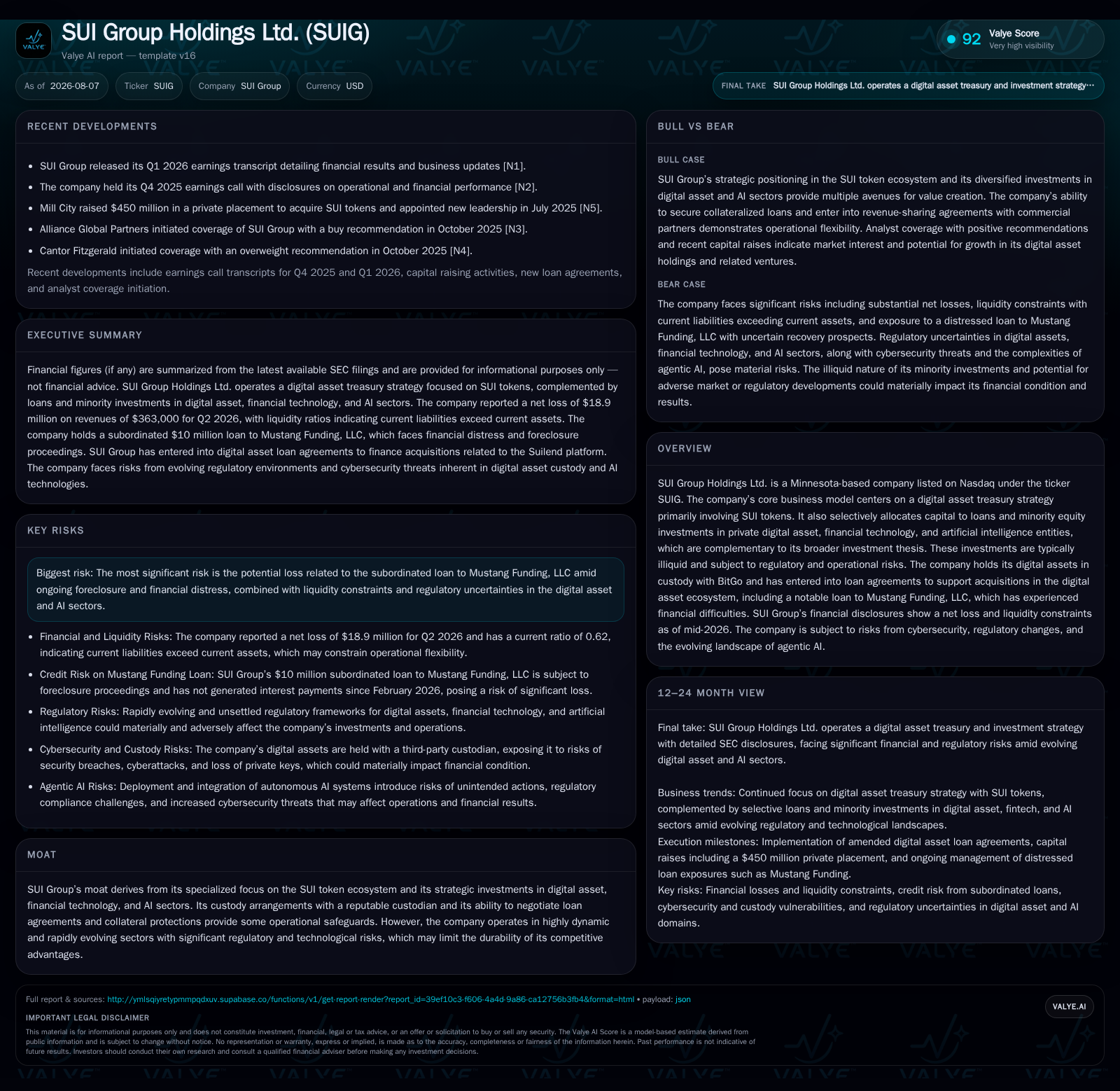
SUI Group Holdings Ltd.’s August 2026 10-Q reveals growing concerns over credit losses linked to its subordinated loan to Mustang Funding, LLC, which is in financial distress and undergoing foreclosure proceedings. The firm’s capital allocation balances staking rewards from a concentrated SUI token treasury with illiquid minority equity investments in fintech and AI sectors. While BitGo custody enhances security for the digital asset holdings, it does not mitigate market volatility or credit risks. SUIG’s weak current ratio of 0.62 underscores liquidity pressures exacerbated by potential impairments, setting a cautious outlook as the company manages loan repayment uncertainties and evolving regulatory challenges [S2][S3][F1].
Rising Credit Risks from Mustang Funding Loan Pressure
The latest 10-Q filing from August 2026 reveals that SUIG’s subordinated loan to Mustang Funding, LLC has become a significant source of portfolio risk. Mustang Funding is currently experiencing financial distress and facing foreclosure proceedings, raising the prospect of impaired recoveries or write-downs against this credit exposure [S2][S3]. This situation underscores the operational challenge of managing illiquid credit positions within a digital asset investment framework traditionally focused on liquid token holdings.
The lack of clarity on timing and magnitude of repayments disrupts cash flow predictability and undermines net asset value (NAV) stability. This concentrated credit risk also exemplifies the broader vulnerabilities faced by smaller digital asset investment firms extending loans secured by crypto-related collateral amid volatile market conditions.
Balancing Staking Rewards with Illiquid Minority Investments
SUIG’s business model hinges on a digital asset treasury heavily weighted towards SUI tokens that generate staking rewards—yield derived from participation in network consensus mechanisms—which contributes a recurring revenue stream tied directly to token market performance [S1][S2]. However, this income is inherently variable due to fluctuating token prices.
Alongside staking revenue, SUIG pursues strategic minority equity stakes in fintech and AI startups considered complementary to its core thesis [S28]. These investments are characterized by illiquidity due to transfer restrictions and lack of controlling interests, which limits SUIG's ability to influence operations or realize near-term gains. This duality between liquid staking returns and locked private equity stakes imposes tension on liquidity management and capital allocation decisions.
Custody Arrangements Enhance Security but Not Market or Credit Risk Mitigation
SUIG utilizes BitGo as its third-party custodian for digital assets, leveraging institutional-grade security protocols critical for safeguarding against cyber threats common in cryptocurrency management [S1]. While this custody framework reduces operational risk related to theft or hacking, it does not shield the firm from broader market volatility affecting token valuations nor credit risks stemming from troubled loans or private investments.
Unlike some peers that combine custody with active exchange or trading platforms—such as Coinbase Global—SUIG’s reliance on custodial services is narrowly focused on secure storage rather than transactional revenue generation.
Competitive Positioning Highlights Concentration Risks Relative to Peers
Within the digital asset investment ecosystem, firms like Galaxy Digital deploy diversified strategies encompassing direct crypto holdings alongside merchant banking activities including lending platforms, thereby spreading risk across multiple asset classes. In contrast, SUIG operates on a smaller scale with concentrated exposure particularly evident in its Mustang Funding loan.
Its approach blending digital asset treasury management with selective minority investing in fintech/AI startups aligns loosely with venture capital practices but lacks accompanying control or liquidity features typical in early-stage venture investing. This positions SUIG uniquely compared to public treasury-focused companies such as MicroStrategy that maintain primarily liquid bitcoin holdings without similar illiquid stakes.
Growth Drivers Amid Regulatory Complexity
SUIG’s growth thesis rests on increasing institutional adoption of blockchain ecosystems that utilize SUI tokens, which potentially expands staking reward opportunities. Additionally, emerging fintech and AI startups seeking capital provide supplementary investment avenues aligned with innovation trends.
However, these growth prospects are counterbalanced by evolving regulatory landscapes: money transmission laws impacting fintech entities; nascent AI-specific legislation such as the EU Artificial Intelligence Act; and other jurisdictional compliance complexities introduce operational challenges that can affect portfolio valuations and exit options [S28].
Transfer restrictions on private minority stakes further constrain liquidity during periods of market stress.
Key Risks: Liquidity Strains and Regulatory Uncertainty
Liquidity emerges as an acute concern given SUIG’s reported current ratio of approximately 0.62 at June 30, 2026—indicating that current liabilities materially exceed current assets [F1]. This imbalance limits financial flexibility to meet near-term obligations without external capital or successful monetization events.
Delays or defaults in loan repayments from Mustang Funding exacerbate liquidity pressures. Concurrently, regulatory uncertainties surrounding investments in fintech and AI sectors pose risks to valuation stability and operational licensing requirements.
Monitoring improved liquidity ratios through enhanced cash inflows or loan recoveries will be critical alongside clearer regulatory guidance that could ease compliance burdens.
Outlook: Monitoring Operational Metrics for Stability Signals
Investors should closely watch forthcoming quarterly results for updates on:
- Loan impairment provisions related to Mustang Funding credit exposure [S2][S3],
- Variations in staking reward yields tied to SUI token market dynamics,
- Regulatory developments impacting fintech/AI investees that may affect valuation assumptions,
- Strategic portfolio reallocations aimed at mitigating credit concentration risks or enhancing liquidity. These indicators will provide insight into SUIG’s ability to navigate short-term stresses while positioning for long-term growth within an evolving blockchain-fintech-AI ecosystem.
Financial Profile Discussion: Liquidity Constraints Amplify Operational Leverage Risks
This financial profile reflects operational leverage risks intensified by ongoing net losses largely driven by investment impairments linked to troubled loans such as Mustang Funding [F1]. The combination of volatile digital asset valuations and illiquid private investments heightens unpredictability around cash flow generation.
It does not constitute investment advice. Readers should conduct their own due diligence._
Disclaimer: This is research-only, informational analysis and not investment advice. It may include AI-generated interpretation and general industry context. Always verify important details using primary sources.

Comments