
SpyGlass Pharma Advances Late-Stage Development of Sustained-Release Glaucoma Therapy Amid Patent Litigation and Capital Needs
SpyGlass Pharma focuses on its BIM-IOL System for sustained bimatoprost delivery, progressing clinical trials but faces intellectual property disputes and funding demands.
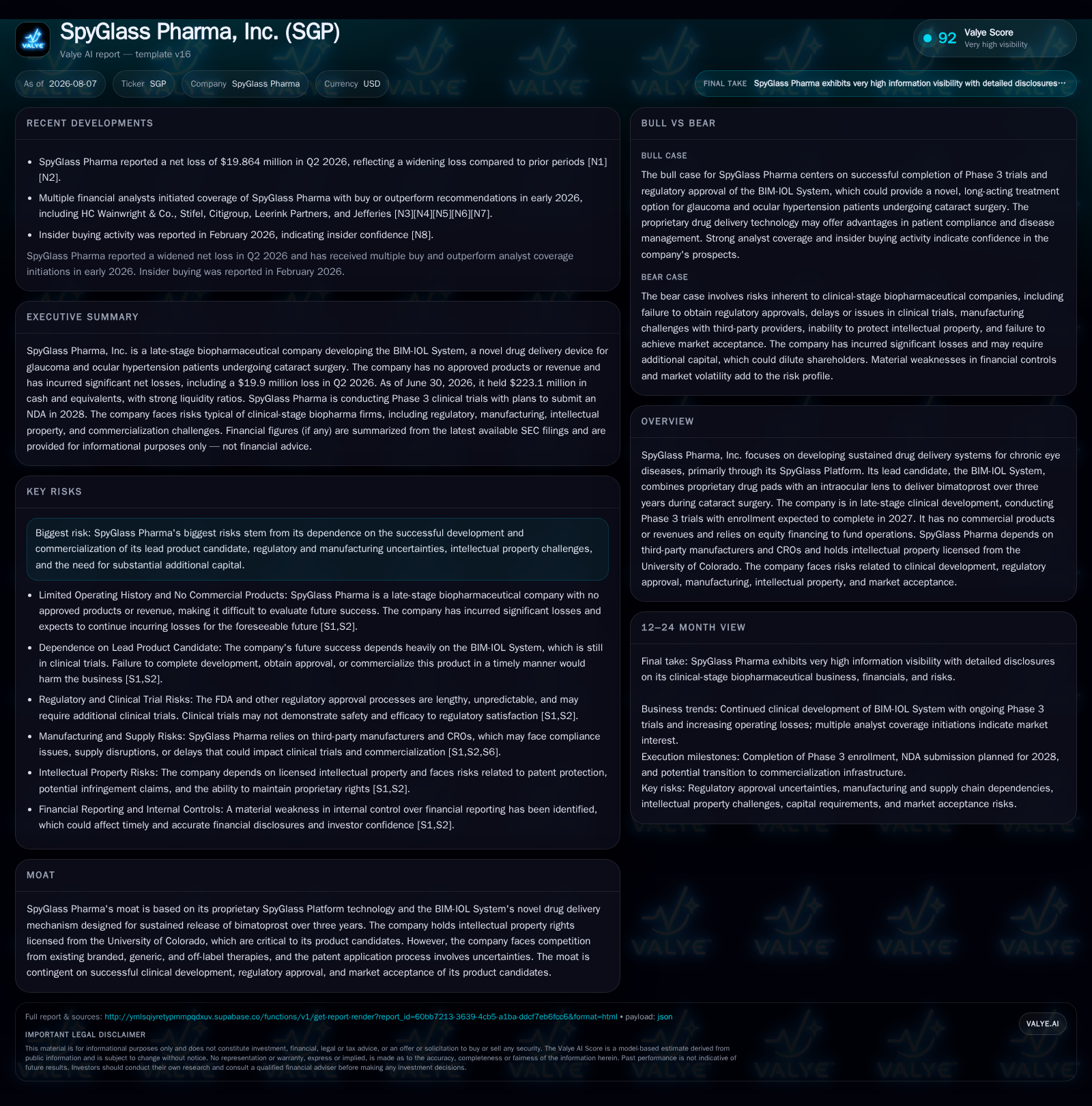
SpyGlass Pharma operates in the biotechnology ophthalmic drug delivery sector, advancing its proprietary BIM-IOL System designed to deliver bimatoprost over three years during cataract surgery. The company recently reported continued clinical progress with Phase 3 enrollment on track for completion by 2027 and maintains strong cash liquidity following its February 2026 IPO. However, SpyGlass faces risks including ongoing patent litigation initiated by Glaukos Corporation, intense competition from established glaucoma therapies, and reliance on third parties for manufacturing and clinical trial execution. Success hinges on timely regulatory approval, efficient capital deployment, and securing market acceptance by cataract surgeons integrating treatment into existing workflows.
Recent Operating Update: Clinical Progress and Legal Developments
SpyGlass Pharma’s latest quarterly filing dated August 6, 2026 reported continued advancement of its lead product candidate, the BIM-IOL System. This proprietary system integrates a novel drug pad delivering bimatoprost with an intraocular lens implanted during routine cataract surgery. The company commenced two registrational Phase 3 clinical trials in July 2025, targeting a combined enrollment of approximately 800 patients across about 45 sites, with anticipated enrollment completion by 2027 [S1], [S2]. These trials embed SpyGlass firmly in the late-stage development phase — traditionally a critical inflection point where successful efficacy and safety data strongly impact valuation and strategic options.
In parallel with clinical progress, SpyGlass disclosed ongoing patent infringement litigation filed by ophthalmic device competitor Glaukos Corporation in September 2025. Glaukos alleges trade secret misappropriation relating to intellectual property central to SpyGlass’s technology platform [S1], [S4]. The case involves claims under the federal Defend Trade Secrets Act as well as California unfair competition laws with potential remedies including injunctions and damages. The court denied preliminary injunction motions in December 2025 but ordered forensic review procedures. Such IP disputes are customary for emerging biotech firms relying on licensed technologies but represent material legal risk that could delay commercialization or impose costly settlements.
Business Model: Leveraging Sustained Drug Delivery in Ophthalmology
SpyGlass’s business model revolves around proprietary sustained-release drug delivery technology — branded the SpyGlass Platform — focused on chronic eye diseases like open-angle glaucoma (OAG) and ocular hypertension (OHT). Its BIM-IOL System delivers bimatoprost, a prostaglandin analog (PGA) long approved as a topical IOP-lowering agent since 2001. By embedding drug pads on an intraocular lens (IOL) replacing the natural lens during cataract surgery, the system delivers continuous therapy over approximately three years without patient-administered drops [S1]. This approach targets two interconnected pain points: poor patient adherence to daily eye drops and limited glaucoma treatment uptake during cataract procedures.
Revenue generation will initially rely on bringing this system through Phase 3 trials, gaining FDA approval via a streamlined 505(b)(2) New Drug Application reflecting the prior approval of bimatoprost itself. Post-approval, SpyGlass plans to commercialize independently or via partnerships targeting ambulatory surgery centers (ASCs), where routine cataract surgeries are performed [S1]. The system is positioned to expand treatment beyond specialized surgeons trained in micro-invasive glaucoma surgery (MIGS), democratizing intervention at standard cataract surgeries — potentially tripling surgeon participation in IOP management through existing procedural workflows [S1].
Margins will initially be negative due to heavy R&D spending without commercial sales; however, embedding therapy into a common surgery theoretically reduces incremental procedural costs and supports pricing power anchored on therapeutic durability and patient convenience advantages. Operationally, volume growth depends on ASCs’ adoption rates and successful reimbursement negotiations — pivotal factors influencing market penetration.
Industry Structure and Competitive Position
The ophthalmic sustained drug delivery field is competitive with established branded topical PGAs like Lumigan® (bimatoprost), generic equivalents, off-label treatments, as well as emerging implantable devices from companies such as Glaukos Corporation and Aerie Pharmaceuticals. SpyGlass distinguishes itself primarily via the integration of drug delivery with IOL implantation during cataract surgery — a high-volume procedure exceeding millions annually in the U.S.—thus leveraging an existing touchpoint rather than standalone injections or implants.
This device-drug combination approach aims to address drawbacks like poor patient adherence prevalent in topical therapies while offering superior convenience compared to MIGS or other invasive procedures that require additional surgical training or clinic visits. Intellectual property licensed from the University of Colorado anchors this differentiation but is vulnerable to challenges highlighted by ongoing litigation with Glaukos [S1], [S4]. SpyGlass also outsources key components such as contract research organizations (CROs) for clinical trials and contract manufacturing organizations (CMOs) for product supply — standard industry practice yet introducing dependency risks related to scale-up capacity and quality control.
Growth Drivers
SpyGlass’s growth prospects hinge largely on several core drivers:
- Phase 3 Trial Enrollment & Success: Completion of enrollment by end-2027 is critical for moving towards FDA submission targeted for 2028 [S1]. Positive efficacy/safety outcomes confirming sustained IOP reduction (~36%-37% mean reduction demonstrated in early trials) would validate the platform’s therapeutic premise.
- Regulatory Approval Trajectory: Utilizing the FDA's 505(b)(2) pathway leverages existing safety data of bimatoprost, potentially shortening review time versus de novo therapies.
- Surgeon Adoption: Integration into routine cataract surgery routines aimed at increasing use beyond specialists trained in MIGS addresses a significant untapped market segment.
- Patient Adherence Improvements: Demonstrated independence from daily topical drops may drive hospital systems’ preference for durable solutions reducing follow-up burden.
- Expansion Pipeline: Development of a ring-shaped drug delivery implant for standalone use post-cataract or retreatment markets broadens potential indications [S1].
- Strategic Partnerships: Potential licensing or co-commercialization deals may accelerate market penetration leverage manufacturing or distribution synergies.
Risks and Watchpoints
Notwithstanding promising attributes, SpyGlass absorbs typical late-stage biotech risks amplified by specific factors:
- Clinical Trial Risks: Failure to meet safety/efficacy endpoints could derail regulatory plans; long enrollment timelines may delay milestones.
- Intellectual Property Uncertainty: The trade secret lawsuit with Glaukos introduces uncertainty regarding freedom-to-operate which could result in injunctions or royalty liabilities impacting profitability.
- Manufacturing Scale-Up: Reliance on third-party CMOs necessitates stringent quality assurance; delays here can cascade into launch timing setbacks.
- Capital Intensity & Dilution Risk: Despite a strong cash position post-IPO, operating losses continue with no revenue stream; additional capital raises may cause shareholder dilution [S2], [F1].
- Regulatory Hurdles & Market Acceptance: Even after approval, reimbursement policies, pricing pressures, competitive generic alternatives, or reluctance among surgeons could limit uptake.
- Legal & Compliance Exposure: Operating in a highly regulated environment exposes SpyGlass to compliance costs tied to healthcare laws including anti-kickback statutes affecting commercialization models [S13].
What to Watch Next
Investors and industry watchers should monitor:
- Quarterly updates documenting Phase 3 enrollment pacing relative to mid-term goals expected through late 2027.
- Progression of FDA interactions preceding NDA submission planned for calendar year 2028.
- Outcomes or material developments in Glaukos litigation affecting intellectual property rights clarity.
- Announcements around commercialization strategy refinement including potential partnerships or licensing agreements.
- Updates on manufacturing scale ramp-up capabilities ahead of anticipated commercial launch timelines.
- Financial disclosures outlining burn rate adjustments against cash runway projections beyond current horizon estimates through at least mid-decade [S2], [F1].
Financial Profile Discussion
SpyGlass holds robust liquidity compared with typical pre-commercial biotech peers given its recent February 2026 IPO proceeds totaling $172.5 million gross plus pre-existing cash reserves. As of June 30, 2026, cash and equivalents stood at $223 million with current assets at roughly $236 million against minimal current liabilities near $9.4 million — yielding an exceptionally strong current ratio above 25x [F1]. This buffer supports substantial R&D activities including expensive Phase 3 trial execution anticipated over multiple years.
Operating losses persist as expected for this stage; accumulated deficit reached $104.7 million by end-2025 reflecting ongoing investment in platform development without product revenues [S1], [F1]. Future capital requirements will depend heavily upon trial progression pace and potential commercialization costs post-regulatory approval as outlined historically but remain manageable within current liquidity forecasts extending through at least 2028 barring unforeseen setbacks [S14], [F1].
This financing profile generally parallels peer ophthalmic biotech companies advancing innovative sustained-delivery implants poised for first approvals but underscores dependency on equity financing trends typical before revenue generation begins.
This analysis relies exclusively on information derived from SpyGlass Pharma's regulatory filings issued through August 6, 2026 ([S1]-[S3]), supported by contemporaneous financial snapshots ([F1]) and sector-standard industry context informed by ophthalmic drug delivery biotechnology frameworks. It does not incorporate speculative forward-looking market estimations nor investment research views but aims at elucidating operational fundamentals shaping SpyGlass's trajectory amid evolving development milestones and external risk factors.
Disclaimer: This is research-only, informational analysis and not investment advice. It may include AI-generated interpretation and general industry context. Always verify important details using primary sources.

Comments