
TFS Financial Advances Mortgage Portfolio Growth with Strengthening Funding and Risk Controls
Q3 2026 results reveal robust loan origination growth supported by diverse funding sources and prudent risk management amid interest rate pressures.
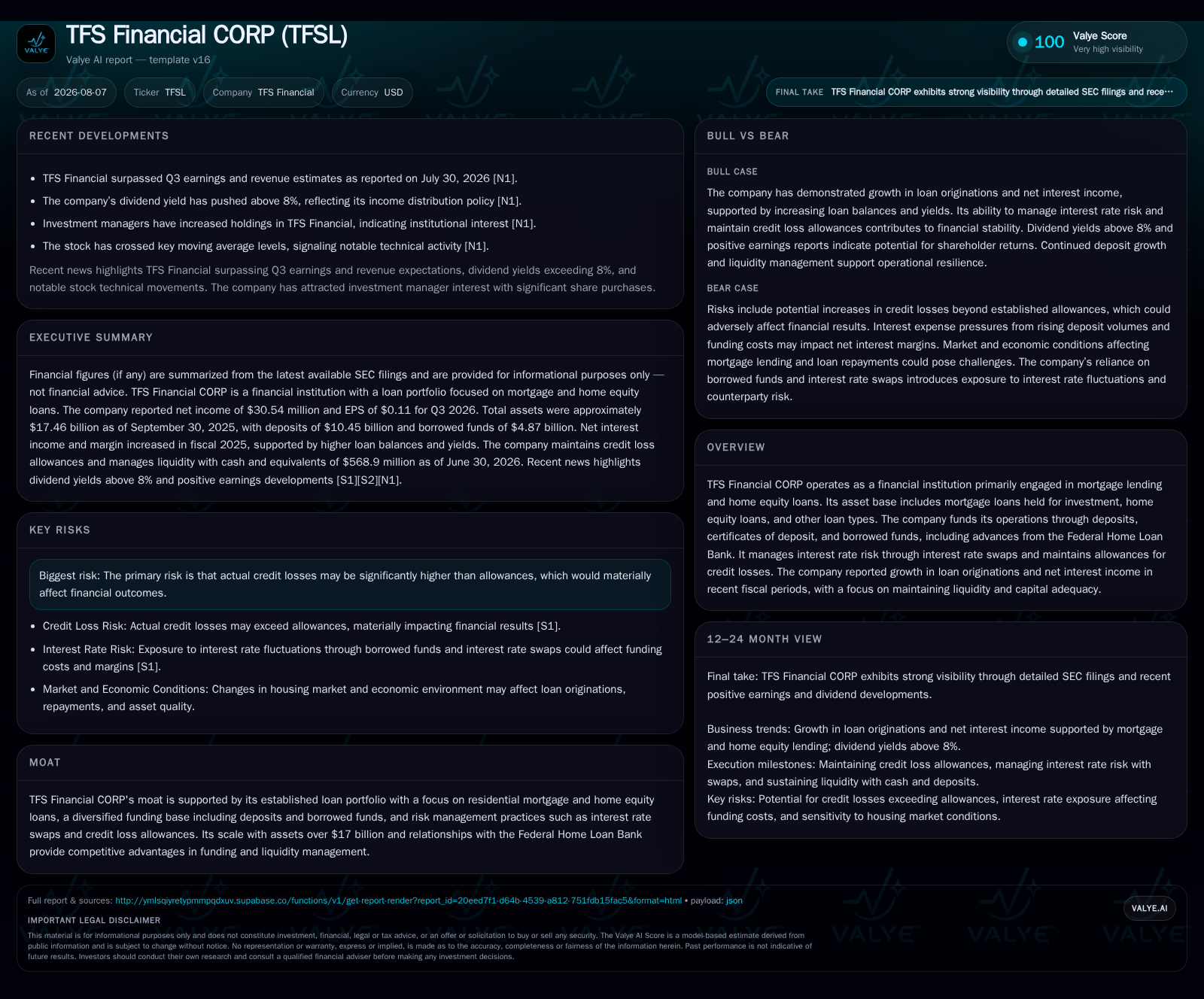
TFS Financial CORP reported marked expansion in mortgage and home equity loan originations in the latest quarter, reflecting resilience despite a challenging interest rate environment. The company’s diversified funding mix—highlighting both deposits and Federal Home Loan Bank advances—underpins liquidity stability, while disciplined credit loss allowances and active use of interest rate swaps mitigate key risks. Comparisons with regional peers confirm TFSL’s competitive positioning in controlling credit risk and managing funding costs. Investors should monitor forthcoming credit quality trends and refinancing demand shifts as principal risks to near-term growth.
Q3 Loan Originations Scaling Within a Shifting Interest Rate Environment: Operational Evidence & Implications
In its Q3 2026 filing, TFS Financial CORP (TFSL) demonstrated a meaningful uptick in loan originations, particularly in residential purchase mortgages and adjustable-rate loan products, underscoring sustained asset growth despite an evolving interest rate backdrop [S2], [S1]. During the prior annual period ending September 30, 2025, first mortgage originations totaled approximately $1.19 billion with nearly 90% classified as purchase transactions and around 11.5% adjustable-rate loans — indicative of a disciplined underwriting focus favoring higher-credit-quality borrowers over refinance volume which typically contracts in rising rate phases [S1]. This quarter-to-quarter continuation of healthy origination activity drives incremental net interest income by expanding the portfolio of mortgage loans held for investment.
This volume growth has strategic significance. Mortgage lending institutions like TFSL generate core revenue predominantly through the net interest income spread between interest earned on these loans versus cost of funds. Hence, originations directly increase earning assets — subject to underwriting quality which governs future credit loss risk. The increased share of purchase loans may signal more structural demand driven by housing market dynamics rather than refinancing demand cyclical shifts. However, rising interest rates could eventually dampen refinancing inflows unless offset by shifts in borrower credit profiles or product features such as adjustable-rate structures.
Balanced Funding Mix Anchors Liquidity Management Amid Market Cost Pressures
Backing its expanded loan portfolio, TFSL maintains a balanced liability structure combining customer deposits — including demand deposits and certificates of deposit — with wholesale funding accessed through Federal Home Loan Bank (FHLB) advances [F1], [S2]. As of June 30, 2026, cash and equivalents stood at $568.9 million while total debt approximated $2.47 billion, resulting in net debt near $1.9 billion — a leverage footprint typical for regional savings associations engaged predominantly in mortgage lending [F1]. This blend provides both stability from core deposit bases less sensitive to rate volatility and flexibility from FHLB borrowings used strategically for liquidity management or portfolio expansion.
Effective liquidity management is critical given ongoing market cost pressures on deposits driven by competitive local banking markets and broader monetary policy tightening. Certificates of deposit tend to carry higher fixed costs than demand deposits but offer predictability in funding availability. FHLB advances provide an efficient complement allowing TFSL to optimize its funding mix dynamically without over-reliance on any single source.
Peer savings institutions similarly leverage FHLB advances as standard practice; hence TFSL's diversified approach aligns well within sector norms reducing funding concentration risks that can raise refinance or withdrawal vulnerabilities during adverse conditions.
Credit Quality Profile: Allowance Coverage And Emerging Risks In The Loan Portfolio
TFSL's allowance for credit losses has been maintained prudently relative to loan balances held for investment, reflecting careful underwriting standards and ongoing portfolio surveillance [S1], [S2]. Nonetheless, regulatory caution persists regarding potential underestimation risks given macroeconomic uncertainty which could stress borrower repayment capacity or depress collateral values especially if housing markets soften.
The company’s disclosures explicitly acknowledge that actual credit losses may exceed established reserves materially, an important risk factor that could prompt quarterly earnings volatility or capital drawdown if realized losses escalate beyond forecast thresholds [S1]. Monitoring metrics like delinquency rates segmented by mortgage type (fixed-rate vs adjustable-rate), note seasoning profiles, and geographic concentrations will provide essential confirmation signals about reserve adequacy ahead.
Compared to regional bank peers nuanced similarly exposed to residential mortgages — such as those emphasizing home equity loans — TFSL appears aligned in deploying cautious provisioning strategies without aggressive reserve building which can depress short-term returns but preserves capital buffer integrity.
Hedging Dynamics: Interest Rate Swaps Usage Reflecting Sector Best Practices
In response to inherent interest rate risk stemming from fixed- versus floating-rate asset/liability mismatches characteristic of mortgage lenders, TFSL employs a robust program of interest rate swap contracts designed to hedge variable cash flow exposures impacting net interest margin stability [S1], [S2]. These derivatives effectively convert portions of fixed-rate asset earnings into floating rates or offset increases in liability costs thereby smoothing earnings fluctuations resultant from market rate gyrations.
The scale and designation of these swaps conform to sector norms among peer regional lenders who rely heavily on such instruments as fundamental risk mitigation tools amid historically volatile rate regimes. The efficacy of this approach lies not only in limiting downside margin compression but also supporting more predictable financial planning horizon facilitating balanced capital allocation.
'Loan Sales & Servicing': Supplementary Revenue Streams Maintaining Earnings Resilience
While primary revenue derives from net interest income on loans held for investment, TFSL supplements profitability modestly through loan sales gains, servicing fee income, and securitization proceeds documented in its noninterest income line items [S1], [S2]. Though quantitatively smaller compared with core net interest earnings, these ancillary streams contribute valuable diversification benefits by offsetting cyclicality inherent in mortgage origination volumes.
Their presence reflects effective capital recycling strategies enabling TFSL to optimize portfolio composition dynamically while extracting value across the mortgage lifecycle — consistent with practices observed across specialized savings institutions competing within the same value chain segment.
Sector Positioning: Regional Peers Comparison Highlights Strengths And Areas To Monitor
Against peer benchmarks such as regional banks Riverview Bancorp or Citizens Community Bancorp known for sizable residential mortgage portfolios, TFSL matches favorably on loan growth trajectory and shows comparable diligence on credit quality monitoring as evinced by allowance levels aligned closely with portfolio risk profiles [N2], [N3]. Its diversified funding base inclusive of robust FHLB advance utilization positions it well relative to peers increasingly challenged by deposit cost inflation.
TFSL's methodical use of hedging derivatives further underscores a competitive moat not universally embedded within smaller community lenders who might lack analogous scale or expertise. However, emerging uncertainties around changing refinancing demand patterns amid rate volatility present a common challenge across the peer group warranting close observation.
'Watchpoints' On Credit Loss Uncertainty And Refinancing Demand Shifts Ahead Of Guidance Release
Going forward into Q4 2026 and beyond, two principal risks dominate the near-term outlook: first, potential upward revisions in actual credit losses surpassing current provision buffers could induce capital strain and earnings volatility given the concentration in residential-related mortgages; second, evolving refinancing activity influenced heavily by prevailing interest rate levels may dampen new originations volume or shift product mix affecting yields.
Regulatory developments or localized housing market downturns could exacerbate these pressures requiring adaptive management responses seen already in allowance recalibrations or incremental hedging adjustments documented recently [S1], [S2]. Monitoring these indicators relative to reported quarterly results will serve as critical milestones confirming sustainability of current growth narratives.
Financial Profile Discussion
As of June 30, 2026, TFSL holds approximately $569 million in cash and equivalents juxtaposed against total debt around $2.47 billion resulting in a net debt position near $1.9 billion — reflecting reliance on manageable leverage typical within the mortgage lending savings institution archetype [F1]. This balance sheet configuration indicates sufficient liquidity runway combined with access to wholesale borrowing facilities supporting both operational demands and strategic investments.
This analysis emphasizes recent operating evidence from TFS Financial's filings illuminating its ability to grow loan originations profitably amidst pressured funding costs while managing credit risks carefully through reserves and derivative hedges consistent with industry best practices. Continued scrutiny on allowance adequacy and refinancing demand evolution is warranted as these variables will critically define performance trajectories going forward within competitive regional banking cohorts focusing on residential mortgages.
Disclaimer: This report is for informational purposes only and does not constitute investment advice or research views.
Disclaimer: This is research-only, informational analysis and not investment advice. It may include AI-generated interpretation and general industry context. Always verify important details using primary sources.

Comments