
Verrica Pharmaceuticals Strengthens YCANTH Sales and Insurance Coverage While Managing Debt Limits
Q2 results highlight growing YCANTH commercialization for molluscum contagiosum alongside secured credit facility constraints and ongoing dermatology pipeline developments.
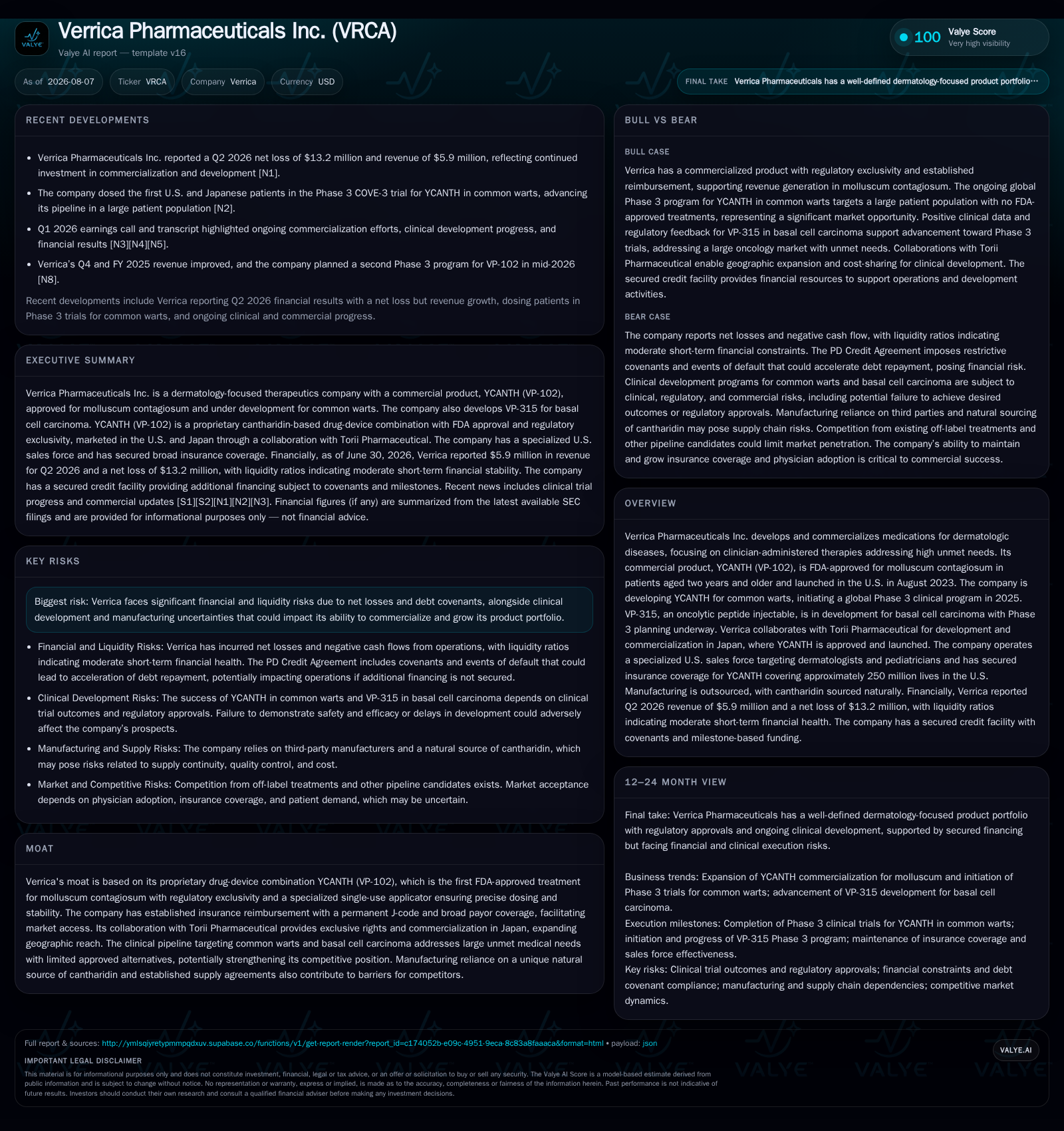
Verrica Pharmaceuticals, focused on dermatologic therapeutics, reported continued commercialization of its FDA-approved drug-device combination YCANTH (VP-102) for molluscum contagiosum with an expanding specialty sales force and broad insurance coverage. The company’s financial position shows constrained liquidity managed through a new secured credit agreement with restrictive covenants tied to YCANTH revenue and cash levels. Verrica’s clinical pipeline includes ongoing development of YCANTH for common warts and VP-315 for basal cell carcinoma, positioning it within a niche biotech dermatology market that relies heavily on regulatory approval, reimbursement, and commercial execution. Key risks include debt covenant compliance, funding R&D pipeline progression, and manufacturing dependencies. Upcoming milestones will center on achieving revenue thresholds, executing clinical trials, and expanding geographic partnerships.
Recent Operating Update: Q2 2026 Results Highlight Commercial Execution Amid New Debt Facility
In its latest quarterly filing dated August 6, 2026 [S2], Verrica Pharmaceuticals detailed progress in its flagship commercial product YCANTH (VP-102), alongside key finance developments underpinning near-term runway. The company has established a focused specialty sales organization comprising approximately 40 representatives as of end-2025 dedicated to pediatric dermatologists, dermatologists, pediatricians, and other selected primary care providers [S1]. Following FDA approval in July 2023 and U.S. launch shortly after [S1], the company continues efforts to expand market access supported by permanent J-code reimbursement that covers around 250 million insured lives nationwide [S1].
To sustain operational funding amid ongoing net losses typical of biotech commercial-stage companies progressing pipeline candidates, Verrica entered into a significant senior secured credit facility on August 3, 2026 with PD Joint Holdings totaling $27.5 million available (initial draw of $12.5 million plus $15 million contingent on hitting specified milestones) [S21]. This facility matures at the end of 2030 but contains customary covenants mandating minimum annual YCANTH revenues and requiring liquidity above $5 million—thresholds tied directly to the core product’s commercial performance [S2]. Failure to meet these covenants or generate sufficient cash flow would risk default triggering acceleration or refinancing difficulties.
The company’s liquidity profile as of June 30, 2026 shows cash reserves of approximately $11.2 million against current liabilities of about $22.4 million for a current ratio of roughly 1.45 [F1], indicating moderate short-term solvency but highlighting continued need for cash generation or financing given operating losses.
Business Model: Clinician-Administered Dermatology Drug-Device Combo with Pipeline Expansion
Verrica’s revenue model hinges on the successful commercialization of YCANTH (VP-102), an FDA-approved drug-device combination delivering a proprietary GMP-controlled cantharidin formulation for molluscum contagiosum treatment across adult and pediatric patients aged two years or older [S1]. Molluscum is a contagious skin disease prevalent primarily in children with limited approved therapies; Verrica estimates over one million annual diagnoses in the U.S., signifying an addressable market exceeding $1 billion [S1]. The product’s unique single-use applicator ensures precise lesion dosing critical for safety and efficacy differentiation versus historically compounded cantharidin products.
Revenue flows derive mostly from product sales through pharmaceutical wholesalers servicing dermatology-focused healthcare providers; this channel requires extensive specialty field efforts to gain physician adoption given historical unmet treatment needs [S1]. Secured insurance reimbursement with a dedicated J-code facilitates payor acceptance critical to patient access, impacting provider prescribing decisions significantly given varied U.S. insurance formularies [S17].
Beyond molluscum treatment, Verrica is advancing YCANTH towards a follow-on indication targeting common warts; global Phase 3 trials are set to commence in 2025 [S1]. This indication expands potential patient population exposure with significant unmet need due to the absence of efficacious approved options.
Complementing this dermatologic focus is VP-315 (ruxotemitide), an injectable oncolytic peptide currently progressing towards registration-directed studies for basal cell carcinoma treatment—an oncology-adjacent therapeutic vertical addressing skin cancers prevalent globally but lacking convenient injectable modalities [S1]. This diversification strengthens Verrica’s pipeline value proposition though remains early-stage.
The company leverages international partnerships such as the collaboration with Torii Pharmaceutical Company granting exclusive rights for development and commercialization of YCANTH in Japan—where it is already approved and launched—highlighting strategic geographic expansion aimed at broadening revenue streams beyond the U.S. domestic market [S1]
Industry Structure & Competitive Position: Niche Dermatologic Biotech with Regulatory Exclusivity & Device Differentiation
Within the biotechnology sector focused on dermatologic therapeutics—a niche combining pharmaceutical science with medical device innovation—Verrica occupies a specialized segment centered on clinician-administered topical formulations of high unmet medical need conditions. Peers include companies like Dermira focusing on specialty dermatologic therapies with dedicated sales forces and Cara Therapeutics developing topical/injectable products.
Verrica’s moat derives from multiple interlocking competitive advantages: regulatory exclusivity secured by FDA granting New Chemical Entity (NCE) designation coupled with patent protection; proprietary drug formulation purity exceeding 99% coupled with GMP-manufactured pharmaceutical API supply [S1]; a unique single-use application device ensuring precise delivery enhancing safety/efficacy profiles relative to legacy compounded alternatives; and permanent J-code facilitating broad third-party payer coverage essential for prescription drug uptake in this fragmented reimbursement landscape [S1][S17].
This combination erects substantial barriers to generic or competitive substitutes especially as alternative treatment options remain scant or unregulated compounded agents. Nevertheless, reliance on a single core FDA-approved product implies substantial concentration risk.
Growth Drivers: Insurance Coverage Expansion, Pipeline Advancement & Global Market Penetration
Key growth vectors include increased patient treatment volumes driven by rising physician awareness facilitated by the established sales force targeting appropriate healthcare professionals treating molluscum contagiosum [S1][S17]. Continued inscription into formularies maintaining or expanding insurance coverage—currently covering an estimated ~250 million U.S. lives—is vital to securing sustainable prescription growth given cost sensitivity in pediatric populations
Late-stage clinical trial progression notably commencing Phase 3 studies for common warts positions Verrica to broaden label indications addressing another sizable dermatologic condition with historically few effective treatments available commercially [S1]. Concurrently, VT-315’s development readies entry into basal cell carcinoma injections representing higher-value oncology-focused therapeutics leveraging new biological modalities [S1].
Clinical trial risks including potential delays or negative data from Phase 3 common wart studies or VP-315 registrations could materially impair future revenue prospects fostering investor uncertainty reminiscent of sector peers encountering late-stage failures.
Operationally, manufacturing depends on sourcing high-purity natural cantharidin processed through contract manufacturers—a possible bottleneck raising supply chain vulnerability concerns given strict regulatory GMP compliance mandates that could hamper capacity scaling or cause regulatory setbacks if eventuated [S1]
Financing risk remains acute as recent filings emphasize liquidity constraints despite new credit facilities drawing attention to restrictive covenants including maintaining minimum cash balances ($5 million) and scheduled repayments linked directly to annual YCANTH revenues—parameters that might limit strategic flexibility if not consistently met amid fluctuating sales [S2][S21]. Failure here raises risk of accelerated repayment demands threatening continuity without alternative capital inflows.
Competitive dynamics pose an indirect threat due to potential off-label use by physicians favoring alternative compounded products if pricing or access hurdles emerge despite insurance coverage—a universal challenge amongst dermatologic specialty biotechs aiming at relatively small patient populations where physician preference heavily influences market share [S17]
What to Watch Next: Regulatory Milestones & Financial Metrics Anchored on Product Performance
Upcoming catalysts include initiation timing and data readouts from global Phase 3 trials for common warts indication anticipated starting mid-2025 reflecting management prioritization toward pipeline-indication expansion [S1]. Positive outcomes would validate platform versatility bolstering market penetration prospects.
Further international commercialization developments stemming from Torii partnerships could generate milestone payments or royalties forming incremental non-U.S revenue underpinning geographic diversification aims announced previously while reducing dependence on sole U.S marketing efforts.
Manufacturing scale responsiveness particularly securing uninterrupted API supply chains compliant with GMP remains important operational KPI indirectly ascertainable via inventory status disclosures or press updates correlated against production adherence timelines.
Financial Profile Discussion
Cash equivalents stood at about $11.2 million as of June 30, 2026 while current assets exceeded current liabilities by approximately $10 million yielding a current ratio of about 1.45—a modest buffer reflecting constrained short-term liquidity tightly managed amid outstanding debt obligations historically at around $3.8 million albeit potentially improved under the new credit agreement terms deploying up to nearly $28 million available upon milestone achievement [F1][S21]
The PD Credit Agreement imposes financial discipline via covenants linking borrowing capacity tightly with delivered YCANTH revenue criticality evidencing external lender scrutiny aligned closely to core product commercial success serving as primary repayment source hence shaping capital allocation priorities toward optimized go-to-market efficacy balanced versus sustained R&D spending pace required for pipeline maturation [S2][S21]
In summary, Verrica's financial profile reflects both opportunities born from newly launched first-in-class treatments combined with risks inherent in running a single-core product operation heavily reliant on clinical progress and successful expansion into new indications supported by complex debt arrangements governing available operational funds.
This analysis synthesizes information from Verrica Pharmaceuticals’ recent SEC filings focusing specifically on their upcoming opportunities alongside inherent sector-specific risks without serving as investment advice.
Disclaimer: This is research-only, informational analysis and not investment advice. It may include AI-generated interpretation and general industry context. Always verify important details using primary sources.

Comments