
Cryoport’s Strategic Expansion and Financial Resilience in Temperature-Controlled Biologics Logistics
Cryoport’s latest quarter highlights operational momentum via portfolio focus and partnerships while managing persistent losses amid capital-intensive supply chain demands.
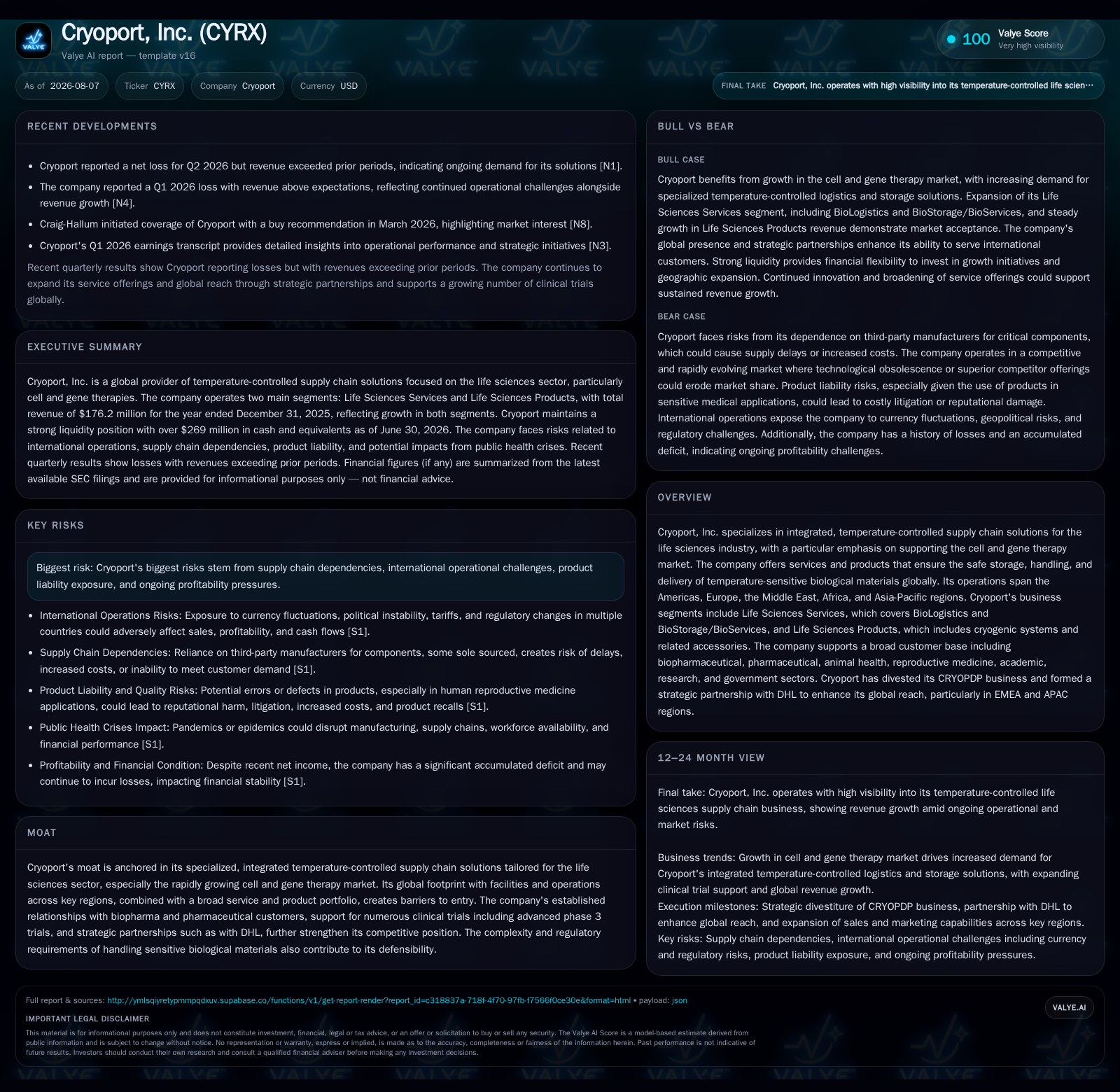
In Q2 2026, Cryoport reported revenue growth surpassing estimates alongside ongoing adjusted EBITDA losses driven by investments in geographic expansion and supply chain capabilities [S2][N1]. The firm’s integrated temperature-controlled logistics model, combining proprietary cryogenic packaging with specialized bio-logistics services, underpins its differentiated positioning in the cell and gene therapy supply chain [S1]. Complex global operations and regulatory compliance create barriers to entry but also expose Cryoport to supply chain and liability risks [S1][S2]. Strategic alliances, notably with DHL, broaden service reach and support service-level agreement (SLA) adherence—key to customer retention in this niche market [S3][N1]. Continued growth will hinge on scaling shipment volumes, minimizing temperature excursion incidents, and expanding cryogenic equipment utilization amid evolving regulatory landscapes. Cryoport maintains a strong liquidity position despite net losses, supporting ongoing investment toward sustainable profitability [F1][S2].
Q2 Operational Update: Revenue Beat Offsets Ongoing Losses Amid Portfolio Refinement
Cryoport’s second-quarter report filed August 6, 2026, reveals a revenue performance that exceeded market expectations even as net losses continued—reflecting the dual reality facing capital-intensive life sciences logistics providers. This uptick in top-line reflects underlying demand resilience across Cryoport's integrated cold chain ecosystem while adjusted EBITDA remained negative as the company pursues investments in expanding its specialized infrastructure and technology platforms [S2][N1]. The divestiture of the CRYOPDP business has streamlined focus on core Life Sciences Services and Products segments without yet shifting the profitability trajectory. Evidently, Cryoport is navigating a phase characterized by structural growth investments rather than near-term margin expansion—a typical profile for firms scaling complex bio-logistics operations amid rapid cell and gene therapy development cycles.
Integrated Cold Chain Model Anchored in Cell and Gene Therapy Boosts Pricing Power and Customer Dependency
At the heart of Cryoport's competitive advantage lies its integrated business model marrying proprietary cryogenic shipping containers and packaging solutions with comprehensive temperature-controlled logistics services. This combination enables end-to-end management of highly sensitive biological materials requiring stringent regulatory compliance. Customers span biopharmaceutical companies developing advanced therapeutics—including clinical trial sponsors—and rely on Cryoport’s ability to maintain cold chain integrity through real-time temperature monitoring and secure chain-of-custody protocols [S1]. The technical complexity of cryogenic shipping coupled with the regulatory oversight for clinical trials erects meaningful switching costs; once integrated into therapeutic supply chains, these barriers enhance customer retention potential and justify premium pricing aligned with high-value product transport. Cryoport's deployment of freezing equipment and controlled-storage facilities must balance capacity constraints against fluctuating shipment volumes linked to clinical trial schedules and commercial launches. The interplay between capacity utilization of high-precision cryogenic containers—a costly fixed asset—and consistent on-time delivery metrics underscores operational discipline in this sector [S2]. Furthermore, extensive international regulatory requirements impose compliance costs that serve as practical entry barriers but also increase operational risk exposures including customs delays or localized licensing issues. The company highlights risks tied to supply chain disruptions for components used in their proprietary packaging systems which could impair timely shipment execution or elevate costs [S1][S2]. Such factors reinforce Cryoport's moat yet require ongoing risk mitigation.
Strategic Partnerships Expand Geographic Reach While Enhancing Service-Level Capabilities
Cryoport's strategic alliance with DHL stands out as a key enabler for scaling international freight operations without fully duplicating expensive infrastructure investments. Through this collaboration announced prior to mid-2026 filings, Cryoport leverages DHL’s global network to optimize delivery routes enhancing both geographic coverage and SLA compliance in terms of timeliness and shipment integrity—critical KPIs monitored by customers overseeing sensitive biologics transportation [S3][N1]. By aligning with an established leader in third-party logistics capable of handling time-pressured pharmaceutical shipments (comparable peers include FedEx Custom Critical or World Courier specializing in clinical trial logistics), Cryoport integrates broad freight capabilities while retaining control over its niche cryogenic packaging products. This partnership is reflective of industry trends where specialized providers form alliances with larger logistics operators to augment scale economies while preserving service differentiation.
Growth Engines: Cell & Gene Therapy Expansion, Clinical Trial Volume Rise, and Packaging Innovation Traction
Macro tailwinds remain intact for Cryoport given the accelerated global adoption of cell and gene therapies which require rigorous cold chain logistics from lab through clinical trials to potential commercial distribution. Increasing clinical trial activities—especially late-stage studies—drive recurring shipment volumes demanding precise temperature controls often below -150°C achievable only via specialized cryogenic containers designed by Cryoport [S1]. Concurrently, incremental advances in packaging innovations aimed at reducing temperature excursion events bolster value propositions by minimizing spoilage risk—a major cost driver alongside reputational liability. As these therapies transition towards commercialization phases accompanied by personalized medicine approaches requiring fragmented batch logistics rather than bulk shipments, Cryoport’s ability to customize shipping solutions enhances appeal. Thus volume growth coupled with technology upgrades represent a sustained growth runway tied tightly to sector dynamics.
Risks to Watch: Supply Chain Vulnerabilities, Regulatory Changes, Product Liability Exposure, and Competitive Pressure from Large Logistics Operators
Significant vulnerabilities persist around sourcing critical components due to supplier concentration and global disruptions that can cascade into delayed shipments or cost inflation—issues underscored repeatedly in recent risk disclosures [S1][S2]. Compliance failures within multiple regulatory frameworks risk penalties or operational suspensions affecting customer confidence. Additionally, product liability poses a systemic threat given the catastrophic impact of temperature excursions on biologics viability potentially triggering costly recalls or litigation that can damage brand equity. Finally, intensifying competition from larger third-party logistics providers expanding their cold chain offerings threatens pricing leverage unless balanced by superior integration or specialty expertise maintained by Cryoport.
What’s Next—Monitoring Shipment Volumes, Excursion Rates, SLA Compliance, and Milestones in Partnership Deployments
Looking ahead, meaningful progress will be gauged through concrete KPIs such as rising shipment volumes correlating with new customer onboarding or increasing trial activity; maintaining low rates of temperature excursions—a signal of quality control effectiveness; consistent SLA adherence reflecting on-time deliveries amidst complex transit conditions; plus optimized utilization rates for capital-intensive cryogenic equipment critical for margin improvement [S2][N1]. Furthermore, milestones relating to expanded DHL partnership deployment—perhaps including new geographies or integrated IT systems—will provide visibility on scalability prospects. These operational markers collectively will inform whether current investment outlays translate into sustainable competitive advantages.
Financial Profile Discussion: Solid Liquidity Buffers Support Investment During Transition Toward Sustainable Profitability
As of June 30, 2026, Cryoport held approximately $269 million in cash and cash equivalents against total debt obligations near $186 million resulting in an estimated net cash surplus position near $83 million—providing a comfortable liquidity cushion amid ongoing operating losses attributed primarily to growth-focused capital expenditures [F1]. The current ratio stood at about 2.08 indicating sufficient short-term asset coverage over liabilities supportive of operational flexibility [F1]. Adjusted EBITDA remains negative reflecting continued spending on geographically distributed cold storage centers, R&D initiatives around packaging innovation, as well as IT systems upgrades essential for sophisticated tracking required by regulators [S2]. Management signals disciplined capital allocation targeting a balance between expanding capacity footprint aligned with anticipated demand versus prudent cost containment measures guided by phased cash burn management [N1]. This financial posture implies resilience allowing Cryoport room to execute its strategic vision while navigating inherent sector cyclicality.
This analysis synthesizes publicly filed regulatory disclosures supplemented by contemporaneous market reports without offering investment research views or forecasts. All financial data is cited per latest available SEC filings dated August 2026 or corresponding verified sources.
Disclaimer: This is research-only, informational analysis and not investment advice. It may include AI-generated interpretation and general industry context. Always verify important details using primary sources.

Comments