
NorthEast Community Bancorp’s Earnings Volatility Amid Portfolio and Repurchase Moves
Q2 2026 results undershoot amid credit and margin pressures, while stock repurchases signal active capital management.
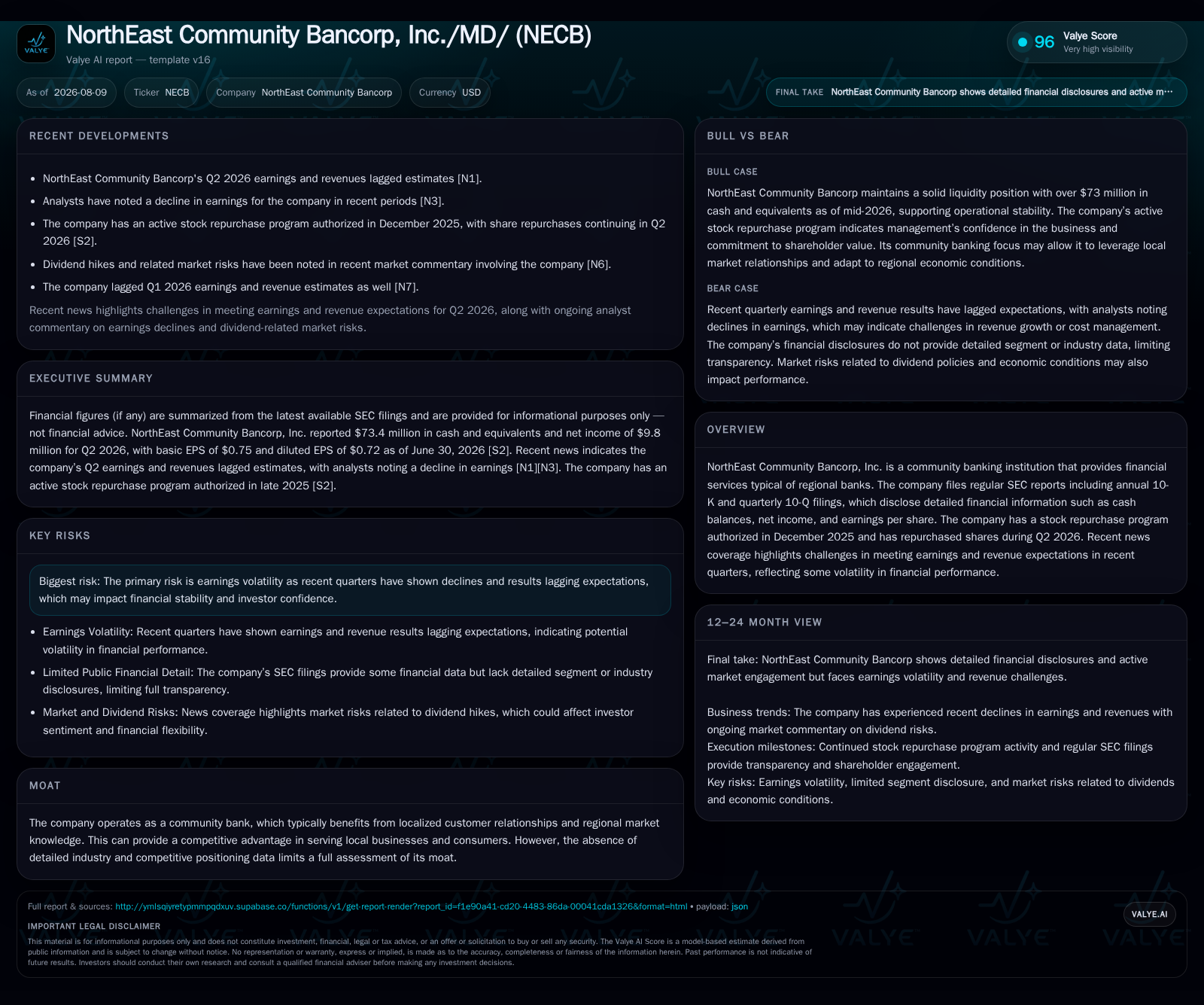
NorthEast Community Bancorp reported second-quarter 2026 earnings and revenues below expectations, reflecting ongoing earnings volatility tied to localized credit risks and net interest margin compression. The bank continued its third authorized stock repurchase program, executing buybacks during the quarter despite earnings pressure, highlighting a capital return orientation amid constrained profitability. Operating primarily in New York and Massachusetts, NECB’s financial performance is influenced by regional economic conditions impacting loan quality and deposit funding costs. Key watchpoints include credit quality trends, deposit beta evolution, and efficiency metrics as determinants of near-term recovery or further earnings softness.
Q2 Operating Results Under Earnings Pressure: Missed Estimates Amplify Volatility Concerns
In the quarterly report filed August 7, 2026, NorthEast Community Bancorp disclosed financial results for Q2 that lagged analyst estimates for both earnings per share and total revenue [S2][N1]. This performance shortfall underscores the persistent challenge of earnings volatility typical of community banks exposed to localized credit risks and fluctuating net interest margins. The company attributed some pressure to elevated provision for loan losses reflecting tightened credit conditions in its Northeast markets. Despite these profit headwinds, NECB actively pursued capital return through stock repurchases during the quarter—a clear signal of management prioritizing shareholder value even during operating stress [S2]. The missed earnings mark contrasts with prior quarters' more stable outcomes but is consistent with the company's historical episodic volatility tied mainly to loan portfolio quality swings.
Core Business Model Anchored in Local Lending: Revenue Sources and Loan Portfolio Dynamics
NECB operates as a community bank primarily serving retail consumers, small businesses, and owners of low- to moderate-income multifamily residential real estate predominantly within New York State and Massachusetts [S1][F1]. Its branch network—including eleven branches across Bronx, Westchester, Essex, Middlesex, and Norfolk counties—and three loan production offices embed the company deeply in its regional footprint facilitating core deposit gathering. This localized relationship banking model supports NECB's main revenue engine: net interest income earned from lending activities funded mainly by customer deposits [S1]. Loans originate mainly as construction loans, commercial real estate mortgages (multifamily residential), and commercial & industrial loans. Given the regional economic mix of service-oriented industries with pockets of affordable housing demand, NECB's portfolio composition reflects sensitivity to local market economics. Deposit beta—how rapidly deposit costs rise when benchmark rates increase—is a key lever influencing net interest margin management within this structure. Maintaining competitive deposit pricing while protecting spreads remains a critical balancing act influenced by customer relationships fostered through the branch network.
Competitive Landscape: Where Localized Banking Meets Regional Peer Trends on Pricing and Risk
Within NECB’s catchment area, competition is robust from national banks with broader scale, similarly sized community banks focused on regional niches, credit unions targeting consumer deposits at competitive rates, as well as emerging fintech lenders offering digital alternatives for both deposits and loans. Such a competitive environment compresses pricing power on deposits and puts pressure on originations—particularly in segments sensitive to economic cycles like construction lending. Regulatory compliance costs further strain smaller institutions relative to larger competitors. While NECB's deep regional presence offers relationship advantages for local borrowers reluctant to switch providers quickly, growing fintech penetration encourages ongoing innovation investment to maintain customer relevance.
Credit Quality Watch: Non-Performing Assets and Loan Loss Provisions Driving Profitability Swings
Recent disclosures highlight an uptick in provision for loan losses during Q2 linked to increased non-performing assets within NECB’s multifamily residential and construction loan portfolios [S1]. The localized nature of their portfolio means concentrated exposures can amplify performance swings compared with diversified national lenders. Quarterly spikes in provisions weigh heavily on short-term profitability given limited scale economies. Going forward, controlling asset quality deterioration amid uncertain regional economic growth will be pivotal in stabilizing NECB’s earnings trajectory.
Capital Allocation Choice: Evaluating Stock Repurchases Amid Net Income Pressure and Regulatory Frameworks
In December 2025, NECB authorized a third stock repurchase program permitting up to approximately 1.4 million shares—or roughly 10% of outstanding shares—to be bought back starting December 10th [S2]. During Q2 2026 alone, approximately 43.5k shares were repurchased at average prices near $24 per share, marking steady though measured capital return despite subpar quarterly profits [S2]. Such buyback activity is notable given the common tendency in smaller banks to conserve capital when facing earnings headwinds or regulatory tightening. It suggests management’s confidence in capital adequacy ratios sufficient to support shareholder returns without compromising liquidity or solvency—a balance requiring ongoing scrutiny given leverage levels.
Growth Catalysts: Economic Tailwinds Versus Operational Constraints in NECB’s Regional Markets
NECB's growth prospects fundamentally hinge on favorable local economic conditions stimulating demand for construction financing alongside commercial real estate loans tied to multifamily housing developments characteristic of its Northeastern footprint. Incremental loan pipeline improvements could lift net interest income via volume expansion coupled with potential marginal improvements in pricing power if deposit beta stabilizes or declines. Technology adoption enhancing lending process efficiency or customer engagement also offers incremental upside potential common among peer community banks focused on modernization efforts. However, external constraints such as sustained elevated provisioning requirements from credit risk concerns or heightened competition limiting new business offset these drivers.
Risks Alert: Deposit Cost Sensitivity, Competitive Pressures, and Credit Conditions to Monitor Next Quarter
Looking forward into subsequent quarters, stakeholders should vigilantly monitor changes in deposit beta—rising funding costs erode net interest margin if unreciprocated by loan yield increases—as well as fresh data points on non-performing asset ratios that presage further provisioning. Any material increase in operating expenses relative to revenue threatening efficiency ratio trends would compound existing profitability pressures [S2][N1]. Conversely, early signs of margin stabilization or improved asset quality would indicate potential inflection points for restoring earnings momentum.
Financial Profile Discussion: Current Balance Sheet Stance Supports Tactical Flexibility Despite Earnings Headwinds
As of June 30, 2026, NECB held approximately $73.4 million in cash and equivalents against total debt estimated around $190 million yielding an approximate net debt position near $116.6 million—a moderate leverage posture supportive of ongoing lending activities but necessitating careful capital management under current earnings volatility [F1]. The balance sheet provides liquidity buffers important for weathering transient credit losses yet constrains overly aggressive expansion absent sustained profit recovery. Tangible book value per share trends alongside CET1 capital ratios will serve as sentinel metrics signaling capital adequacy resilience amid regulatory scrutiny common to community banks navigating challenging macroeconomic environments.
This analysis synthesizes publicly available SEC filings up to August 7, 2026 ([S1], [S2], [S3]) alongside market commentary ([N1]). Assertions are strictly grounded in documented disclosures without speculative inference beyond confirmed facts.
Disclaimer: This is research-only, informational analysis and not investment advice. It may include AI-generated interpretation and general industry context. Always verify important details using primary sources.

Comments