
Ivanhoe Electric Advances Santa Cruz Project Amid Saudi Geopolitical and Legal Challenges
Ivanhoe Electric’s latest quarter highlights progress in U.S. mineral development while navigating complex geopolitical and legal risks abroad.
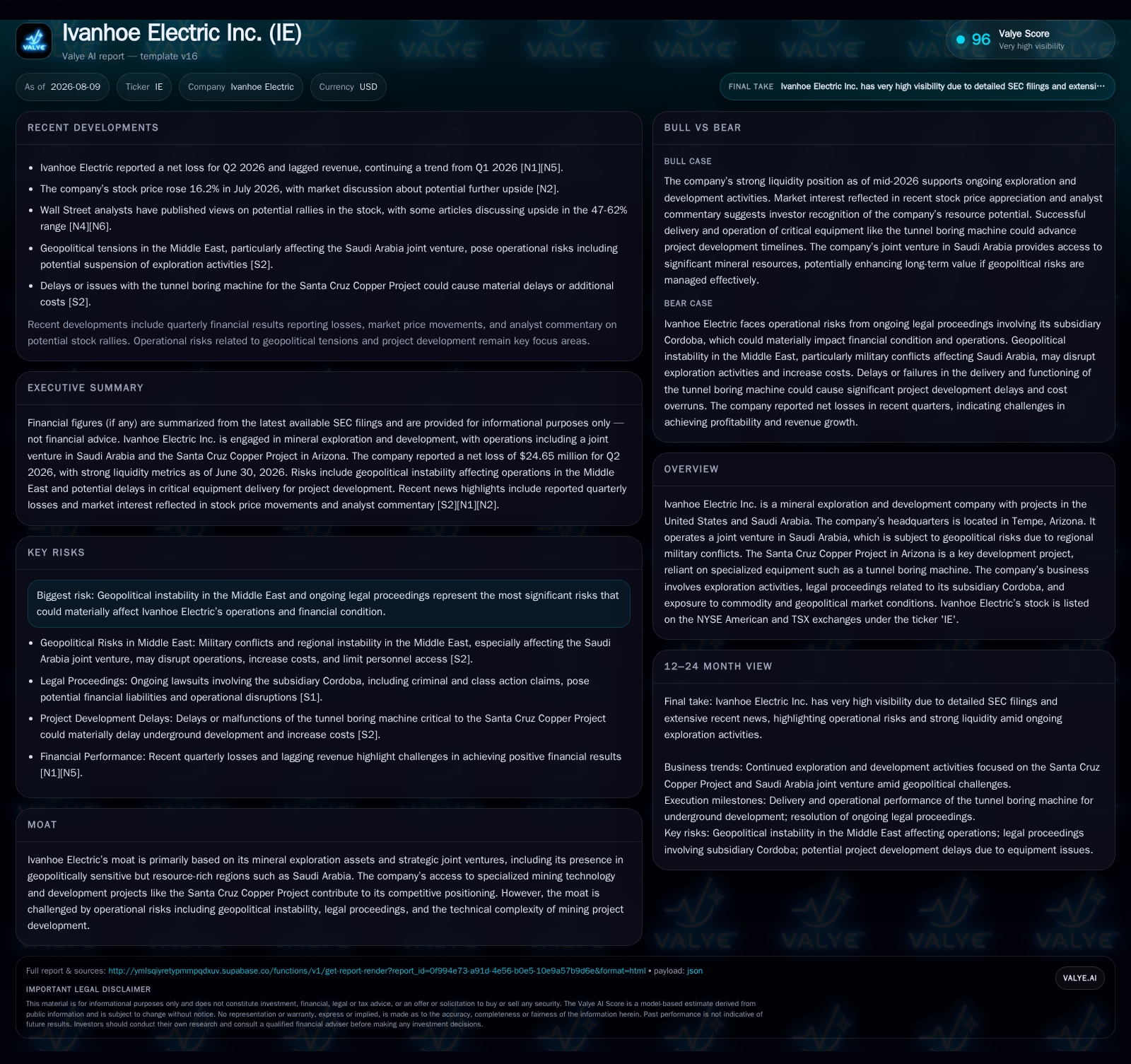
In Q2 2026, Ivanhoe Electric progressed the Santa Cruz Copper Project toward initial construction following a successful preliminary feasibility study, supported by substantial recent equity raises boosting liquidity. The company’s proprietary geophysical technology and strategic partnerships, including a joint venture with Saudi Arabian Maaden and an exploration alliance with BHP, underpin its exploration efforts. However, ongoing military conflicts in the Middle East raise operational risks for Saudi activities, while subsidiary Cordoba’s unresolved legal issues in Colombia present potential financial uncertainties. With over $256 million in cash and no debt, Ivanhoe maintains financial flexibility to advance development milestones amid these challenges.
Recent Operating Update
Ivanhoe Electric’s Q2 2026 Form 10-Q underscores steady advancement of the Santa Cruz Copper Project (SCCP) in Arizona. The company is moving from feasibility into optimization and detailed engineering phases following completion of a Preliminary Feasibility Study (PFS) in June 2025 that validated an underground copper mining operation combined with chloride-assisted heap leaching to produce copper cathode destined for U.S. markets [S2][S1]. Early-stage construction activities are targeted imminently as part of this progression.
Capital formation has been robust with two major equity raises: a February 2025 offering including exercised warrants netting roughly $151 million and an October 2025 offering raising approximately $172 million. These funds are earmarked for land acquisitions at SCCP, ongoing drilling programs across projects including joint ventures, feasibility studies, and general corporate purposes [S1]. This financing underpins an expanding exploration pipeline while maintaining strong liquidity; as of June 30, 2026, Ivanhoe held $257 million in cash with no outstanding debt reported [F1]. The company’s current ratio exceeds five times, reflecting sound short-term financial health [F1].
However, operational challenges persist on two strategic fronts. Ivanhoe’s joint venture with Saudi Arabian Mining Company (Maaden), controlling half of about 50,000 km² of the Arabian Shield for critical metals exploration, faces tangible risks due to ongoing military conflicts involving regional powers such as the U.S., Israel, and Iran. These conflicts threaten personnel safety leading to potential suspension or cessation of exploration activities. Additionally, disruptions to key maritime transit routes like the Strait of Hormuz impede shipping essential supplies and equipment. Air travel restrictions further complicate site access [S2]. Heightened geopolitical tensions also contribute to increased energy prices and insurance costs adversely impacting operational expenditures.
On the legal front, subsidiary Cordoba Minerals Corp., which manages the Alacrán Copper Project in Colombia (approximately 60.8% owned by Ivanhoe), is subject to two extended lawsuits: a criminal case alleging fiduciary breaches by former management dating back to late 2018; and a class action related to community mining rights seeking injunctions against Cordoba’s operations [S1][S8]. These matters entail ongoing legal costs and uncertain outcomes that may materially affect Cordoba’s—and by extension Ivanhoe’s—financial position
Additionally noteworthy is the risk surrounding specialized equipment integral to SCCP’s underground development: the Robbins tunnel boring machine (TBM). Delays or failures in TBM delivery or functionality could materially postpone critical decline excavation schedules necessary for project advancement [S2].
Business Model Overview
Ivanhoe Electric operates as an upstream mineral explorer and early-stage developer focused primarily on copper and other critical metals vital to electrification infrastructure including electric transmission systems and renewable energy technologies. Revenue realization depends on advancing projects from exploration through feasibility to commercial production; currently value capture relies on successful deposit delineation via drilling campaigns, resource estimation improvements, feasibility milestones, and permitting progress.
A key differentiator is Ivanhoe’s proprietary Typhoon™ geophysical surveying technology paired with advanced data analytics provided by its majority-owned Computational Geosciences Inc., enabling enhanced detection of mineral deposits beyond traditional methods. This technology-driven approach aims to reduce exploration risk particularly across underexplored U.S. Southwest territories [S1].
The company's asset portfolio includes wholly owned projects concentrated in the U.S.—notably Santa Cruz Copper Project (Arizona), Tintic (Utah), Hog Heaven (Montana), Bristol (Nevada)—alongside other prospects like Gleeson and Lomitas Negras in Arizona. Internationally it holds strategic positions via joint ventures such as the Maaden JV in Saudi Arabia exploring Arabian Shield belts; Cordoba’s Alacrán Project in Colombia; plus cooperative alliances like that formed with BHP Mineral Resources focusing on critical mineral discoveries within the U.S [S1].
Complementing mineral assets is Ivanhoe’s controlling interest in VRB Energy developing grid-scale vanadium redox flow batteries supporting renewable integration—though currently this segment contributes modest revenue relative to exploration expenditures.
Revenue streams stem mainly from CGI's data processing services sold to mining and oil & gas sectors alongside VRB Energy's battery-related sales; however these remain small compared to high pre-production cash burn driven by exploration activities [S13]
Operating expenses reflect typical junior explorer profiles with significant investment in resource expansion ($63 million spent on exploration expenses in 2025) coupled with administrative overheads managing multi-jurisdictional operations [S13]
Industry Structure & Competitive Position
Ivanhoe Electric occupies a niche among junior/mid-tier explorers focusing on critical metals essential for accelerating global electrification trends—copper being paramount due to its widespread use in electrical infrastructure.
Peers include major producers like Freeport-McMoRan or Southern Copper who combine operating mines with selective upstream exploration; junior explorers rely heavily on capital markets funding during lengthy pre-production cycles.
Ivanhoe's competitive advantages include proprietary geophysical technology reducing discovery risk; strategic JV arrangements expanding access to prospective regions (notably Maaden JV); and a focused portfolio anchored by near-development Santa Cruz Project.
Conversely, exposure to geopolitical risks contrasts peers operating predominantly in stable jurisdictions; ongoing legal proceedings through Cordoba introduce execution uncertainty; reliance on specialized equipment adds operational risk.
Partnerships like BHP's alliance align with industry trends favoring shared capital commitments and risk mitigation among juniors targeting scarce domestic critical metal deposits.
Growth Drivers
Growth hinges on advancing SCCP through engineering design toward permitting and construction enabling transition from exploration expense to revenue generation through copper cathode production.
Demand drivers include:
- Escalating global electrification mandates increasing copper intensity;
- Strategic government initiatives promoting domestic mineral supply chains;
- Enhanced discovery success enabled by proprietary technology particularly within underexplored U.S areas;
- Geographic expansion opportunities via JV licenses despite geopolitical interruptions;
- Operational improvements such as chloride heap leaching enhancing project economics by eliminating smelting/tailings storage costs.
Capital raises support sustained drilling activity and resource updates—key indicators signaling progression toward mine feasibility [S1][S4].
Risks & Constraints
Key risks comprise:
- Geopolitical instability threatening Saudi JV operations through safety concerns or logistical disruptions,
- Legal uncertainties related to Cordoba's Colombian litigations,
- Potential delays/failures involving Robbins TBM affecting critical underground development timelines,
- Commodity price volatility impacting project valuations,
- Regulatory/permitting challenges especially around environmentally sensitive heap leach processes,
- Dependence on capital markets exposed to periodic risk aversion affecting fundraising.
Operational risks include workforce availability constrained by conflict zones or accidents during mine development.
What to Watch Next
Upcoming catalysts include:
- Progress updates on TBM assembly/deployment initiating decline excavation at SCCP [S2][S5];
- Drilling results refining resource estimates or grade profiles;
- Developments resolving Cordoba's legal proceedings influencing contingent liabilities;
- Mine permitting milestones unlocking construction phases;
- Financing advances including potential project debt facilities;
- Operational reports from Maaden JV amid geopolitical conditions;
- Market dynamics around copper and other critical metal prices affecting asset valuations.
Financial Profile Discussion
Ivanhoe maintains a strong liquidity position evidenced by $257 million cash and equivalents as of June 30, 2026, with current assets of $270 million and current liabilities of $53 million, yielding a current ratio of approximately 5.05—indicative of ample coverage for near-term obligations amid intensive investment phases [F1]. The company reported no debt as of December 31, 2025, reinforcing financial flexibility [F1]. Operating losses align with expectations for pre-revenue explorers investing heavily in technical studies [S13].
Expenses primarily relate to advancing mineral projects through drilling and engineering complemented by administrative overhead tied to public company governance across multiple jurisdictions.
Capital allocation prioritizes land acquisition finalization at Santa Cruz alongside aggressive drilling campaigns underpinning resource validation—a prerequisite before large-scale capital deployment—mirroring peer patterns requiring sustained equity funding during long lead times [S1][S13]. The absence of leverage reduces refinancing risk but limits funding alternatives if equity markets tighten unexpectedly.
Overall liquidity metrics suggest sufficient runway through near-term technical milestones though securing production financing remains critical as construction plans mature.
Disclaimer
This analysis is based exclusively on publicly available filings and credible news sources without speculation beyond verified evidence.
Disclaimer: This is research-only, informational analysis and not investment advice. It may include AI-generated interpretation and general industry context. Always verify important details using primary sources.

Comments