
Pulmonx Advances Zephyr Valve Adoption Amid Modest Margin Gains and Debt Constraints
Pulmonx Corp reports narrowed quarterly losses driven by improved device adoption and operational efficiencies but faces ongoing single-product and reimbursement risks.
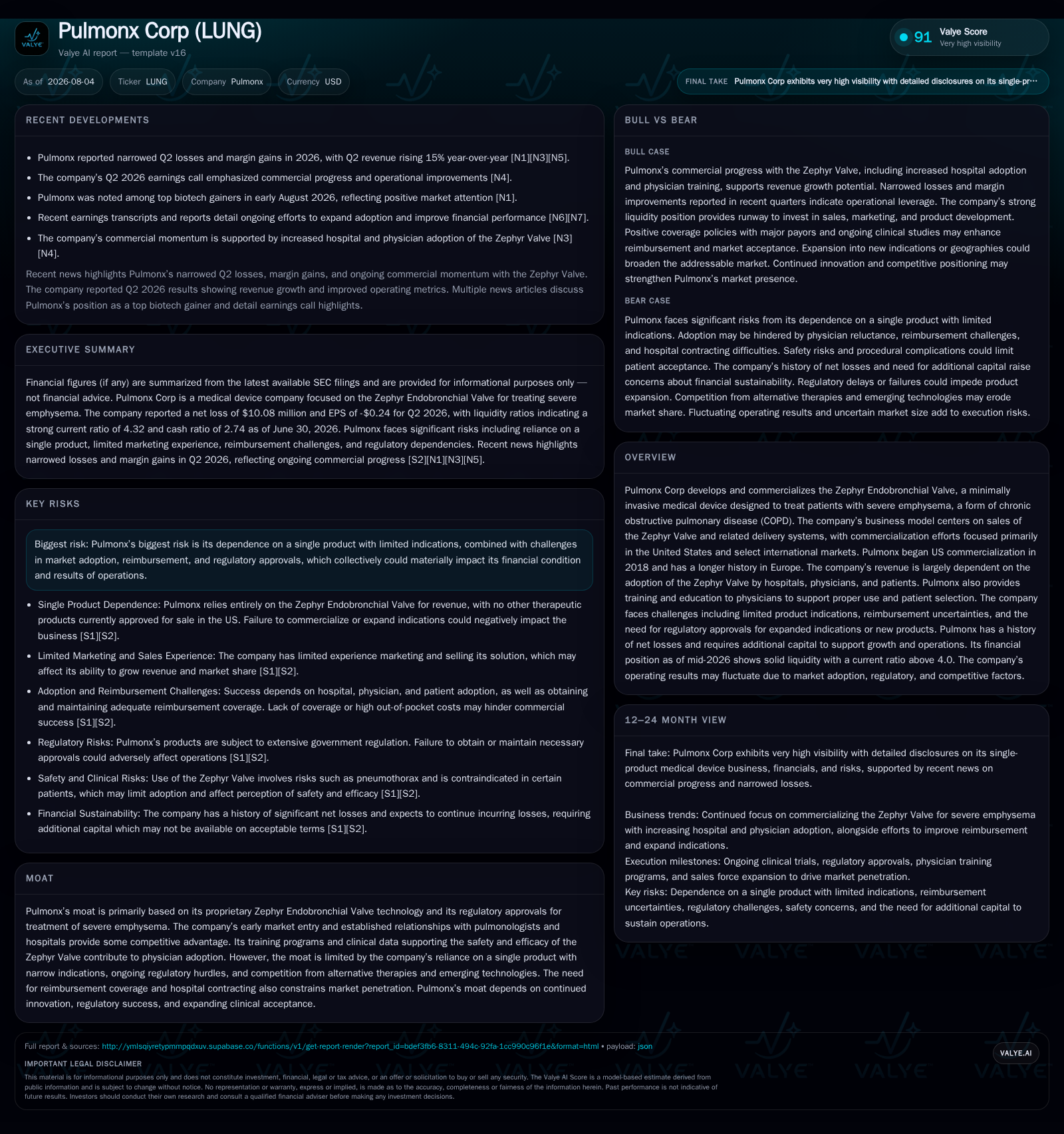
In its latest quarter ending June 30, 2026, Pulmonx Corp demonstrated continued progress in commercializing its Zephyr Endobronchial Valve for severe emphysema, achieving revenue growth that contributed to reduced net losses. Despite operational improvements including enhanced gross margins and sales execution, the company remains dependent on a narrow product portfolio subject to regulatory and reimbursement uncertainties. Capital structure constraints with approximately $62 million in debt paired with $56 million in cash limit financial flexibility. Future growth hinges on expanding clinical indications, securing broader reimbursement, and scaling hospital adoption within the competitive respiratory medical devices space.
Recent Operating Update
Pulmonx Corp’s second quarter 2026 results, filed August 4, 2026, reveal key developments supporting the company’s commercialization trajectory for the Zephyr Endobronchial Valve. The company reported a revenue figure exceeding analyst expectations alongside a meaningful narrowing of quarterly net losses compared with prior quarters [S2][S3]. This outcome stems from modest volume growth in device sales coupled with improved operational efficiencies which assisted gross margin improvement. However, despite these positive signals, losses remain substantial underscoring ongoing investment in scaling commercial capabilities.
The company reaffirmed its primary direct sales model focused on pulmonologists skilled in interventional pulmonary procedures across around 500 high-volume U.S. hospitals. It also continues to support international channel expansion through distributors while maintaining a heavy U.S. revenue concentration (estimated at roughly 95% direct sales in 2025) [S1]. The quarter’s performance confirms steady physician adoption gains buttressed by ongoing training initiatives and educational support aimed at optimizing patient selection and procedural outcomes.
Business Model Analysis
Pulmonx generates essentially all of its revenue from the sale of the Zephyr Endobronchial Valve system – an FDA pre-market approval (PMA) regulated device designed as a minimally invasive option for patients suffering severe emphysema refractory to medical management and unsuitable or unwilling to undergo surgery [S1]. This solution includes not only the implantable valve but ancillary tools such as the Chartis Pulmonary Assessment System which aids patient selection by measuring collateral ventilation status critical for procedural success.
Revenue accrues primarily through direct sales contracts with hospitals and healthcare providers where pulmonologists perform bronchoscopic procedures enabling placement of these valves. Uniquely, Pulmonx employs a specialized sales force targeting interventional pulmonologists – a relatively niche prescriber group compared to general physicians – focusing on awareness-building during well-defined patient populations with critical unmet needs.
Margins benefit from proprietary device technology coupled with outsourcing certain component manufacturing while retaining assembly control. Gross margins have been consistently reported above 70%, reflective of premium pricing aligned with therapeutic efficacy demonstrated through multiple clinical trials showing statistically significant improvements in lung function and quality-of-life metrics versus standard care [S1]. Nevertheless, as a capital-intensive business model necessitating ongoing sales force expansion, clinical research investment, and regulatory efforts for label extensions or pipeline development (notably AeriSeal foam system), operating losses persist.
In parallel to device sales revenues, Pulmonx invests heavily into physician education programs including training workshops and proctoring during initial cases – activities which foster clinician familiarity reducing procedural learning curves and enhancing acceptance. These investments nonetheless weigh on near-term profitability metrics.
Industry Structure and Competitive Position
Operating within the niche segment of respiratory medical devices addressing chronic obstructive pulmonary disease (COPD) patients with severe emphysema, Pulmonx occupies an early-mover role leveraging proprietary Zephyr Valve technology cleared under PMA regulations in major markets including the U.S. and Europe. Peers within this domain include firms like Olympus Corporation with their Spiration Valve System and other companies developing novel COPD therapies spanning pharmaceuticals to alternative devices.
Competitive dynamics hinge heavily on clinical evidence robustness, regulatory approvals breadth, payer reimbursement policies, hospital adoption rate, specialized physician engagement strategies, and manufacturing scalability. Pulmonx’s entrenched relationships among key pulmonologists specializing in interventional procedures provide it some advantage given the specialized nature of implantation techniques required.
However, competitive threats persist: alternative therapies such as bronchoscopic lung volume reduction methods using thermal vapor ablation or other valve designs challenge market share. Additionally, limitations inherent to single-device portfolios raise vulnerability relative to more diversified competitors investing broadly into COPD treatment modalities.
Medicare reimbursement uncertainty remains a critical external factor influencing hospital purchasing decisions since approximately three-quarters of target patients are Medicare beneficiaries—coverage varies at local contractor levels absent a definitive National Coverage Determination (NCD) by CMS [S1]. The complexity delays broad market penetration despite supportive clinical efficacy data.
Growth Drivers
Key vectors fueling Pulmonx’s growth include:
- Expanded Clinical Indications: Ongoing clinical trials aim to broaden the scope beyond severe emphysema subsets potentially enlarging addressable patient population.
- Regulatory Approvals: Securing FDA PMA for the AeriSeal System would diversify product offerings mitigating single-product risk while offering complementary therapy options [S1].
- Physician Adoption Increase: Scaling sales force headcount targeting pulmonologists incrementally drives procedure volume growth; enhanced education facilitates confident use enhancing hospital penetration rates.
- Improved Reimbursement Landscape: Securing favorable coverage decisions from Medicare Administrative Contractors (MACs) or possible future NCD would materially affect volume growth by reducing hospital economic barriers.
- Geographic Expansion: Strengthening international presence via distributor channels paves way for revenue diversification beyond US dependence.
- Product Innovation: Continuous enhancements aimed at improving safety profiles or simplifying implantation can augment competitive positioning against rival therapies.
Clinical outcome data remain central: more extensive long-term studies demonstrating survival benefits aligned with functional improvements may accelerate payor acceptance and procedural referrals.
Risks and Watchpoints
Pulmonx’s foremost risk remains its dependence on a single product line confined to narrowly defined clinical indications. Failure to execute regulatory milestones or unexpected safety signals could stall commercial momentum adversely impacting financial results [S2].
Reimbursement complexities represent another significant constraint; without uniform Medicare coverage nationally or improved private payer policies reducing patient out-of-pocket costs, procedure demand may be suppressed despite unmet clinical need [S1].
Manufacturing scale-up challenges pose operational risks: dependency on third-party suppliers for components subjects production schedules to potential disruption affecting supply continuity potentially limiting gross margin expansion or delaying order fulfillment [S1]
The company has faced legal scrutiny related to sales practices under Anti-Kickback Statute investigations culminating in recent settlement agreements though no material adverse rulings were reported; ongoing compliance diligence is critical to mitigate reputational or financial harm due to regulatory entanglements [S8][S13]
Additionally, rapid innovation rates within the respiratory therapeutic area create competitive pressure necessitating continual R&D investment; failure to innovate meaningfully could result in erosion of clinical preference among physicians favoring newer alternatives.
What to Watch Next
Upcoming catalysts include interim data releases from CONVERT II trial supporting AeriSeal System PMA application status which will indicate pipeline maturation pace. Regulatory timelines for submission acceptance or deferrals will directly influence near-to-mid-term developmental spending trajectories.
Reimbursement developments—particularly any movement toward formalized CMS national coverage policies—will be pivotal markers for broadening utilization rates past early-adopter phases currently characteristic of interventional pulmonology segments.
Monitoring quarterly device volume trends alongside hospital account additions will provide insight into commercial traction effectiveness particularly amid expanded sales force deployment metrics disclosed during earnings calls.
Finally, any updates regarding supply chain adjustments or cost structure improvements convey capacity sustainability impacting longer-term margin progression prospects.
Financial Profile Discussion
As of June 30, 2026 balance sheet snapshots show Pulmonx holding approximately $55.8 million in cash and equivalents against total debt near $62.3 million yielding modest net leverage around $6.5 million—signaling manageable but present leverage constraints requiring careful cash flow management [F1]. The current ratio stands robust at about 4.3 indicating short-term liquidity sufficiency versus liabilities although continued operating losses underline capital consumption pressure demanding either incremental financing or accelerated revenue growth cycles for break-even achievement [F1][S2].
Operating income remains negative reflecting ongoing R&D investments supporting regulatory approvals plus scaling marketing/sales expenses necessary for wider market penetration [F1]. Continued losses mirror typical early commercialization medical device patterns where upfront costs precede sustainable profitability following broader procedural adoption.
Capital expenditure outlays have been directed primarily toward capacity expansions related to manufacturing upgrades alongside technology platform development aimed at integrating digital capabilities enhancing treatment planning precision per industry trends around integrated patient monitoring solutions.
In sum, while short-term financial metrics underscore typical commercialization phase pressures marked by net losses leveraged capital structure, prudent liquidity management combined with strategic execution tied to expanding physician base adoption should dictate transitional path toward operating income improvements over time.
Disclaimer: This analysis is provided solely for informational purposes grounded entirely in public filings and industry context without offering investment advice or research views.
Disclaimer: This is research-only, informational analysis and not investment advice. It may include AI-generated interpretation and general industry context. Always verify important details using primary sources.

Comments