
Investar Holding Corp Sustains Strong Capital Position Amid Moderate Credit Loss Reversals in Q2 2026
Investar Holding maintains well-capitalized status supported by diversified loan portfolio and prudent CECL credit loss management, while navigating steady loan demand and interest rate risks.
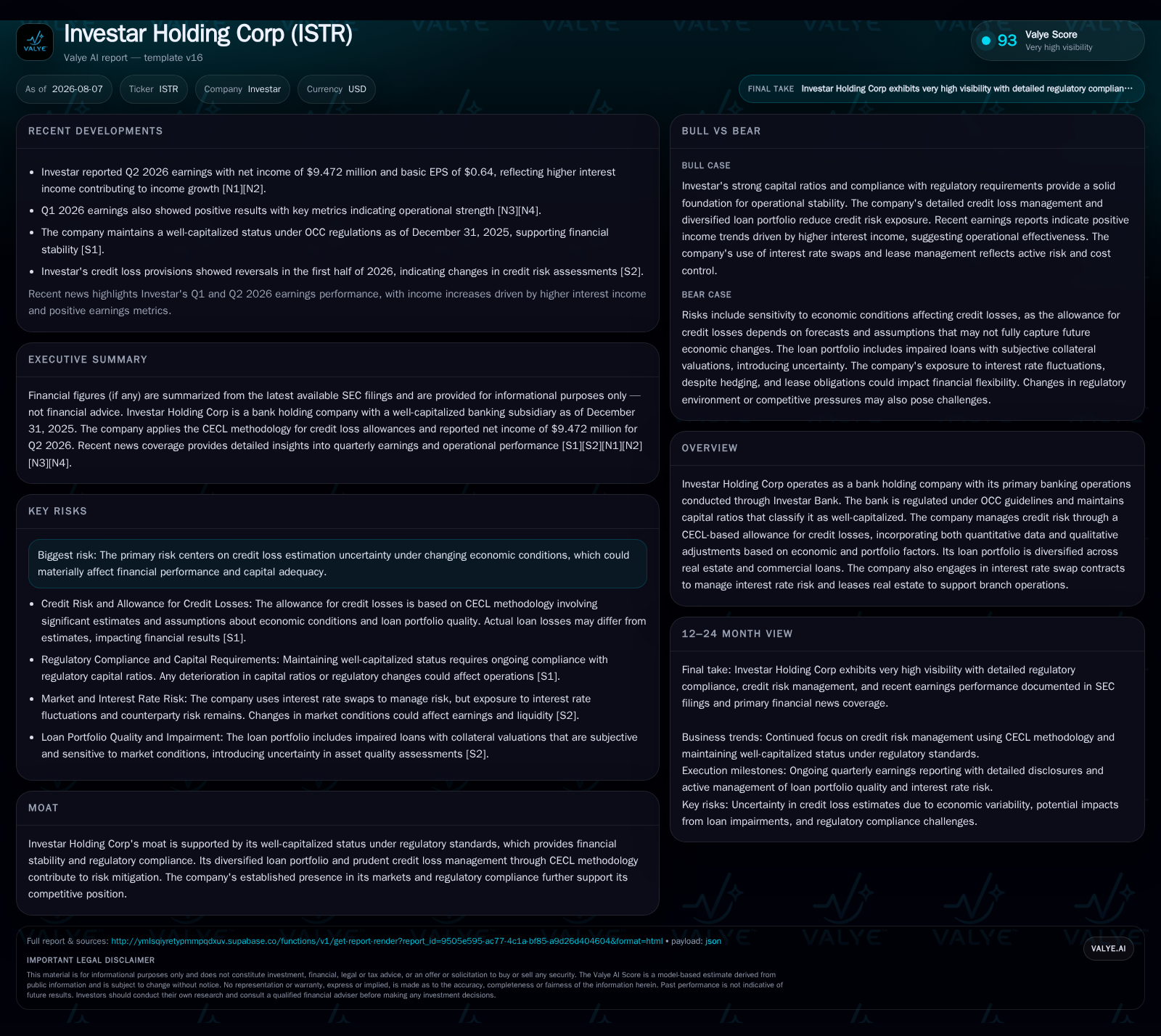
In its latest quarterly report, Investar Holding Corp reported stable operating performance marked by a modest provision for credit losses reversing earlier reserves, reflecting improving credit quality. The company remains well-capitalized under OCC standards with sound Tier 1 ratios, supported by a diversified loan portfolio spanning commercial and real estate sectors. Investar engages actively in interest rate risk management via swap contracts and maintains operational discipline in liquidity and funding sources. Key near-term drivers include sustaining deposit growth and prudent loan portfolio management amid macroeconomic uncertainties affecting credit and interest rates.
Latest Quarterly Operating Update
In the second quarter of 2026, Investar Holding Corp's financial disclosures revealed a subtle shift in credit loss provisions with a net $0.3 million allowance expense. This figure combines a $0.4 million provision on actual loans contrasted by a $0.1 million reversal for unfunded loan commitments, evidencing cautious optimism about borrower repayment capabilities amidst economic uncertainties [S2]. Over the first half of the year, the company recorded a cumulative $1.8 million reversal in credit losses reflecting favorable changes in portfolio credit trends or macroeconomic conditions impacting expected loss models based on CECL methodology.
Loan balances showed steady composition with no indication of material concentrations or emerging problem sectors; meanwhile, allowance for credit losses (ACL) remains aligned with risk perceptions validated by recent experience [S2],[S1]. The company's proactive CECL-based ACL framework integrates quantitative historical loss data with qualitative forecasts ensuring dynamic credit risk management.
Interest rate risk mitigation through derivatives remains highly strategic: as of mid-2026, Investar held offsetting interest rate swap contracts totaling $158.3 million notional amount both with customers and correspondent institutions effectively hedging forecasted variability in interest payments related to anticipated fixed-rate debt rollovers [S2]. Such derivative activities underscore disciplined ALCO management during fluctuating rate environments.
Business Model Specifics
Investar operates primarily through its wholly owned subsidiary Investar Bank, National Association. The business model centers on traditional regional banking fundamentals - originating loans primarily across commercial sectors and diverse real estate classes while leveraging deposits as principal funding sources. Revenue chiefly derives from net interest income generated by the spread between borrowing costs (mainly deposit rates) and yields earned on loan assets and securities investments [S1],[S22].
Non-interest income supplements core earnings through fees associated with loan origination, servicing, deposit maintenance, and ancillary financial services — a typical mix within community/regional bank contexts helping mitigate dependency on pure margin expansion [S22]. The company does not hold trust services or other specialized financial services that might diversify revenues further [S1].
Credit risk management benefits from a balanced loan mix which includes multi-family, farmland, commercial real estate, and commercial business loans limiting sector concentration risks commonly seen in specialized portfolios [S2],[S1]. The allowance for credit losses is calculated per CECL accounting rules tracking lifetime expected losses incorporating economic outlooks.
Physical infrastructure includes branch offices mostly staffed and operated under operating lease agreements rather than through property ownership or finance leases [S23], reflecting commitment to maintaining customer access points while controlling fixed cost exposure.
Management compensation frameworks reinforce retention with contractual clauses around confidentiality post departure plus typical non-competition provisions lasting one year (eighteen months if triggered by change in control scenarios), indicating governance focus on personnel stability amid competitive market pressures [S3]
Industry Structure and Competitive Positioning
Within the regional banking industry—serving individuals and small-to-medium businesses predominantly in Louisiana, Texas, and Alabama—Investar positions itself as a well-capitalized player adhering strictly to OCC regulatory guidelines that define capital adequacy based on Tier 1 leverage ratios and common equity tier 1 (CET1) assessments among others [S1]. Its capital buffer exceeds minimum requirements comfortably; at year-end December 2025 it maintained Tier 1 leverage around 10.73% and total capital ratio over 14%, placing it securely in the "well-capitalized" category per federal regulations.
Peers such as Regions Financial Corporation or Fifth Third Bancorp operate at greater scale but face similar challenges balancing regulatory compliance with market-driven growth imperatives; Investar’s mid-sized footprint is typical of community-focused banking groups emphasizing personalized service to retain loyal clientele despite digital transformation pressures elsewhere in the sector.
Interest rate swaps use aligns with industry norms where matching forecasted liabilities with hedging instruments reduces margin volatility—a critical task given constraining yield curve dynamics affecting net interest margins (NIM) across regional banks [S2],[S18].
Growth Drivers
Key growth routes for Investar revolve around organic expansion within established markets through incremental loan origination focused on sectors demonstrating sustainable demand such as commercial real estate development and agribusiness lending segments prevalent within their geographies [S1]. Such diversification aids mitigation against downturn cycles concentrated solely in one industry.
Capitalizing on technology adoption offers potential efficiency improvements; although no explicit disclosures were provided recently about tech investments, regional banks increasingly leverage digital platforms to enhance customer acquisition/retention which could translate into fee income growth upstream.
Risks and Watchpoints
The dominant risk theme pertains to the uncertainty embedded within credit loss estimates using CECL models particularly under shifting macroeconomic backdrops including trade policies impacting regional economies, inflationary pressures pressuring repayment capacities, or localized sectoral downturns tied to oil/gas price volatility—all material to asset quality and capital adequacy assessments [S1]. Loan charge-off rates deserve close monitoring; while Q2 results signaled only mild provisioning needs post prior reversals suggesting stable portfolio quality so far [S2], sudden deterioration would stress profit margins and necessitate additional reserves.
Interest rate risk also remains salient: mismatches between asset yields and funding costs could compress net interest margins especially if deposit repricing accelerates faster than asset coupon resets; Investar’s hedging programs mitigate but cannot fully eliminate this risk profile [S2],[S18].
Liquidity candidacy depends heavily on maintaining customer confidence especially since brokered deposits used occasionally present cost volatility linked sensitively to competitor pricing; any reputational issue or regulatory downgrade could impair these reliable funding sources swiftly given banking sector sensitivity to rapid information dissemination through new media channels [S18]
Regulatory compliance demands impose continuous costs; evolving rules around capital buffers or cybersecurity increase operational burdens requiring investment without immediate revenue benefit risking margin pressure [S1]
Geographic concentration within Gulf Coast states ties performance closely to local economic cycles including energy sector swings requiring monitoring for adverse shifts affecting borrower industries which constitute meaningful portions of loan exposure [S1],[N3].
What To Watch Next
Investors should track subsequent quarterly filings for indicators of evolving credit loss provisions relative to loan portfolio changes—the scale of reversals or fresh provisions will reveal whether underlying economic factors materially affect borrower stress levels beyond seasonal noise. Deposit growth trends alongside shifts between core versus higher-cost deposit types will illuminate funding cost dynamics impacting future margin expansion potentials.
Updates regarding any sizeable derivative portfolio changes or alterations in hedging strategies might presage changing views on interest rate outlook or balance sheet structure adaptation efforts.
Regulatory communications affirming ongoing well-capitalized status are especially relevant since this classification enables optimal operational flexibility including brokered deposit utilization without special approvals.
Any new announcements concerning geographic expansion plans, technology deployment initiatives aimed at cost rationalization or new fee-based service offerings would hint at strategic directional shifts supporting longer-term growth objectives.
Financial Profile Discussion
As of December 31, 2025, Investar Holding Corp reported total revenue of approximately $93.6 million with net income of $22.9 million indicating solid profitability levels consistent with regional banking peers of similar scale [F1]. Total debt stood around $9.8 million against cash equivalents exceeding $29 million indicating negative net debt positioning which provides liquidity cushion enhancing balance sheet strength against short-term stresses [F1]. Regulatory capital ratios affirm robust capitalization: Tier 1 leverage ratio hovered near 10.7%, common equity tier 1 (CET1) ratio exceeded 11%, surpassing well-capitalized thresholds promulgated by OCC standards thus underpinning capacity for growth initiatives or buffering unexpected losses without constraint effect [S1],[F1]
Loan charge-offs have remained low relative to total loan balances whereas efficiency metrics were not explicitly detailed recently but remain an area where incremental improvement could boost returns especially given competitive pressures on traditional net interest margins facing most regional banks currently.
Disclaimer: This is research-only, informational analysis and not investment advice. It may include AI-generated interpretation and general industry context. Always verify important details using primary sources.

Comments