
ECB Bancorp Expands CRE Lending and Strengthens Deposit Base in Greater Boston
ECB Bancorp’s latest quarterly update solidifies its focus on commercial real estate growth, deposit diversification, and prudent risk management.
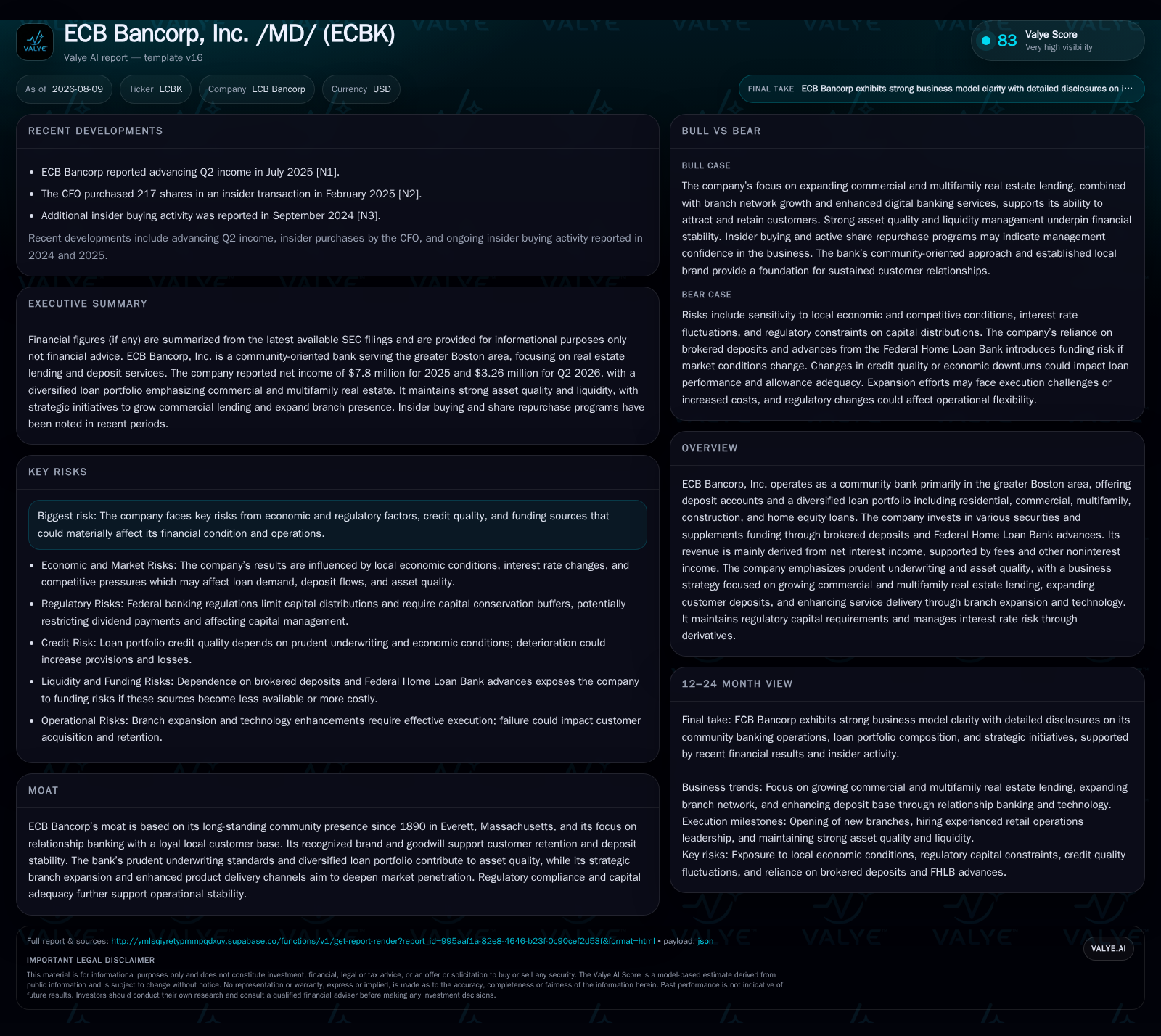
ECB Bancorp, Inc., the holding company for Everett Co-operative Bank, reported continued strategic emphasis on expanding commercial and multifamily real estate lending while maintaining strong underwriting standards and asset quality as of Q2 2026. The bank leverages its entrenched community presence in the Boston area to deepen relationship banking, diversify its deposit base—including brokered deposits—and manage interest rate risk via derivatives. Funding sources include retail deposits, wholesale brokered deposits, and Federal Home Loan Bank advances. Capital adequacy remains sound, supporting dividend policy flexibility. Key risks include geographic concentration and funding volatility. Upcoming milestones will focus on loan portfolio composition shifts and deposit retention metrics.
Recent Operating Update
ECB Bancorp's latest quarterly filing for Q2 2026 highlights its ongoing strategy to favorably reshape its loan portfolio by increasing originations in commercial real estate (CRE) and multifamily real estate loans while maintaining prudent underwriting practices [S2][S3]. This strategic focus aims to enhance the portfolio's yield profile and reduce term-to-maturity, supporting more sustainable net interest margin (NIM). The hiring of a Chief Lending Officer in early 2022 underscores management’s commitment to executing this growth objective with disciplined credit standards [S1].
The bank issued a press release on July 23, 2026, reaffirming these directions but did not provide detailed numeric guidance following the Q2 reporting date [S3]. These operational priorities reflect market adaptation to evolving local real estate opportunities in the greater Boston metro area where ECB operates predominantly.
Business Model Specifics
ECB Bancorp functions as a regional community bank focusing mainly on serving consumers and small to medium-sized businesses within eastern Massachusetts. Its subsidiary Everett Co-operative Bank offers deposit accounts funded primarily by retail customers diversified into checking, savings, certificates of deposit (CDs), and money market products. Monetization hinges on net interest income generated through lending across multiple product lines—residential mortgages, CRE, multifamily loans, home equity lines of credit (HELOCs), construction loans, and select commercial business loans—with supplementary revenue streams from fees associated with noninterest income like account services and interchange fees [S1][S5]
The loan portfolio’s increasing tilt toward higher-yielding CRE and multifamily loans responds to competitive dynamics favoring these sectors locally. These loans typically offer better spreads than traditional one-to-four family residential mortgages but require enhanced underwriting vigilance due to potential cyclical sensitivity. Construction loans add shorter-duration exposure that improves liquidity dynamics.
Funding is sourced extensively from stable core deposits augmented by brokered deposits—which constituted roughly $134 million of total deposits at year-end 2025—and Federal Home Loan Bank (FHLB) advances tallying about $285 million at the same date [S4][S9]. Brokered deposits provide supplementary liquidity but carry higher repricing risk or cost pressure under rising rate scenarios. The company offsets some of this exposure using derivative instruments designated as cash flow hedges to manage variability in future cash flows caused by interest rate shifts [S26].
Branch presence remains limited but strategically expanding; historically centered around Everett with two branches plus an administrative office, ECB Bancorp opened a third branch recently in Wo..., designed to extend market penetration and diversify deposit gathering channels beyond traditional retail methods through enhanced electronic/mobile banking platforms [S5].
Industry Structure and Competitive Position
As a smaller regional player in a dense financial ecosystem dominated by national banks and growing fintech alternatives, ECB Bancorp’s competitive moat centers on deep local relationships cultivated since its founding in 1890 in Everett. Its community-oriented approach fosters customer loyalty that lowers deposit beta—retaining deposit balances despite interest rate fluctuations—and support recurring fee-based income streams complementary to lending operations.
Competitively, ECB faces challenges from larger regional/national banks capable of pricing aggressively across CRE segments as well as credit unions offering favorable deposit rates. However, ECB leverages its localized knowledge to selectively grow CRE/multifamily loan mix with comparatively strong asset quality through prudent underwriting criteria.
Its ability to rely on brokered deposits balanced by strong core deposit inflows provides relative funding stability amid volatile markets but requires ongoing cost optimization to keep efficiency ratio metrics aligned with peer benchmarks.
Monitoring non-performing asset ratios, provision expense trends, capital adequacy metrics (e.g., CET1 ratio), deposit retention rates post-maturity dates for CDs, loan origination volumes across CRE segments, and derivative hedge effectiveness will signal forthcoming performance sustainability or emerging vulnerabilities.
What to Watch Next
Key upcoming milestones include quarterly assessments of:
- Changes in the mix and yield of commercial versus residential mortgage portfolios confirming management’s strategic shift impact.
- Deposit growth particularly core versus brokered mix shifts indicating funding stability trajectory.
- Asset quality metrics such as non-performing assets ratio stability or upticks signaling credit stress.
- Regulatory announcements relating to capital distributions or changes affecting dividend policy flexibility.
- Execution progress on branch network expansion including any acquisitions or new openings boosting local franchise value.
- Effectiveness of derivative strategies managing interest rate risk impacting net interest income volatility.
These indicators will validate whether ECB Bancorp can preserve its prudent risk posture while capitalizing on favorable local real estate dynamics within a competitive banking environment.
Financial Profile Discussion
The company maintains liquidity capacity through a combination of cash holdings, short-term investments, unused borrowing capacity at FHLB ($395 million), Federal Reserve Bank ($75 million), and Atlantic Community Bankers Bank ($15 million) enabling flexible funding under stress scenarios [S10]. Non-brokered time deposits due within one year stood at $451 million (representing ~40% total deposits), largely expected to be retained based on historical experience which mitigates near-term refinancing risk though heightened competition remains a factor [S9].
In summary, ECB Bancorp exhibits sound financial health supporting strategic flexibility with adequate capital buffers amidst moderate leverage reflective of its regional banking archetype.
This analysis synthesizes recent SEC disclosures through August 2026 alongside industry sector frameworks pertinent to regional banking business models focusing on localized real estate lending dynamics and associated funding considerations. It refrains from offering investment advice but aims to clarify operating fundamentals shaping operational priorities and risks within ECB Bancorp’s evolving competitive landscape.
Disclaimer: This is research-only, informational analysis and not investment advice. It may include AI-generated interpretation and general industry context. Always verify important details using primary sources.

Comments