
Taboola Drives Growth Through AI-Powered Advertising Beyond Walled Gardens
Taboola.com Ltd. extends its position in the digital advertising ecosystem with strong Q2 operational results and continued AI innovation targeting performance marketing outside major walled gardens.
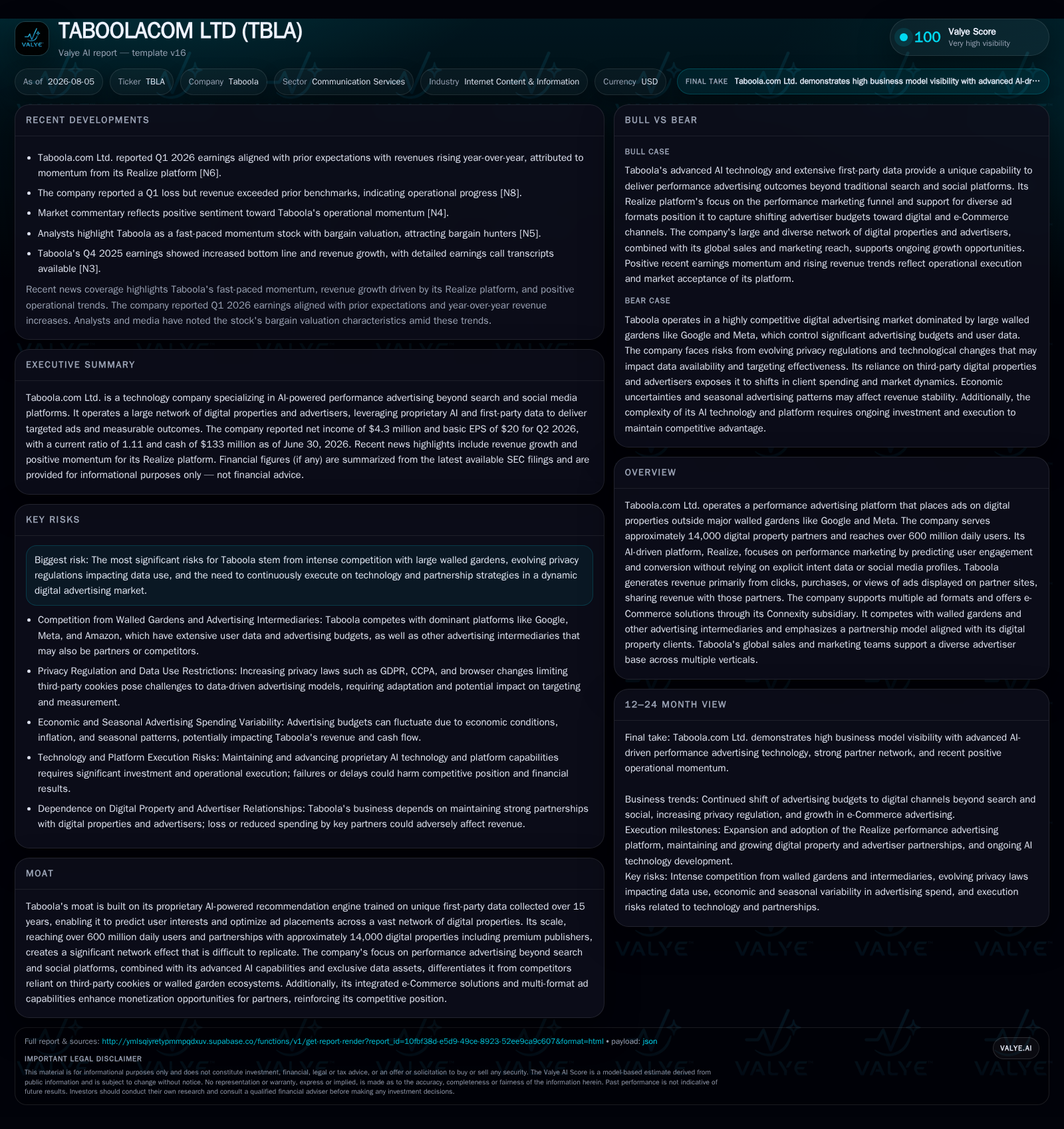
In its latest quarterly filing, Taboola.com Ltd. demonstrated resilience in a competitive and evolving digital advertising landscape by leveraging its AI-driven platform to serve over 600 million daily users across approximately 14,000 digital properties. The company’s revenue model based on performance advertising—where advertisers pay for clicks, purchases, or views—relies heavily on proprietary data and advanced AI to optimize ad targeting beyond search and social dominated ecosystems. While facing ongoing risks from privacy regulations and resource-heavy competition from industry giants like Google and Meta, Taboola’s integrated approach—including e-commerce solutions through Connexity—and strategic partnership model support sustainable growth opportunities. The company maintains a solid financial position with positive net cash and a current ratio slightly above 1.1 as of June 2026.
Recent Operating Update
Taboola.com Ltd.'s second quarter 2026 filings demonstrate operational stability and ongoing growth momentum amidst an increasingly complex advertising ecosystem [S2][S3]. The company continues to serve approximately 600 million daily active users across about 14,000 third-party digital properties — premium publishers including Yahoo, Microsoft, NBCUniversal, CBSi among them [S1]. This massive scale grants Taboola access to unique first-party data critical to its AI-driven content research view engine. While the filing does not disclose precise quarterly revenue or margin figures, the company has reiterated its commitment to expanding user reach, improving ad yield per impression through technological enhancements, and maintaining multi-year partnerships foundational to its business stability [S1].
The combination of large-scale partner relationships and a diversified advertiser base underpins recurring revenue streams primarily driven by performance advertising outcomes — clicks, purchases, or views — rather than mere impressions [S1]. This model aligns incentives between Taboola and its digital property partners since both benefit directly from user engagement leading to monetization
Business Model Analysis
Taboola occupies an intermediary role in the digital content value chain by connecting advertisers seeking audience targeting beyond major search and social platforms with premium publishers offering inventory across web domains and apps. Unlike dominant walled gardens such as Google or Meta that leverage extensive user profiles for targeting within closed ecosystems, Taboola relies on a proprietary AI-powered research view platform — named Realize — which predicts user interests without requiring explicit intent signals or personal data profiles common in these ecosystems [S1].
Monetization primarily stems from advertisers who pay the company based on measurable consumer actions: cost per click (CPC), cost per acquisition (CPA), or view-based pricing in select formats [S1]. Revenue is then partially shared with digital property partners under contractual arrangements often extending multiple years. The company also incurs minimum guaranteed payments to publishers per thousand impressions (TAC guarantees), which represent a risk if yields do not meet those floors but historically have accounted for less than 20% of total TAC costs
Technology infrastructure investments are significant; the deployment of AI requires processing enormous volumes of data daily across thousands of servers worldwide [S29]. Taboola's ability to automate research view delivery while continuously improving algorithms gives it leverage in driving higher click-through rates (CTR) and conversion rates compared to competitors reliant on third-party cookies or limited open-internet inventories.
Complementing its core platform is Connexity, an e-commerce focused advertising subsidiary offering enhanced product discovery solutions. This integration addresses rising advertiser demand within emerging online shopping verticals—a critical growth vector amid escalating shifts toward e-commerce spending [S1][S22].
Industry Structure and Competitive Position
The Internet Content & Digital Advertising industry is bifurcated between dominant walled gardens controlling vast user data within closed environments (e.g., Google’s search & YouTube ads; Meta’s Facebook & Instagram ads) and open Internet-focused platforms specializing in programmatic or performance-based advertising beyond these gardens.
Taboola belongs to the latter group but differentiates itself from pure programmatic exchanges by focusing narrowly on outcome-driven performance ads powered by proprietary AI analytics leveraging first-party data aggregated across a vast network of engaged digital properties [S1]. Key peers span categories such as:
- Walled garden giants (Google / Meta)
- Programmatic DSPs like The Trade Desk
- Performance retargeting specialists like Criteo
- Supply-side platforms including PubMatic & Magnite
- E-commerce ad providers exemplified by Connexity itself.
Its moat arises from exclusive access to real-time behavioral data drawn from over 600 million daily users interacting with partner sites globally—data exclusivity states that competitors cannot easily replicate without similar scale or publisher relationships [S1]. Moreover, Taboola's business-to-business focus means it does not compete with its publishing partners for end-user attention or direct ad sales—a distinct alignment reducing channel conflict common elsewhere.
Growth Drivers
Several secular trends sustain Taboola's growth prospects:
- Advertising Budget Shifts: Continuous migration of budgets away from traditional media toward diversified digital platforms creates large addressable market opportunities. Publishers seek alternative monetization beyond Google/Meta dominance, benefiting open web intermediaries like Taboola.
- AI Adoption: Ongoing enhancements in machine learning models improve predictive accuracy for ad placements boosting CTRs and conversions. Taboola's long-term accumulation of first-party data further amplifies machine learning efficacy.
- E-Commerce Expansion: The Connexity integration leverages retail advertisers’ needs for scalable product discovery solutions outside walled gardens. Growing e-commerce spend drives demand for direct response advertising tied closely to purchase behaviors.
- Multi-format Ads & Analytics: The introduction of novel ad formats coupled with real-time insights dashboards empowers publishers to optimize content strategies dynamically, driving increased yield per impression.
- Geographic Diversification: Expanding presence in emerging markets diversifies revenue sources while capitalizing on increasing internet penetration.
- Strategic Partnerships: Multi-year exclusive contracts reduce revenue volatility while deepening collaborative product development aligned with partner publisher goals.
Risks and Watchpoints
What to Watch Next
Key milestones that will shape near-term operating trajectories include:
- Updates on incremental gains in active daily users reached or expansion of publisher network beyond reported figures.
- Quarterly trends in click-through rates (CTR), conversion rates, revenue per user/session metrics indicating improving yield quality.
- Any disclosures around new multi-format advertising products launching or e-commerce solution expansion through Connexity.
- Regulatory developments especially related to privacy laws compliance costs or restrictions impacting platform targeting capabilities.
- Evidence of client retention rates; securing renewals under favorable terms reflects product competitiveness.
- Investment cadence in R&D especially relating to AI capabilities deployment impacting operational efficiency or marketplace differentiation.
Financial Profile Discussion
As of June 30, 2026, Taboola reported cash and equivalents of approximately $133 million against total debt outstanding near $72 million—yielding a net cash position of roughly $61 million [F1]. Meanwhile, current assets stood at $519 million versus current liabilities near $469 million resulting in a current ratio of about 1.11 [F1]. These indicators suggest adequate short-term liquidity supporting ongoing technology investments amid scaling activities without notable balance sheet stress.
While detailed interim profitability metrics were not disclosed explicitly in the latest quarterly report accompanying filings, the prior twelve-month operating income was approximately $44 million with net income around $42 million at year-end 2025 [F1]. This legacy profitability aligns with a maturing business model balancing growth investments against steady cash generation capacity.
This analysis synthesizes publicly available regulatory filings augmented with established industry understanding specific to internet content advertising intermediaries leveraging proprietary data and AI technologies for performance marketing outside dominant walled gardens. It does not provide investment research views but aims to clarify Taboola.com Ltd.’s operational positioning within this complex digital ecosystem as of mid-2026.
Disclaimer: This is research-only, informational analysis and not investment advice. It may include AI-generated interpretation and general industry context. Always verify important details using primary sources.

Comments