
TELEPHONE & DATA SYSTEMS Explores Strategic Control Over Array Amid Tower Leasing Strength
TDS delivers resilient Adjusted EBITDA from its dual telecom and tower leasing segments while managing strategic acquisition risks.
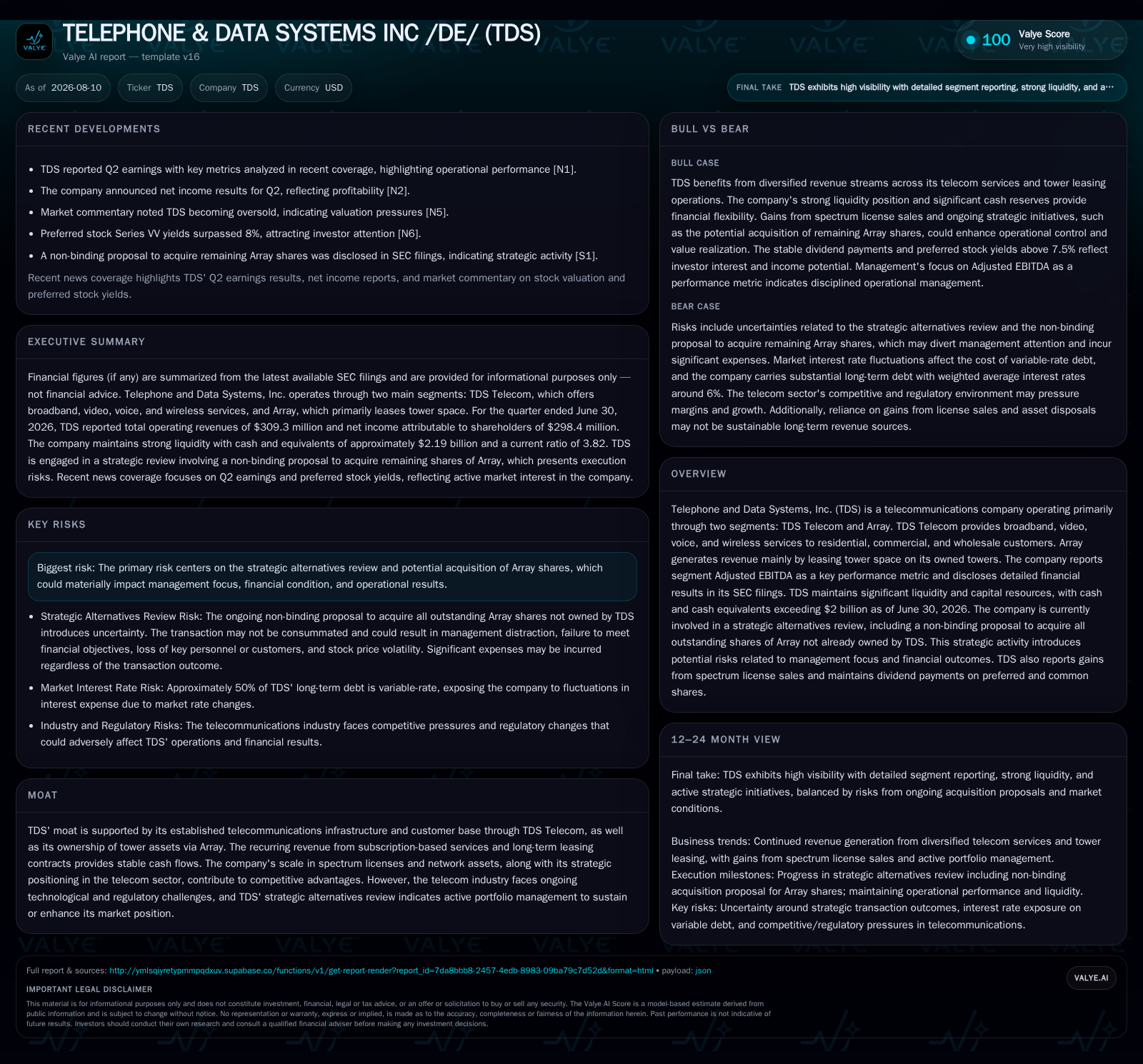
In Q2 2026, Telephone & Data Systems, Inc. (TDS) sustained solid profitability across its two main business segments—TDS Telecom and its tower leasing subsidiary, Array—driven by steady subscription revenues and high tower occupancy rates. The company reported an exceptional gain from wireless spectrum license sales that boosted income but faces operational focus risks due to a pending non-binding proposal to acquire remaining Array shares. TDS’s capital structure remains strong with ample liquidity and net cash, supporting flexibility amid ongoing strategic review. Key near-term milestones include potential consolidation outcomes of Array and continued broadband subscriber metrics.
Q2 Operational Highlights: Stable Segment Profitability Meets Strategic Alternatives Risk
Telephone & Data Systems reported solid financial performance in the second quarter of 2026 with consolidated segment Adjusted EBITDA reaching $126.6 million. This result was bolstered by contributions from its dual segments: $70.4 million from TDS Telecom’s subscription-based services and $56.2 million from Array’s tower leasing operations [S2][S7]. While core operations show resilience marked by stable revenues and controlled costs, a substantial one-time net gain exceeding $411 million was realized from wireless spectrum license sales during the quarter. This gain significantly lifted income before income taxes to approximately $448 million despite ongoing operating expenses [S7][N1].
Simultaneously, the company disclosed a strategic alternatives review process initiated by a non-binding proposal delivered on May 7, 2026 to acquire all outstanding common shares of its subsidiary Array not already owned by TDS. While the terms remain uncertain and transaction completion is not guaranteed, TDS emphasized the possibility of adverse impacts including management distraction from day-to-day operations, volatility in stock price, additional expenses related to the review process, and potential disruptions across customer and employee relationships [S2]. This dual narrative highlights strong operational execution underpinned by recurring revenue streams juxtaposed against strategic risks affecting future capital allocation and corporate focus.
Dual-Core Business Model: Subscription Services Meet Infrastructure Leasing
At its core, TDS operates through two fundamentally complementary business models: retail telecommunications services via TDS Telecom and infrastructure asset monetization via Array. The telecom segment provides broadband internet access alongside video programming packages, voice telephony services, and wireless connectivity primarily targeting three customer groups—residential users seeking bundled consumer packages; commercial clients requiring tailored communication solutions; and wholesale partners relying on bulk network capacity procurement [S4][S7]. Monetization proceeds chiefly through recurring subscription fees with ARPU (average revenue per user) shaped by product mix and service tiers.
On the other hand, Array specializes in leasing cellular tower space to multiple tenants through long-term contracts supported by high occupancy rates that mirror benchmark tower operators such as American Tower or Crown Castle. Such contracts generate steady cash flows insulated from subscriber churn volatility inherent in retail telecom services. Notably, Array reported short-term imputed spectrum lease income approximating $23.8 million in Q2 alone—a reflection of strategic spectrum asset deployments within the tower portfolio [S7]. Together these segments synergize stable subscriber-derived revenue with infrastructure leasing dynamics offering diversified income streams vital for enduring sustainability in capital-intensive telecom sectors.
Industry Positioning: Competing Across Telecom Service Provision and Tower Ownership
Within the broader telecommunications services landscape characterized by integrated service providers like AT&T or Verizon at one end and specialized infrastructure owners at another, TDS occupies a hybrid value chain position spanning retail service provision through TDS Telecom while commanding significant infrastructure assets via Array. This duality positions the company uniquely amid regional broadband providers such as Frontier Communications on the retail side and major national tower leasing firms on the infrastructure front.
Competitive pressures in broadband provision manifest through pricing dynamics influencing churn rates as customers weigh alternatives amidst cable operators or wireless incumbents. Concurrently, regulatory scrutiny affects both segments—particularly around spectrum licensing obligations that impose compliance requirements potentially limiting operational flexibility [S8][S11]. Ongoing federal litigation stemming from prior FCC auction participation involving Array continues to pose potential contingent liabilities albeit presently managed through motions seeking dismissal [S11]. Capital expenditure decisions thus juggle requirements for network upgrades maintaining service competitiveness alongside investments sustaining tower asset quality required for lease renewals.
Growth Catalysts: Leveraging Broadband Demand and Tower Asset Monetization
Multiple secular trends underpin growth opportunities for TDS. Increasing consumer demand for high-speed broadband access linked to telework adoption and streaming video consumption drives subscriber base expansion prospects within TDS Telecom’s service territories. This growth potential is augmented by ARPU improvements as consumers up-tier or bundle services enhancing unit economics.
Simultaneously, the proliferation of 5G networks necessitates denser cellular configurations which expand demand for tower leasing capacity benefitting Array’s portfolio occupancy levels. Managed enterprise networking solutions provide additional avenues where customized telecom infrastructure nurtures higher-margin offerings.
Capital expenditures allocated roughly $179 million for TDS Telecom network expansion against a modest $3.9 million dedicated to Array indicate ongoing prioritization toward enhancing consumer-facing infrastructure while maintaining tower assets capable of sustained lease contract renewals [S7][S23]. These investment patterns signal confidence in leveraging both sides of TDS’s franchise amid technological evolutions shaping competitive positioning.
Risks from Strategic Review: Management Focus, Financial Outcomes, and Integration Challenges
Despite operational strengths, TDS explicitly flags material risk from its strategic alternatives review centered on acquiring residual shares of Array. The company acknowledges uncertainties regarding transaction completion which could precipitate management diversion away from core business execution potentially impairing achievement of operational objectives or customer retention [S2]. Moreover, additional costs incurred during review—including legal fees—directly impact profitability metrics.
Regulatory risk persists due to ongoing litigation relating to wireless spectrum auction compliance alleging possible False Claims Act violations against entities affiliated with Array. Although prior favorable rulings have reduced exposure such matters remain active with motions pending dismissal—highlighting latent contingent risk factors that bear monitoring for financial impact or reputational consequences [S11][S8].
Further integration considerations would emerge if the acquisition proceeds given previous minority interests held in Array necessitating alignment across corporate governance structures potentially inducing post-transaction complexity requiring deft management attention.
Near-Term Milestones: Acquisition Outcomes, Subscriber Metrics, and CapEx Execution
Key upcoming events warrant close observation as indicators of directional momentum or challenge for TDS’s business profile expansion trajectory. In particular:
- Progression toward definitive agreements around the proposed full ownership of Array remains pivotal potentially reshaping ownership stakes impacting consolidated results.
- Subscriber count trends across broadband/wireless product lines serve as leading indicators reflecting competitive positioning relative to regional peer sets.
- Churn rate fluctuations will signal effectiveness at retaining customers amid sector pricing pressures.
- Execution against planned capital expenditures especially related to fiber acquisitions (e.g., Granite State Communications purchase expected Q3 2026) reflects commitment toward broadening network reach critical for sustaining growth aspirations [S23][N1]
Monitoring these markers will elucidate whether operational leverage supports durable Adjusted EBITDA expansion or if strategic uncertainties curtail reinvestment appetite.
Financial Profile Discussion: Strong Liquidity Underpins Strategic Flexibility
From a balance-sheet standpoint as of June 30, 2026, TDS exhibits robust liquidity with cash & cash equivalents amounting to approximately $2.19 billion contrasted against total debt near $671 million resulting in a net cash position exceeding $1.5 billion that materially underpins financial flexibility at manageable leverage levels (current ratio around 3.82) [F1]. This conservative capital structure fosters capacity for both organic investments—such as continued CapEx programs—and potential acquisition financing without imposing immediate distress concerns.
Fixed- versus variable-rate debt splits evenly providing some insulation against interest rate volatility though overall average coupon remains near 6% consistent with telecom sector norms amid rising borrowing costs [S2]. Free cash flow generation driven by positive operating activities coupled with gains on licensing transactions further reinforces internal funding capabilities ensuring sustainability.
This financial strength contrast favorably against peers who may carry higher leverage ratios thereby constraining investment agility especially in periods demanding technology upgrades integral for competing effectively within fast-evolving connectivity markets.
This analysis synthesizes information obtained exclusively from Telephone & Data Systems’ recently filed SEC disclosures as well as publicly available market commentary without extrapolation beyond verified data points provided [F1]. It does not constitute investment advice but aims to highlight operational developments and contextual industry framing relevant for understanding evolving enterprise execution dynamics within integrated telecommunications service provision combined with infrastructure asset monetization models.
Disclaimer: This is research-only, informational analysis and not investment advice. It may include AI-generated interpretation and general industry context. Always verify important details using primary sources.

Comments