
Oklo Advances Fast Fission Nuclear Power Amid Fuel Supply and Regulatory Milestones
Oklo progresses reactor licensing, fuel recycling, and isotope production with plans to commercialize its modular Aurora powerhouses.
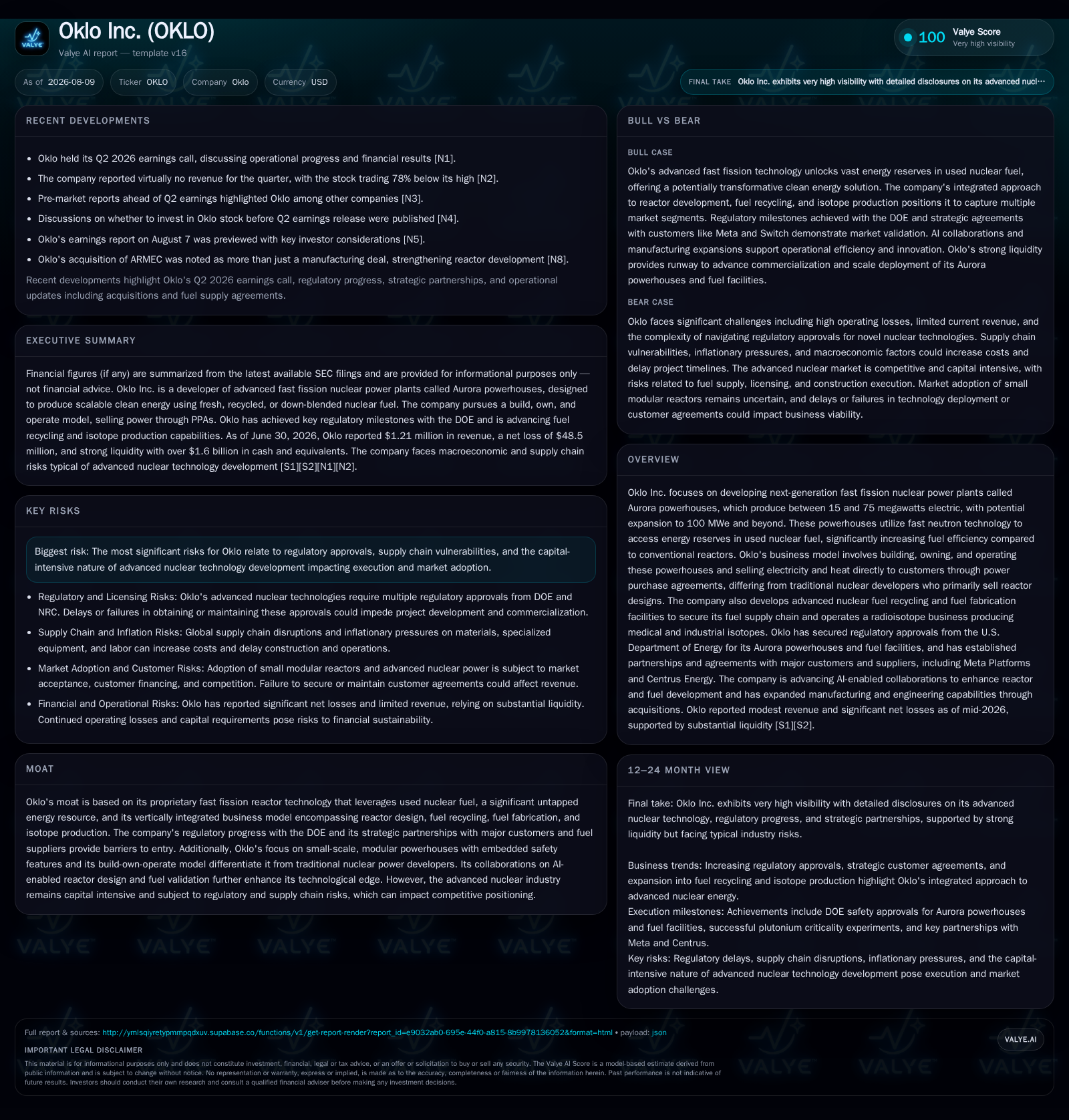
In Q2 2026, Oklo reported continued advancement of its fast fission small modular reactors (SMRs) technology, notably reaching criticality on its Groves Isotope Test Reactor and progressing licensing for its Aurora powerhouses. The company is building vertically integrated capabilities by developing fuel recycling and fabrication facilities to secure supply chains amid an inflationary and supply-constrained environment. Strategic partnerships and government collaborations underpin fuel sourcing and AI-enabled design innovation, positioning Oklo distinctively in the advanced nuclear power sector. However, substantial regulatory, capital intensity, and supply risks persist as Oklo targets commercial deployment starting in 2028.
Recent Operating Update
Oklo’s Q2 2026 filing highlights critical progress across its core operational domains: licensing, fuel supply, reactor demonstrations, and strategic partnerships [S2]. Notably, the Groves Isotope Test Reactor attained first criticality on August 5, 2026 [S13], representing an important validation step of Oklo’s ability to integrate radioisotope production within its nuclear ecosystem. Additionally, the company achieved several regulatory approvals including the Nuclear Safety Design Agreement and Preliminary Documented Safety Analysis (PDSA) both for the Aurora reactors at the Idaho National Laboratory (INL) site and its associated fuel fabrication facility [S2][S11][S12]. These milestones reduce regulatory uncertainty around the commissioning timeline that targets late 2027 or early 2028 for the first commercial powerhouse [S9][N1].
Fuel supply developments were also material this quarter. Oklo entered into a non-binding memorandum of understanding with Standard Nuclear Inc. to explore recycled nuclear fuel purchases [S2], signaling steps toward its diversified fuel sourcing strategy. This complements an existing letter of intent with Centrus Energy Corp. for a multi-year supply of domestically produced high-assay low-enriched uranium (HALEU), expected to start deliveries in 2029 [S18]. Concurrently, the company advances participation in the DOE’s Surplus Plutonium Utilization Program to deploy plutonium-based fuels [S12], providing operational flexibility during evolving fuel market dynamics.
Strategic partnerships announced include collaborations supporting the Genesis Mission that leverages artificial intelligence (AI) technologies from NVIDIA Corporation, Los Alamos National Laboratory (LANL), Battelle Energy Alliance, and INL [S18][S19]. These efforts aim to improve efficiency in multiphysics reactor modeling, fuel validation especially for plutonium-bearing fuels, digital twin development, grid reliability studies, and overall engineering workflows. Integration of AI represents a competitive advantage by accelerating complex design processes intrinsic to novel reactor systems.
Business Model Overview
Oklo operates primarily as an integrated developer-owner-operator of advanced nuclear power facilities centered on its proprietary Aurora line of small modular reactors (SMRs). The Aurora reactors utilize fast fission technology capable of running on fresh uranium fuels, recycled nuclear fuels recovered from used spent fuel pools via proprietary recycling technologies, or down-blended fuels including plutonium-based materials [S1][S22]. This fast neutron spectrum approach significantly increases nuclear fuel utilization efficiency compared to conventional thermal reactors which harness roughly 5% of original fissile material energy content.
Revenue generation is expected through long-term power purchase agreements (PPAs) where Oklo sells both electricity and industrial heat product to end customers predominantly in high-demand sectors such as data centers (e.g., via arrangements like Meta Platforms' prepayment funding), energy-intensive industrial enterprises, military bases (e.g., Eielson Air Force Base), and utilities exploring clean baseload options [S16][S18]. Oklo’s vertical integration extends beyond power production to nuclear fuel cycle services including manufacturing of advanced fuels at on-site fabrication facilities approved under DOE programs such as Fuel Line Pilot Program (FLPP) [S15][S19], as well as construction plans underway for large-scale commercial fuel recycling plants targeting operations in the early 2030s [S11][S20]. These integrated capabilities aim to secure supply chains for critical inputs while creating additional revenue streams from recycled fuel sales.
Complementing this is Oklo’s radioisotope business acquired through Atomic Alchemy, expanded via the Groves Isotope Test Reactor project designed to produce medical and industrial isotopes vital for emerging AI infrastructure applications alongside traditional energy and defense uses. This diversification potentially cushions cyclicality inherent in electricity markets by anchoring base revenues on isotopes sales under DOE contracts combined with use of internally developed reactor technology [S2][S13]
Industry Structure and Competitive Positioning
The advanced nuclear power generation industry comprises developers of next-generation reactors that offer enhanced safety architectures, improved economics at smaller scales, scalable modular designs, and novel fuel cycle approaches improving sustainability. Oklo competes alongside peers such as TerraPower (advanced fast reactors), NuScale Power (modular light-water reactors), BWX Technologies (fuel fabrication and isotopes), and broader incumbents like Exelon operating legacy fleets.
Oklo distinguishes itself through rapid regulatory progress enabled by embedding safety features facilitating safety analysis acceptance by DOE; demonstrated experimental validation campaigns at national labs supporting fast-spectrum plutonium-fueled designs; an integrated build-own-operate commercial model providing asset ownership economics not reliant solely on license fees; and vertical integration securing fuel recycling output linked directly back into Aurora powerhouses [S1][S11][S14]. However, competition arises from reactors leveraging better-established licensing pathways or utility-owned models potentially capturing captive power demand without third-party ownership risk premiums.
Macroeconomic pressures such as inflation impacting steel prices, specialized component procurement challenges due to limited suppliers manufacturing first-of-a-kind parts designed for Oklo’s unique technology stack remain ongoing challenges typical across the industry [S1]. Securing repeatable fueling contracts combining HALEU procured domestically along with recycling outputs addresses critical raw material constraints faced by all peers due to limited global availability.
Growth Drivers
Oklo’s growth prospects hinge on surging demand for reliable low-carbon baseload energy prompted by accelerating electrification trends across transportation sectors, industrial processing shifts away from fossil fuels, worldwide carbon emissions regulations tightening energy portfolios towards nuclear options; rapidly expanding data center footprints driven by AI/cloud infrastructure requiring stable uninterrupted supplies; government incentives subsidizing next-gen clean energy tech deployments; breakthroughs in reactor technology reducing upfront capital intensity relative to legacy plants; expanded domestic uranium enrichment ecosystems facilitating HALEU availability; advancing fuel recycling technologies unlocking near-unlimited U.S. spent-fuel-derived resources; rising geopolitical interest pushing energy sovereignty initiatives supporting distributed regional SMR builds; strategic collaborations integrating AI-driven design shortening iterative development cycles; and the multi-decade horizon allowing scale economies to emerge across successive Aurora deployments.[N1][S16]
Additionally, Oklo’s diversification into radioisotope production supports parallel growth vectors given increasing demand across medical diagnostics/treatment fields coupled with emerging AI-related industrial applications requiring isotopic sources unavailable via competing non-nuclear methods.
Risks and Constraints
Primary risks stem from Oklo's still nascent commercial stage exhibiting negative cash flow profiles as significant capital expenditures are expended ahead of any plant commissioning revenues [F1]. Regulatory approval timelines remain inherently uncertain despite favorable DOE milestones recently accomplished due to complexity surrounding licensing under both DOE RPP processes and eventual NRC licensing required prior to operation outside federal sites [S1][S13]. Delays here would push out revenue onset dates sharply.
Supply chain vulnerabilities persist given reliance on few suppliers able to fabricate ultra-specialized reactor components vital for safety-function systems uniquely tailored for fast reactors compared with common thermal designs [S1]. A similar concentration exists around advanced nuclear fuels such as HALEU where global capacity remains constrained causing upward price pressure exacerbated by tariffs or sanctions impacting uranium enrichment feedstock availability.
Inflationary cost escalations impact not only raw materials but also skilled labor rates contributing to execution risk amid tight project scheduling tied intimately with government funding disbursement timing that can be disrupted by changing fiscal priorities or political shifts [S1]. Market adoption risks relate to competing clean energies advancing aggressively such as renewables plus storage alternatives that can increasingly meet grid reliability thresholds at rapidly declining costs creating pricing ceiling pressures on nuclear generated wholesale prices affecting PPA negotiations negatively.
Personnel retention challenges arise within specialized engineering talent pools required for ongoing innovation cycles essential given reactor novelty maximizing safe operational limits while achieving competitive economics. Any failure to sustain relationships securing key customer PPAs or binding agreements may materially impair cash generation ability until multiple plants are commissioned given long sales lead times associated with utility procurement cycles currently experienced across peers.
What To Watch Next
Key upcoming milestones include:
- Construction progress updates on Aurora-INL powerhouse aiming at late 2027/early 2028 first unit startup confirmation along with pre-commercial operating licenses progression;
- Fuel recycling facility licensing trajectory implications post-NRC pre-application engagements planned through late 2020s accelerating final permitting;
- Final negotiated contract terms emerging from ongoing discussions with Standard Nuclear Inc. regarding recycled fuel purchase definitives expected within this fiscal year;
- Advances from AI collaboration programs yielding demonstrable improvements in model accuracy or engineering cycle time reductions impacting key cost estimates;
- Additional binding PPAs executed especially with large data center customers or utilities adding materially sizable capacity projects expanding beyond current LOI backlog exceeding ~18 GW equivalent implied pipeline scaling;
- Supply chain normalization signals calming recent inflation-driven component cost escalations aiding steady-state margin forecasts;
- Execution on announced Advanced Fuel Center $1.68 billion capex plan developing final design package authorization steps before construction launch.
Monitoring these indicators will shed light on Oklo's capacity to convert pipeline engagements into contractual backlog growing reliably toward its commercial operational phase while simultaneously mitigating critical execution risks highlighted throughout filings.
Financial Profile Discussion
From a liquidity perspective as of Q2 June-end 2026 Oklo holds approximately $1.64 billion in cash & equivalents against modest current liabilities near $52 million yielding a very strong current ratio around 48.5x signifying ample short-term financial flexibility amid ongoing development spending [F1]. Total debt stands low near $42.5 million reflecting limited leverage usage so far supporting sustained capital investment primarily funded through equity raises confirmed by recent $440 million public offerings closed mid-2025 plus strategic investor commitments [S21][F1].
Operating results remain loss-making consistent with early commercialization status reporting net losses exceeding $105 million annually given sizeable investments deployed into R&D personnel costs; facility construction capex; engineering consulting fees needed throughout long multi-year development lifecycle phases prior to revenue onset expected post-Aurora startup after target date window around late CY27/early CY28 [F1][N1]
Future positive cash flow conversion depends heavily upon successful commissioning followed by stable operational uptime delivering contracted PPA revenues which offer scalable margin improvement versus initial R&D-heavy years.
This analysis aims purely at providing insight into Oklo Inc.'s business dynamics based on verified SEC filings and recognized industry context without issuing any investment research views or forecasts.
Disclaimer: This is research-only, informational analysis and not investment advice. It may include AI-generated interpretation and general industry context. Always verify important details using primary sources.

Comments