
Treace Medical Concepts Accelerates Foot and Ankle Surgical Innovation with Strengthened Market Position
Treace Medical’s latest quarterly results highlight accelerating revenue growth driven by product innovation and reinforced by active patent protection despite ongoing operating losses.
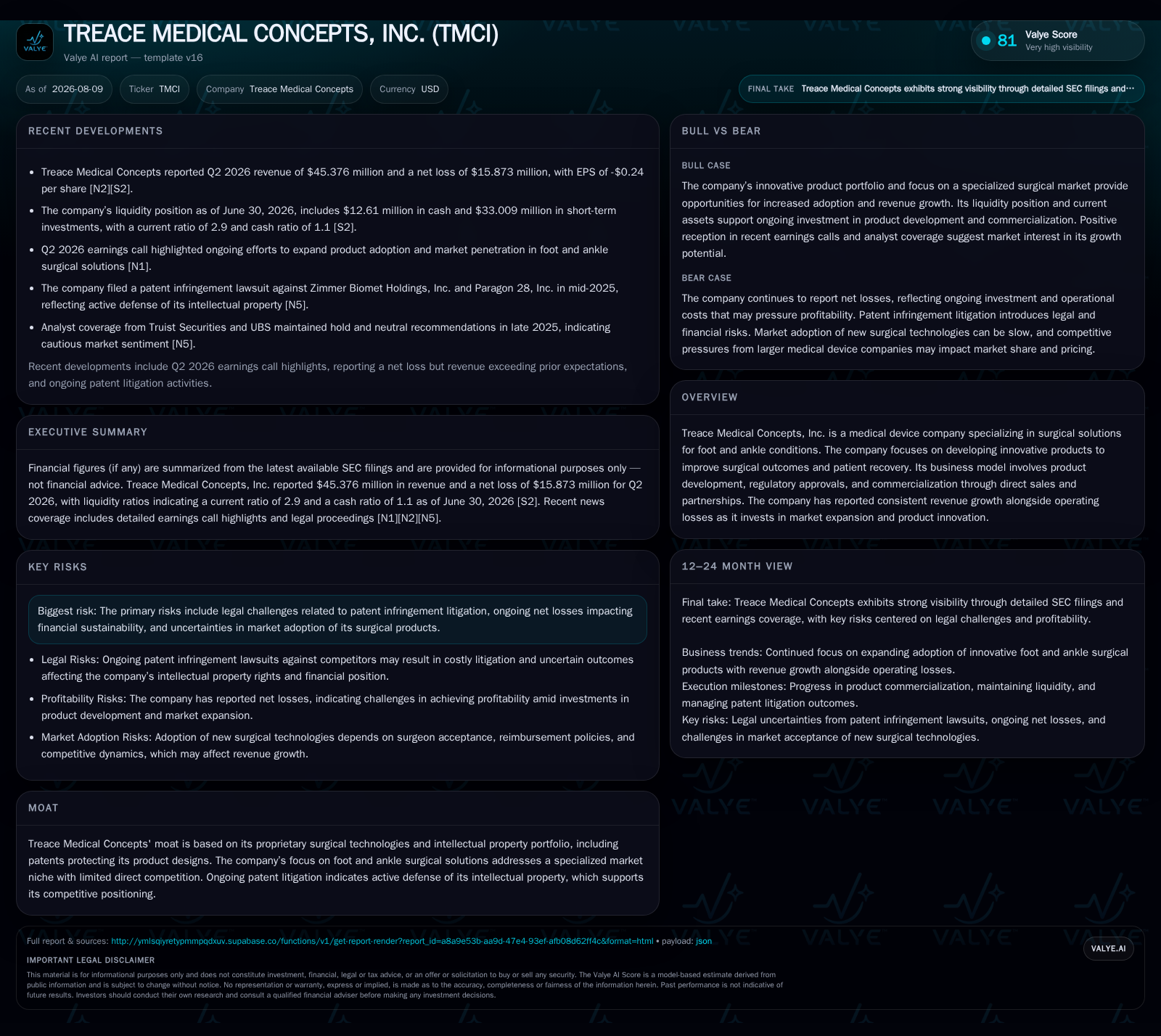
Treace Medical Concepts reported a revenue beat in Q2 2026, reflecting growing adoption of its innovative foot and ankle surgical devices. The company’s business model centers on proprietary orthopedic implants marketed through a direct sales force complemented by distributor partnerships, underpinned by ongoing regulatory clearances and clinical evidence development. While active patent litigation confirms the strength of Treace’s intellectual property moat, it also contributes to near-term financial risks. The path to growth depends on expanding surgeon adoption, geographic penetration, and successful navigation of reimbursement and competitive pressures. Financially, Treace maintains a solid liquidity buffer with $12.6 million cash against $60 million debt as of June 2026 but continues to operate at losses due to heavy R&D and SG&A investments.
Q2 Operational Momentum Validates Product Commercialization Strategy
In its latest quarterly filing on August 7, 2026, Treace Medical Concepts revealed a solid operational performance with revenues surpassing previous estimates. This growth is attributable primarily to increased utilization of their orthopedic implants in surgical cases involving foot and ankle reconstruction and bunion correction procedures [S2][S3][N1][N2]. The rising case volume signals advancing market adoption within a specialized orthopedic niche where surgeon choice leans heavily on clinical outcomes and product familiarity.
Despite the positive topline trajectory, Treace continues to report operating losses—a reflection of strategic reinvestment into market expansion via expanded direct sales efforts and intensified R&D spending to support new product launches.
Proprietary Surgical Technology Fuels Targeted Revenue Expansion Amid Challenging Adoption Curve
Treace’s business model revolves around designing specialized orthopedic implants tailored for foot and ankle conditions. These products require rigorous regulatory clearances before commercialization—a barrier protecting incumbents but also dictating innovation pacing [S1]. The company emphasizes bunion correction devices that combine patented design features intended to improve surgical precision and patient recovery time.
R&D expenditure remains historically significant relative to revenues, underscoring Treace’s commitment to sustaining an innovation pipeline that can overcome surgeon preference inertia typical in orthopedic surgery sectors. This dynamic is critical since surgeons often adopt new tools only after demonstrable clinical evidence accrues over multiple case examples.
Patent Litigation Underpins Competitive Moat but Poses Financial Risks
A cornerstone of Treace's competitive positioning is its intellectual property portfolio fortified by multiple patents covering its core device designs. Active patent litigation illustrates management’s aggressive defense strategy aimed at protecting market exclusivity from established orthopedic device manufacturers or emerging competitors [S1][S7].
While this reinforces structural barriers to entry—critical for premium pricing power—it also introduces financial risks through litigation-related costs and potential contingencies. Ongoing cash burn partly reflects these dynamics alongside the usual costs tied to prolonged legal engagement.
Direct Sales Execution and Distributor Partnerships Forge Market Penetration Pathways
Go-to-market efforts combine a focused direct sales force targeting orthopedic surgeons within hospitals and surgery centers alongside a network of distributor partnerships extending reach beyond core territories [S1]. This dual-channel strategy balances personalized surgeon engagement critical for device adoption with scalable access across broader geographies.
Key Growth Drivers: Product Innovation, Clinical Evidence, and Geographic Reach
Treace identifies several vectors fueling incremental adoption: first, continuous product innovation validated through regulatory approvals enabling new launches; second, expanding clinical training programs enhancing surgeon proficiency with their systems; third, penetration into previously under-served geographic markets [S1][N1].
These drivers relate directly to sector trends where aging demographics increase foot and ankle disorder incidence rates. Moreover, favorable reimbursement policies for increasingly complex reconstructive surgeries provide an underlying demand base receptive to improved implant technologies if supported by robust clinical outcomes.
Risks Sharp Focus: Litigation Exposure, Market Adoption Hurdles, and Pricing Pressures
Primary risks disclosed include vulnerabilities from intense patent litigation which may result in costly settlements or injunctions impacting commercial freedom [S7]. Additionally, slower-than-expected market uptake could arise if surgeons remain hesitant pending more extensive use experience or competing products gain footholds.
Reimbursement variability poses classic headwinds affecting procedural economics for hospital payors—common across orthopedic implant makers including referenced peers like Wright Medical or Zimmer Biomet. Pricing pressures intensified by competitive dynamics or healthcare cost containment initiatives further challenge margin expansion prospects.
Milestones in Focus: Regulatory Approvals and Surgeon Adoption Trends to Monitor
Looking ahead, stakeholders should monitor upcoming regulatory clearance announcements that unlock new product introductions essential for sustaining growth momentum [S1][S2]. Parallelly, updates on clinical trial outcomes or surgeon training program expansions serve as tangible indicators of deepening market penetration.
These inflection points will provide clearer confirmation whether recent revenue acceleration translates into durable share gains amidst sector competition.
Financial Profile Discussion: Cash Flows, Operating Losses, and Leverage Context
As of June 30, 2026, Treace holds approximately $12.6 million in cash and equivalents against $60 million in total debt, resulting in a net debt position near $47.4 million while maintaining a healthy current ratio of about 2.9—signaling ample short-term liquidity coverage [F1]
The firm continues ramping investments into R&D and SG&A expenses aligned with extending its innovation pipeline and scaling commercial infrastructure. These factors contribute to sustained operating losses reported annually that reflect strategic tradeoffs typical for emerging medical device innovators betting on long-term growth over near-term profitability [F1][S2].
Capital structure terms involve secured loans backed by company assets including intellectual property—a common financing mechanism providing flexibility yet imposing regular interest obligations potentially sensitive to earnings variability [S5]
Overall, Treace's financial stance provides reasonable runway though vigilance remains warranted on cash burn rates relative to progress against commercial scaling milestones.
Disclaimer: This is research-only, informational analysis and not investment advice. It may include AI-generated interpretation and general industry context. Always verify important details using primary sources.

Comments