
Alpha Metallurgical Resources Elevates Production Amid Coal Market Volatility
Alpha Metallurgical Resources advances production and leverages a diversified contract portfolio to navigate persistent metallurgical coal price fluctuations in Q2 2026.
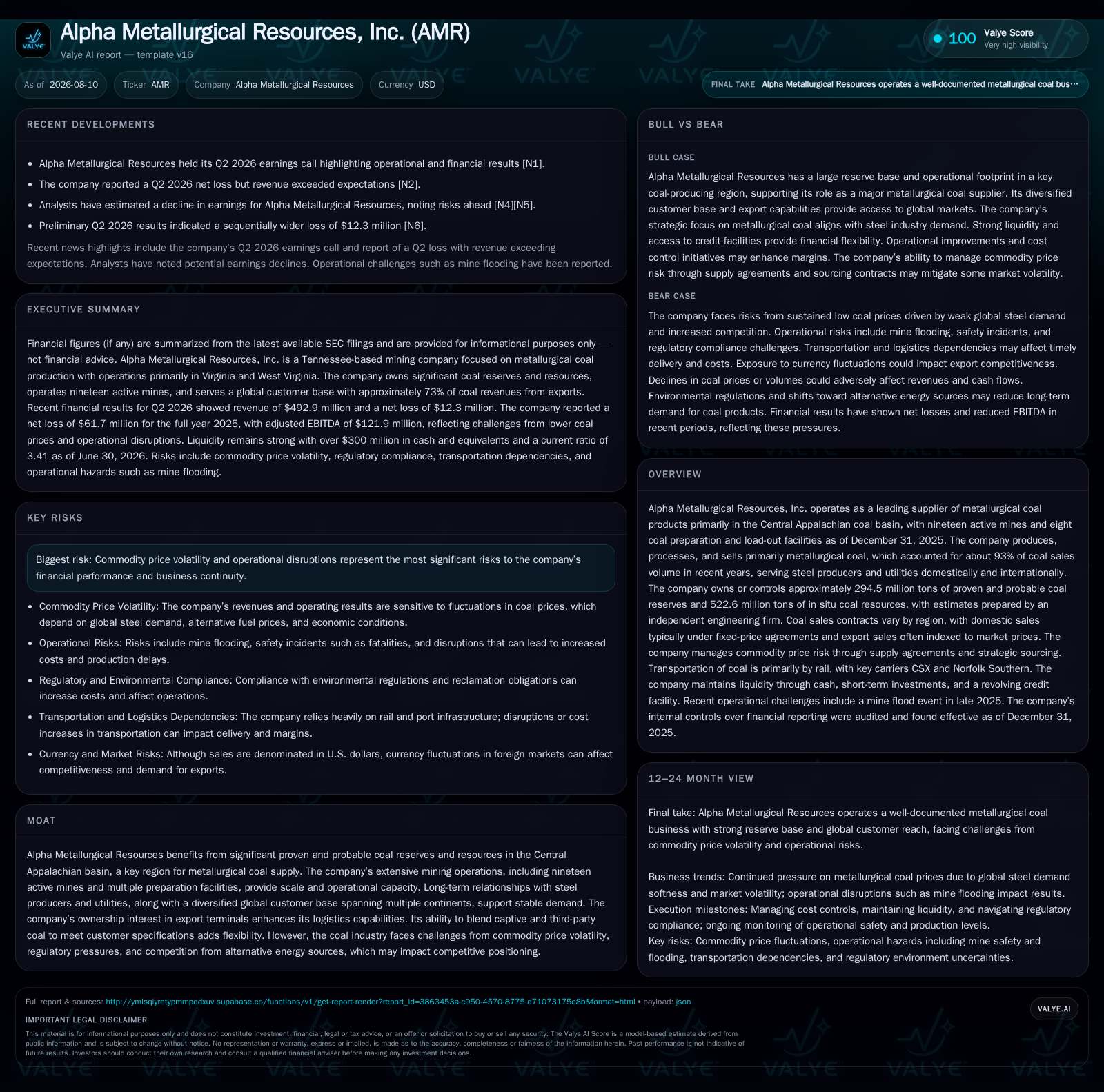
In its Q2 2026 filing, Alpha Metallurgical Resources (AMR) reported increased production volumes driven by restarts of idled mines, signaling operational resilience amid volatile metallurgical coal prices. The firm’s focus on fixed-price contracts domestically paired with market-indexed export sales shapes a balanced revenue profile that moderates commodity price risk. AMR’s ownership of significant Central Appalachian coal reserves and control over export logistics assets underpins its competitive positioning despite regulatory pressures and market cyclicality. Key risks remain commodity price swings and operational disruptions, while growth hinges on reserve quality utilization and market demand recovery indicators.
Q2 Production Expansion Sets Operational Tone for 2026
Alpha Metallurgical Resources (AMR) demonstrated tangible operational progression in its Q2 2026 report, with coal production volumes rising compared to the prior quarter. This increase is primarily attributed to reactivations within the Elk Run mining complex — previously idled due to cost inefficiencies during softer met coal prices — signaling management’s confidence in market recovery [S2]. Restarting Elk Run’s Checkmate Powellton mine mitigates past production shortfalls caused by elevated costs and facilitates improved scale leverage. This uptick enhances fixed asset utilization across their nineteen active mines in the Central Appalachian basin. The concurrent maintenance of mine operating costs per ton is pivotal here; emerging data suggests containment of cost pressures, an encouraging sign given inflationary headwinds faced industry-wide.
Production capacity directly impacts revenues as tonnage sold is fundamental within their business model: AMR monetizes extracted metallurgical coal primarily through shipments to steel producers domestically and internationally. Higher volumes underpin top-line resilience when pricing pressure persists.
Metallurgical Coal Portfolio Composition and Customer Contracting Insights
Metallurgical coal comprises roughly 93% of AMR’s coal sales volume, affirming its strategic pivot away from thermal coal after divesting thermal-focused operations in Pennsylvania [S1]. The product suite spans several coal quality grades: High-Vol A/B from surface mines within Kingstone/Mammoth complexes, Mid-Vol from underground mines like Kingston’s Douglas seam, and Low-Vol from new developments such as the Wildcat underground mine slated for production ramp-up [S1]. This diverse grade distribution supports tailored consumption requirements from steelmakers sensitive to coke quality.
Importantly, contract structures form a balanced risk-return profile. Domestic sales are largely conducted under fixed-price contracts, offering revenue stability insulated from spot market swings. Conversely, export sales—accounting for about 73% of coal revenues—are generally priced via market-indexed contracts, exposing AMR to global metallurgical coal price volatility influenced by cycling steel demand in countries like India and Brazil [S1][S14]. This mix enables AMR to capture upside in buoyant export markets while maintaining downside protection at home.
Coal blending capabilities further differentiate the firm by enabling bespoke customer specifications through combinations of captive and third-party sourced coals at their preparation plants. Such flexibility is a competitive advantage amid heterogeneous global steelmaking requirements.
Industry Structure Shapes Pricing Power and Competitive Differentiation
Alpha Metallurgical's positioning benefits substantially from its Central Appalachian proven and probable reserves totaling roughly 294.5 million tons with additional sizable in situ bituminous resources estimated at over half a billion tons [S1]. This reserve base offers meaningful longevity relative to peers such as Arch Resources and Contura Energy operating similar seams but often contending with variable reserve qualities or more limited logistics reach.
The industry’s high capital intensity—exemplified by costly underground mining methods—and long permitting cycles act as natural barriers limiting new entrants or swift capacity expansion. However, pricing power is tempered by the commoditized nature of metallurgical coal where global benchmark pricing influences contract negotiations; thus, AMR’s ability to navigate between fixed-price domestic contracts and indexed exports is an essential hedge against cyclical downturns.
Logistics and Terminal Control Bolster Market Access Advantage
A distinctive element of AMR’s competitive strategy lies in its control over critical logistics infrastructure. The company manages multiple rail load-out facilities directly linking their preparation plants to major railroads (CSX and Norfolk Southern), crucial for reliable delivery schedules amidst tight supply chain conditions [S1]. Beyond rail access, AMR owns a substantial 65% stake in Dominion Terminal Associates (DTA), an export terminal at Newport News providing vital storage capacity and blending services enabling flexible shipment timing and quality adjustments [S11].
Owning terminal stakes contrasts favorably versus competitors reliant solely on third-party port facilities where loading delays or capacity constraints can erode margins. The company invests circa $21 million annually toward DTA upgrades over five years to minimize downtime—a necessary step given previous mechanical reliability issues impacting shipping cadence [S11]. This strategic logistics command consolidates AMR's supply chain resilience enabling competitive timeliness especially in premium met coal export markets.
Growth Prospects Driven by Reserve Quality and Market Demand Trajectories
AMR’s resource quality coupled with ongoing development projects underscores growth potential albeit within structural limits inherent to mining timelines. Notable is the Wildcat underground mine—developed since 2024—with expected initial output commencing early 2026 producing Low-Vol met coal valued highly by certain steel producers emphasizing sulfur restrictions [S1][S2]
Reserve life estimates vary by seam quality but generally reflect multi-year horizons sufficient to sustain or modestly grow volumes if supported by favorable market prices. Nonetheless, long lead times for mine development cap rapid scaling possibilities; thus growth relies heavily on gradual ramp-ups rather than step-changes.
Global steel production trends drive underlying metallurgical coal demand; infrastructure investment cycles particularly in emerging markets represent key drivers stimulating export volumes. Conversely, environmental regulations tightening across jurisdictions inject uncertainty into long-term prospects given associated compliance costs.
Key Risks: Price Volatility, Operational Reliability, and Regulatory Pressures
The foremost risk shaping AMR's earnings volatility remains commodity price fluctuations inherent to globally traded metallurgical coal affected by upstream steel industry cycles [S1]. While contract mix partially hedges this risk, significant spot exposure remains through export index-linked agreements. Additionally, diesel fuel cost volatility impacts production expenses given expected diesel consumption exceeding 22 million gallons annually [S1], accentuating margin squeeze potential if input prices surge.
Operational disruptions represent another material hazard. For instance, an unplanned flooding event at the Rolling Thunder mine incurred non-recurring costs in late 2025 impacting short-term throughput and requiring remediation investments [S21]. Safety incident rates also correlate directly with productivity losses; thus ongoing workforce training and equipment maintenance are critical operating KPIs.
Environmental regulatory frameworks impose incremental capital expenditure needs particularly regarding reclamation obligations under the Surface Mining Control Act as well as bonding requirements for worker compensation claims such as black lung benefits contributing notable financial assurances that reduce liquidity flexibility [S15][S16]
What to Monitor Next: Margins, Contract Renewals, and Production Metrics Ahead of Q3
Key near-term indicators are forthcoming Q3 volumes which will affirm whether Q2 production gains are sustainable post-mine restarts especially at higher-cost complexes like Elk Run [N1][S2]. Closely watched will be average realized prices differentiating fixed-contract domestic sales from fluctuating export realizations reflecting international demand shifts.
Contract renewal cadence could reshape exposure profiles if there is any shift toward greater fixed-price contracting mitigating commodity swings. Progress on infrastructure upgrades at DTA terminal might also impact shipment efficiency metrics influencing export profitability.
Capital expenditure alignment with operational results will signal management discipline amidst challenging macroeconomic conditions ensuring that investment supports productive capacity rather than inflating overheads unnecessarily.
Financial Profile Discussion: Liquidity Strength Supports Strategic Flexibility
As of June 30, 2026, AMR maintained approximately $308 million in cash and equivalents against modest total debt near $8.2 million yielding a negative net debt position close to $299 million — a robust liquidity stance unusual among mid-sized miners [F1]. Current ratio stands healthy at about 3.4x reflecting prudent working capital management amid volatile revenue streams [F1].
Despite recording a net loss during latest fiscal periods due primarily to macro-driven lower realized prices impacting operating income negatively at approximately -$61 million last full year-end [F1], AMR’s balance sheet strength provides leeway for opportunistic capital allocation including continued modest share repurchases controlled within available cash flows as per Board discretion [S8][S9]. Such financial flexibility provides buffer against cyclicality inherent in metallurgical coal mining operations.
This analysis is based exclusively on publicly available filings and news sources without any forward-looking projections or research views. Details herein reflect management reports as of August 7th, 2026 filings complemented by sector expertise characteristic of upstream metallurgical coal mining operations serving domestic steel producers with growing global export footprint diversification.
Disclaimer: This is research-only, informational analysis and not investment advice. It may include AI-generated interpretation and general industry context. Always verify important details using primary sources.

Comments