
USBC Advances Tokenized Deposit Platform Amid Execution and Liquidity Challenges
USBC is progressing through multi-phase delivery of its blockchain-enabled US dollar tokenized deposits, leveraging strategic partnerships while navigating regulatory and financial hurdles.
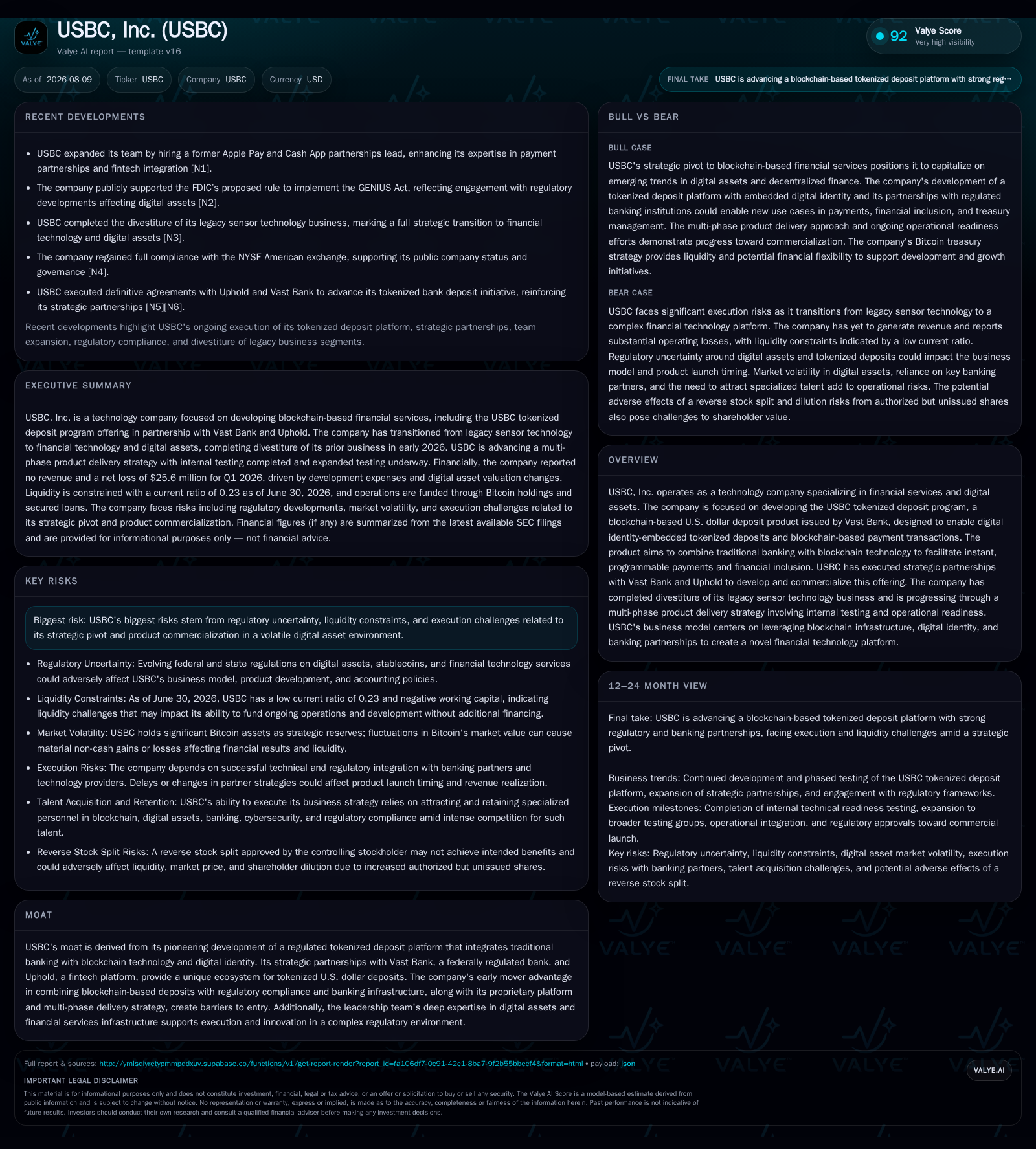
USBC continues developing its USBC tokenized deposit program, a blockchain-based digital dollar product integrating regulated banking with programmable payments. The company is advancing internal pilot testing and product readiness, supported by partnerships with Vast Bank and Uphold. However, USBC faces material liquidity constraints, ongoing operating losses driven by development costs and digital asset volatility, and the regulatory uncertainty typical of tokenized deposit platforms. Near-term milestones include phase progression toward retail launch and operational readiness, with successful execution dependent on capital availability and regulatory approvals.
Recent Operating Update: Phase 1 Testing and Capital Raise
USBC’s quarterly report for the period ending June 30, 2026 highlights steady advancement of its phased delivery strategy for the US dollar tokenized deposit platform. The company is actively conducting Phase 1 internal pilot testing within controlled employee environments to validate core functionalities such as onboarding workflows, digital identity recovery mechanisms, ACH funding integration, transaction processing including spending and treasury conversions, messaging infrastructure, and comprehensive activity logging. This foundational testing is essential to verify operational resilience ahead of any wider public release [S2], [S26].
On the financing front, USBC drew an additional $3 million in July 2026 under its Master Loan Agreement with Payward Interactive, raising total borrowings to $18 million at an 8.5% fixed interest rate due July 2027. Despite this capital infusion, liquidity remains strained as evidenced by a current ratio near 0.23 at quarter-end—reflecting significant current liabilities relative to available assets—and underscoring the capital intensity of blockchain deposit platform development alongside persistent operating losses [F1], [S3].
Business Model: Tokenized Deposits Enabled by Regulated Banking Partnerships
USBC operates at the confluence of traditional banking and blockchain infrastructure by offering U.S. dollar-denominated tokenized deposits issued through federally regulated banking partners. This model enables customers to hold blockchain-based digital representations of fiat deposits embedded with digital identity credentials that facilitate programmable payments directly on the ledger.
Strategic partnerships are central: Vast Bank functions as the federally chartered issuing bank underwriting customer deposits behind these tokenized liabilities. Uphold provides fintech platform integration including consumer-facing mobile and web interfaces. Under this tri-party framework, USBC acts as network operator delivering core blockchain ledger services coupled with wallet functionality and developer portals designed for extensibility into third-party applications post-launch [S11], [S25].
This partnership model addresses critical regulatory compliance challenges confronting many blockchain-enabled deposit initiatives by blending banking oversight with innovative programmable payment capabilities—creating potential competitive moats against less-regulated stablecoin issuers.
Industry Structure & Competitive Positioning
Tokenized deposits reside where regulated banks intersect with decentralized ledger providers and fintech payment platforms. Peer categories include stablecoin issuers (e.g., Circle’s USDC) who offer blockchain-backed fiat substitutes but generally lack direct bank-account issuance governed under federal charters.
USBC differentiates itself through regulated issuing bank custody combined with native programmable payment features enabled by smart contracts and integrated digital identity layers supporting financial inclusion objectives. However, this approach entails intricate compliance demands exceeding those faced by pure stablecoin or payment-token competitors.
Companies lacking robust licensed banking partners face higher regulatory barriers or trust deficits that may impede adoption.
Growth Drivers
Key growth catalysts for USBC include rising demand from consumers and merchants for instant-settlement payment solutions transcending legacy ACH or card rail delays. Programmable payment utilities enabled through smart contracts enhance automation potential across financial workflows.
Evolving regulatory acceptance towards blockchain-enabled banking products opens avenues for innovative offerings featuring enhanced identity verification that promote broader financial inclusion.
Product developments like USBC Pay—enabling direct consumer-to-merchant on-chain U.S. dollar transactions that bypass traditional card networks—signal steps toward expanding real-world utility critical for driving network effects required for scaling transaction volumes [S18].
Institutional interest in digital asset treasury strategies coupled with growing stablecoin adoption also create tailwinds potentially benefiting demand for tokenized fiat deposits.
Risks & Constraints
Regulatory uncertainty remains a dominant risk given evolving federal stances toward stablecoins and tokenized deposits that could impose new compliance costs or operational restrictions affecting product viability.
Execution risks include platform security vulnerabilities inherent in nascent blockchain infrastructures; delays or failures during pilot phases could defer commercial launch timelines.
Liquidity constraints pose ongoing challenges amid significant quarterly operating losses ($25.6 million net loss in Q1 2026) heavily driven by unrealized $20 million impairments on Bitcoin holdings used within treasury strategies—highlighting exposure to volatile crypto markets [S17], [S23].
Concentration risk arises from dependency on a limited number of strategic partners—primarily Vast Bank—for fiduciary issuance roles.
Additionally, competition for specialized talent in blockchain finance may hamper development velocity.
What To Watch Next
Upcoming milestones will focus on Phase 1 pilot outcomes informing timing for subsequent phases culminating in public retail launches subject to board approvals and regulatory clearances from banking partners. Operational KPIs such as test user onboarding rates, transaction throughput under stress conditions, system uptime reliability, and KYC completion rates will be key indicators of readiness.
Balance sheet updates regarding capital availability—especially potential equity raises or expanded credit facilities—will indicate capacity to sustain development burn rates through extended commercialization horizons.
Market reception to initial USBC Pay merchant deployments will provide early validation needed to attract further fintech integrations enhancing network extensibility.
Financial Profile Discussion
As of June 30, 2026, USBC held approximately $3 million in cash equivalents against nearly $20 million in current liabilities resulting in a current ratio around 0.23—indicating acute short-term liquidity pressures amid heavy investment cycles focused on platform engineering and compliance activities [F1], [S2].
Net debt stands above $1 million considering outstanding borrowings primarily from fixed-rate loans due next year constraining financial flexibility absent additional funding events [F1], [S3].
Operating losses persist reflecting elevated SG&A expenses driven by stock-based compensation ($3.3 million), vendor payments related to program development ($4.7 million), plus public company administrative overheads (total SG&A approximately $11 million in Q1) [S17]. These costs substantially exceed near-term revenue prospects given early-stage commercialization status
Digital asset valuation swings significantly impacted earnings via a $20 million fair value loss on Bitcoin holdings illustrating treasury management risks inherent in hybrid crypto-financial institutional models deployed during commercial gestation phases [S17], [S23].
USBC’s near-term financial viability depends critically on securing incremental capital or monetizing crypto holdings judiciously while advancing product commercialization phases toward revenue generation from transaction fees or interest spreads once publicly launched.
This analysis synthesizes recent filings evidencing USBC’s ongoing transformation into a pioneer at the intersection of regulated banking issuance and programmable blockchain deposits. While technological progress is evident via phased pilot rollouts and merchant payment functionality alongside strategic banking fintech partnerships, significant risks related to capital constraints, regulatory dynamics, execution fidelity, and volatile digital asset exposures remain key watchpoints shaping future competitive positioning within this emerging fintech niche.
Readers should consider this an analytical overview rather than investment advice.
Disclaimer: This is research-only, informational analysis and not investment advice. It may include AI-generated interpretation and general industry context. Always verify important details using primary sources.

Comments