
Minerva Neurosciences Advances CNS Pipeline Amid Strong Liquidity Position
Clinical-stage biopharma Minerva pursues roluperidone development with healthy cash reserves supporting near-term milestones.
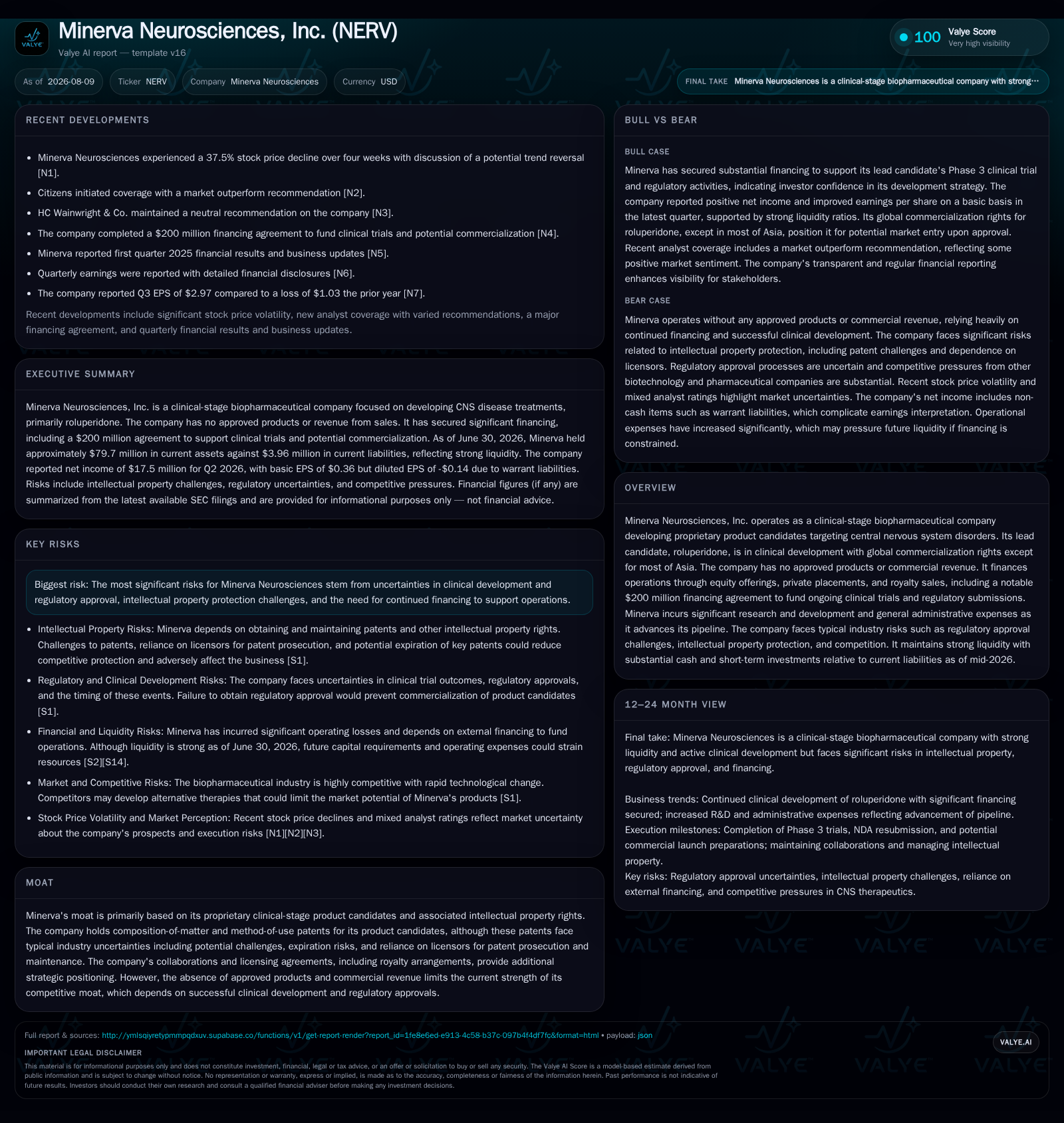
Minerva Neurosciences, a clinical-stage company focusing on central nervous system disorders, provided its Q2 2026 update reaffirming progress on its lead product candidate roluperidone. With no commercial products yet, the company relies heavily on equity financing and royalties to fund R&D. Its latest quarterly filing confirms a robust liquidity profile with over $24 million in cash and equivalents and a very strong current ratio, positioning it well to advance key clinical trials and regulatory work. Intellectual property protection continues to be a strategic focus amid typical biotech development risks.
Recent Operating Update
Minerva Neurosciences’ latest quarterly filing as of June 30, 2026 reiterates its clinical-stage status focused on proprietary treatments for central nervous system (CNS) disorders [S2]. Notably, it maintains no products approved for commercial sale yet and generates no product revenue. The company primarily supports operations through equity offerings, private placements, royalties from licensing agreements, and milestone payments linked to ongoing collaborations [S1]. As disclosed in the August 7, 2026 earnings press release [S3], Minerva emphasizes advancing its lead candidate roluperidone globally outside most of Asia.
The company reported holding $24.65 million in cash and cash equivalents at quarter-end alongside current assets totaling approximately $79.7 million versus current liabilities around $3.96 million. This results in an exceptionally strong current ratio of about 20.14x [F1], signaling substantial short-term liquidity to fund near-term clinical trial costs and general operating expenses. The concentration of cash equivalents in short-term highly liquid instruments minimizes counterparty credit risk [S2].
Business Model
Minerva operates predominantly as a clinical-stage biopharmaceutical firm whose value creation hinges on advancing drug candidates through costly multi-phase clinical trials toward regulatory approval—a lengthy process common in biotech focused on CNS disorders. Revenue is typically expected from milestone payments tied to collaborator achievements (e.g., Janssen partnership), royalty streams post-approval, and eventual product sales [S1]. However, until approval occurs, reliance on capital raises via equity issuance remains critical.
Its lead compound roluperidone is strategically significant: possessing global commercialization rights except most Asian markets underscores focused geographic control while allowing potential regional partnerships. This licensing model is emblematic of biotech firms that often out-license or collaborate early with pharma partners to leverage development expertise and broaden commercialization reach.
R&D investment dominates operating expenses due to the inherent nature of drug development requiring extensive human trials for efficacy and safety validation. Additionally, Minerva incurs general administrative costs tied to infrastructure supporting scientific innovation, regulatory compliance, and intellectual property management [S2],[S1].
Ownership of patents—both composition-of-matter (protecting the chemical entity) and method-of-use claims—is vital for protecting competitive advantage. Yet Minerva depends partly on licensors for prosecution and maintenance of some patent families, introducing potential vulnerability should licensors deprioritize these patents [S1]. Failure to maintain intellectual property rights could erode exclusivity periods essential for returns post-approval.
Industry Structure and Competitive Position
Operating within the biotechnology sector specializing in CNS therapeutics situates Minerva in a high-risk/high-reward segment characteristic of extended development timelines absent commercial income until approval phases conclude successfully. Peers such as Sage Therapeutics and Acadia Pharmaceuticals likewise pursue neuropsychiatric disorder treatments across varying developmental stages offering comparative context regarding pipeline breadth and progression challenges.
Biogen and Eli Lilly stand as aspirational commercialization benchmarks given their extensive track records navigating regulatory pathways for CNS disorders; partnerships or licensing deals with such established pharmaceutical companies are common strategies for firms like Minerva to enhance market access upon approval.
The competitive landscape is shaped by innovative modalities targeting complex CNS conditions where unmet medical needs remain high but scientific hurdles tend to slow progress. Thus intellectual property strength combined with positive clinical data becomes pivotal differentiation factors.
Growth Drivers
Key growth drivers reside primarily in successfully advancing clinical trial phases for roluperidone along with other pipeline candidates possibly under evaluation. Positive clinical outcomes significantly increase chances of regulatory submissions gaining approval—an event that would trigger milestone fees and later royalty revenues.
Strategic collaborations provide not only financial support but also access to development expertise; however, milestone payments tied to partner achievements remain uncertain until realized [S1]. The presence of a sizable $200 million financing arrangement underlines confidence from investors or royalty entities keen to underwrite Minerva’s progression through pivotal development stages.
Unmet therapeutic needs in CNS diseases alongside emerging scientific insights fuel long-term demand potential. Additionally, evolving regulatory frameworks occasionally offer expedited pathways which could shorten time-to-market for breakthrough therapies.
Risks and Watchpoints
Minerva faces the inherent biotech uncertainties: failure or delay in achieving positive clinical trial results would substantially impede progress. Regulatory hurdles remain significant since approvals depend stringently on demonstrating both safety and efficacy within strict guidelines.
Patent portfolio management risk arises from dependence on licensors who control prosecution; if they halt maintenance or challenges arise from competitors’ patents, exclusivity might be compromised [S1]. Furthermore, any breach by collaborators such as Janssen on royalty obligations could compel Minerva into compensatory payments adversely affecting financial health.
Manufacturing scale-up complexities post-approval also merit attention as failure here can jeopardize commercial launch timing.
Cybersecurity threats pose non-trivial operational risks given reliance on sensitive data management; governance oversight attempts mitigating this exposure via layered executive responsibility [S1].
What to Watch Next
Upcoming milestones that will provide clearer demand signals include roluperidone’s progression through late-stage trials toward regulatory submission events. Milestone achievement frequency linked to collaboration agreements will be critical markers indicating financial inflows stability.
Checkpoint events such as successful Phase III data readouts or FDA acceptance would substantially de-risk investment outlooks. Continued updates regarding the robustness of patent prosecution efforts remain noteworthy given their implications for competitive positioning.
Financial disclosures addressing burn rate adjustments relative to fundraising outcomes will clarify runway duration and capital structure health beyond the current quarter’s snapshot.
Financial Profile Discussion
As of June 30, 2026, Minerva reports cash and equivalents of approximately $24.65 million backed by current assets near $79.7 million against liabilities below $4 million. This yields an exceptionally high current ratio exceeding 20x—a strong liquidity buffer uncommon among peer biotechs at comparable stages [F1],[S2]. This ample liquidity supports ongoing advancement of clinical programs without immediate financing constraints.
Total debt levels appear modest relative to cash resources based on best-effort metrics; net debt approximates negative $19.9 million reflecting net cash position [F1]. Such a profile reduces near-term solvency risks but does not shield fully against dilutive pressures over longer horizons unless accompanied by successful asset monetization through licensing milestones or eventual commercialization.
Operating losses continue reflecting R&D intensity intrinsic to clinical-stage firms; managing net burn while progressing critical scientific objectives will remain a balancing act visible in subsequent reporting cycles [S3].
This analysis synthesizes Minerva Neurosciences’ latest public disclosures with biotechnology sector dynamics relevant to clinical-stage CNS-focused companies. All financial figures are grounded in the most recent SEC filings as of August 7, 2026 [S2],[S3],[F1]. No investment advice or price targets are included herein.
Disclaimer: This is research-only, informational analysis and not investment advice. It may include AI-generated interpretation and general industry context. Always verify important details using primary sources.

Comments