
MIAX Strengthens Multi-Asset Footprint Through Technological Edge and Strategic Growth
MIAX's Q2 2026 results demonstrate expansion driven by proprietary low-latency trading platforms across options, equities, futures, and international markets.
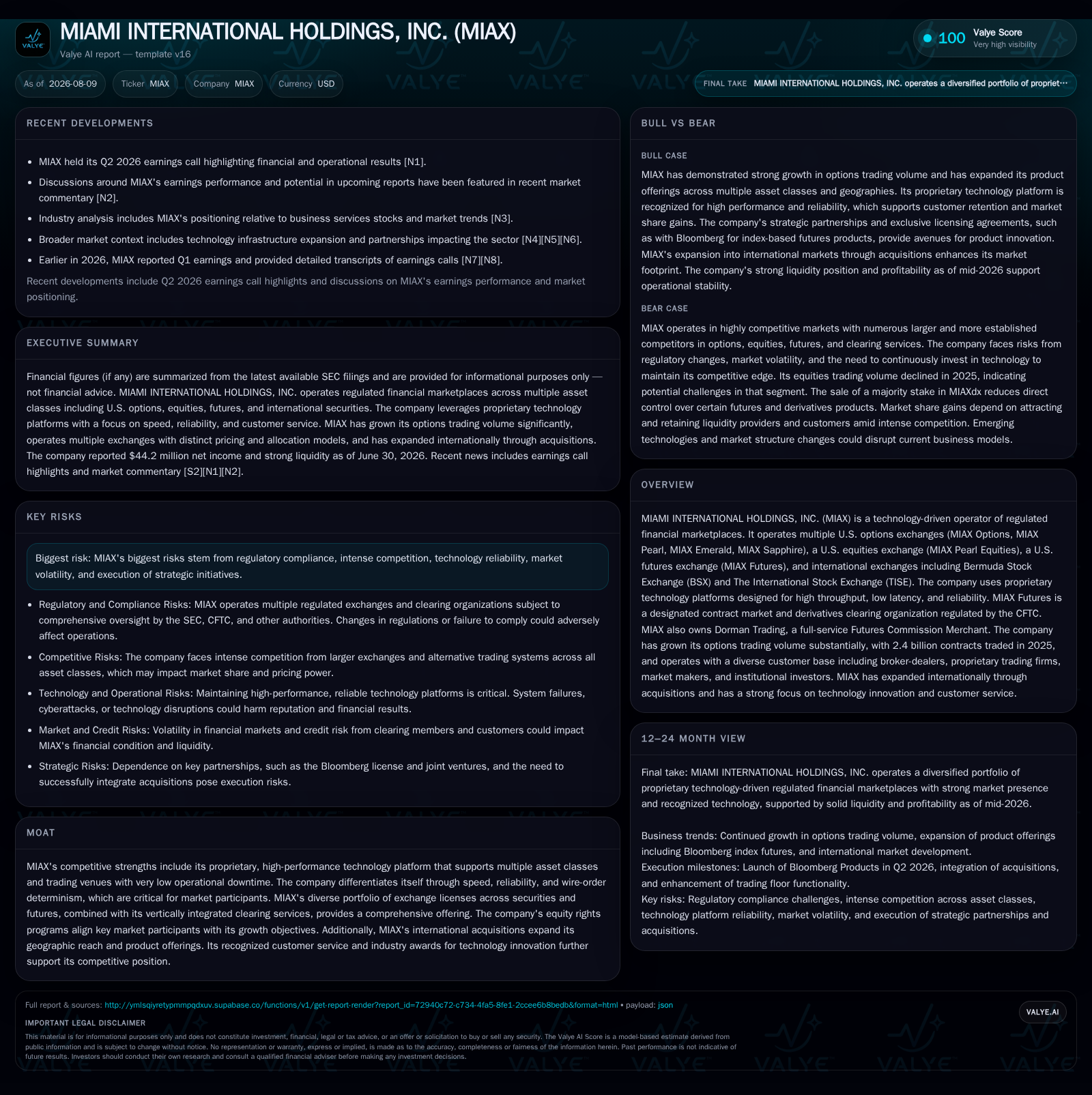
Miami International Holdings (MIAX) reported operational progress in Q2 2026 underscoring its strategy of leveraging state-of-the-art technology for multi-asset exchange growth. The company’s uniquely deterministic matching engines combined with its vertically integrated clearing and FCM services position it to capture expanding market volumes across U.S. and international jurisdictions. Recent strategic acquisitions and new product launches, including Bloomberg-licensed index futures, further diversify MIAX’s offerings. MIAX faces typical industry risks around regulatory complexity, competitive fee pressure, and technology reliability but maintains a strong liquidity profile supporting ongoing innovation.
Q2 Operational Dynamics Reinforce Tech-Driven Volume Gains
Miami International Holdings' latest quarterly report for Q2 2026 demonstrates continued traction in leveraging its technology-centric strategy to amplify trading volume across its diversified asset class ecosystem. The company reported that trading volumes on its U.S. options exchanges scaled consistently with underlying market demand dynamics aided by the superior performance characteristics of its matching engines [S2][S3]. Growth in average daily volume (ADV) for multi-listed options contracts reflects growing participation from broker-dealers, proprietary traders, and market makers attracted by fast execution speeds and reliable system uptime. This operational momentum is critical since transaction fees derived from contract executions are the principal revenue driver for exchange operators like MIAX.
While explicit numeric trends for Q2 volumes are not fully detailed in the report, MIAX's historical pattern of 41.1% increase in total options contract volume in 2025 to 2.4 billion contracts signals structural strength [S1][S23]. The continuing shift towards sophisticated derivatives strategies makes ultra-low latency execution vital—a domain where MIAX emphasizes differentiation through its platform architecture.
MIAX’s Proprietary Trading Architecture: Speed, Throughput, Determinism
A defining competitive moat for MIAX lies in its proprietary technology platforms developed in-house to deliver high throughput and exceptionally low latency order processing critical to modern electronic trading. The company’s MIAX Emerald Exchange boasts wire-order determinism ensuring that orders arriving within as little as eight nanoseconds maintain their relative processing sequence all the way through to the matching engine [S1]. Such precision sequencing is invaluable to latency-sensitive clients engaging in algorithmic and high-frequency trading who invest heavily in co-located data centers near exchange infrastructure.
Throughput capabilities allow MIAX to handle significant message traffic efficiently without bottlenecks or queuing delays, which can degrade consistent latency metrics, especially during periods of market volatility [S25][S29]. Moreover, multi-venue architecture spans multiple U.S.-regulated options exchanges—MIAX Options, MIAX Pearl, MIAX Emerald, MIAX Sapphire—and an equities venue (MIAX Pearl Equities), each employing tailored allocation models such as Price-Time or Pro Rata combined with differentiated fee structures like Maker-Taker or Taker-Maker [S13][S17]. This architectural foundation supports order flow diversification that shields revenue streams against single-product concentration risk.
Diversified Offering Across Options, Equities, Futures, and International Markets
Miami International has evolved into a multi-asset operator well beyond its initial options focus. It operates across regulated securities markets overseen by the SEC for options and equities and holds key licenses from the CFTC as a designated contract market (DCM) and derivatives clearing organization (DCO) via its wholly owned MIAX Futures Exchange [S1][S6]. This vertical integration extends with ownership of Dorman Trading LLC, a full-service Futures Commission Merchant (FCM), which provides clearing and execution services broadly covering institutional clients and retail intermediaries [S1][S17].
International expansion forms another significant leg of their strategy through acquisitions of the Bermuda Stock Exchange (BSX) and The International Stock Exchange Group Limited (TISEG), which operate under Bermuda Monetary Authority (BMA) and Guernsey Financial Services Commission (GFSC) regulation respectively [S4][S16]. These venues offer capital market instruments ranging from equities to insurance-linked securities largely targeted at global investors seeking offshore exposure. Integration efforts include migrating BSX trading to MIAX-developed systems enhancing operational efficiency.
This broad portfolio spanning multiple asset classes and geographies differentiates MIAX from peers primarily concentrated on a single asset class or domestic footprint. It also facilitates cross-selling opportunities between clients active in securities and futures while delivering clearinghouse scale economies.
Industry Landscape: Peers and Competitive Differentiators in Technology and Licensing
Within the fiercely contested financial markets infrastructure domain dominated by incumbents such as CBOE Group (options), Nasdaq (equities/options), CME Group (futures/clearing), and Intercontinental Exchange (ICE – multi-asset exchanges plus Clearing Corporations), MIAX carves out a niche emphasizing technological edge combined with tailored client service. Unlike some competitors focused on sheer scale or legacy dominance, MIAX competes on demonstrably lower latency systems coupled with wire-order determinism prized by quantitative trading firms [S11][S26].
Fees remain an intense battleground. MIAX employs varied maker-taker or taker-maker models appropriate for each exchange venue designed to stimulate liquidity provisioning while optimizing net fee capture [S17]. While these fee structures mirror peer patterns, smaller scale means competing effectively entails constant innovation both technologically and commercially.
Moreover, licensing breadth—covering SEC-approved national securities exchanges alongside CFTC-regulated DCM/DCO futures marketplaces—and complementary FCM operations create a vertically integrated ecosystem difficult for pure-play single asset exchanges to replicate fully.
Growth Catalysts: Product Innovation Propel Futures Expansion & Market Data Monetization
Product innovation anchors near-term growth initiatives highlighted by MIAX’s exclusive Bloomberg License Agreement allowing it to list proprietary index futures/options based on Bloomberg indexes such as the B500 Index starting mid-2026 [S4][S7]. These "small notional" products—offering granular exposure appealing to retail investors—expand futures offering beyond traditional agricultural contracts historically dominant at MIAX Futures.
Transitioning MIAX Futures from agricultural concentration towards broader financial derivatives enhances addressable market size while aligning with evolving customer demands for diversified risk management tools [S7][S21]. Complementing product innovation is expanding market data monetization—including real-time feeds licensed exclusively on Bloomberg platforms—that leverages proprietary order book data spanning equities and options venues [S22].
Market data revenue streams present higher margin recurring business less sensitive to cyclical volume swings albeit requiring continuous investment in analytics capabilities.
Key Risks Remain Centered on Regulatory Complexity & Execution Reliability Considerations
MIAX faces regulatory challenges customary to multi-jurisdictional exchange operators encompassing compliance burdens under SEC rules for equity/option markets plus CFTC requirements governing futures exchanges [S18][S28]. Potential changes in legislation altering payment-for-order-flow practices or limiting access fees could materially impact revenue profiles given dependence on transactional activity.
Clearinghouse risks centered on member defaults or abrupt margin calls present credit exposures necessitating prudent risk management policies particularly within Dorman Trading FCM operations exposed to counterparty credit risks [S18]
Pricing pressures stemming from increasing competition across U.S. equities/options exchanges force continuous reassessment of fee models potentially compressing margins if volume does not scale adequately [S26][S28]
Monitoring volume trends alongside technology uptime metrics will be essential early indicators of risk realization.
Upcoming Milestones To Monitor: Bloomberg Product Launch Timelines & Clearinghouse Growth Signals
Investors should monitor Q3/Q4 2026 product launches specifically regarding Bloomberg-index-based small-notional futures contracts debuting exclusively on MIAX Futures—expected to accrue incremental transaction fee income once customer adoption gains traction [S4][N1]. Market reception among retail brokerage channels will be telling for longer-term success.
Incremental clearing member sign-ups at MIAX Futures or Dorman Trading constitute another demand marker reflecting trust in clearinghouse stability critical amid industry consolidation trends [N1]. Also relevant are expanded listings from TISEG extending European reach which may enhance cross-border activity over time.
Tracking detailed pricing changes alongside volumes per venue will help assess pricing power sustainability versus competitive encroachment.
Financial Profile Discussion
Disclaimer: This is research-only, informational analysis and not investment advice. It may include AI-generated interpretation and general industry context. Always verify important details using primary sources.

Comments