
Rapid Micro Biosystems Advances Growth Direct Adoption Amid Cash Flow and Validation Challenges
The company reports steady Growth Direct system placements and validation progress while managing ongoing losses and financing conditionalities.
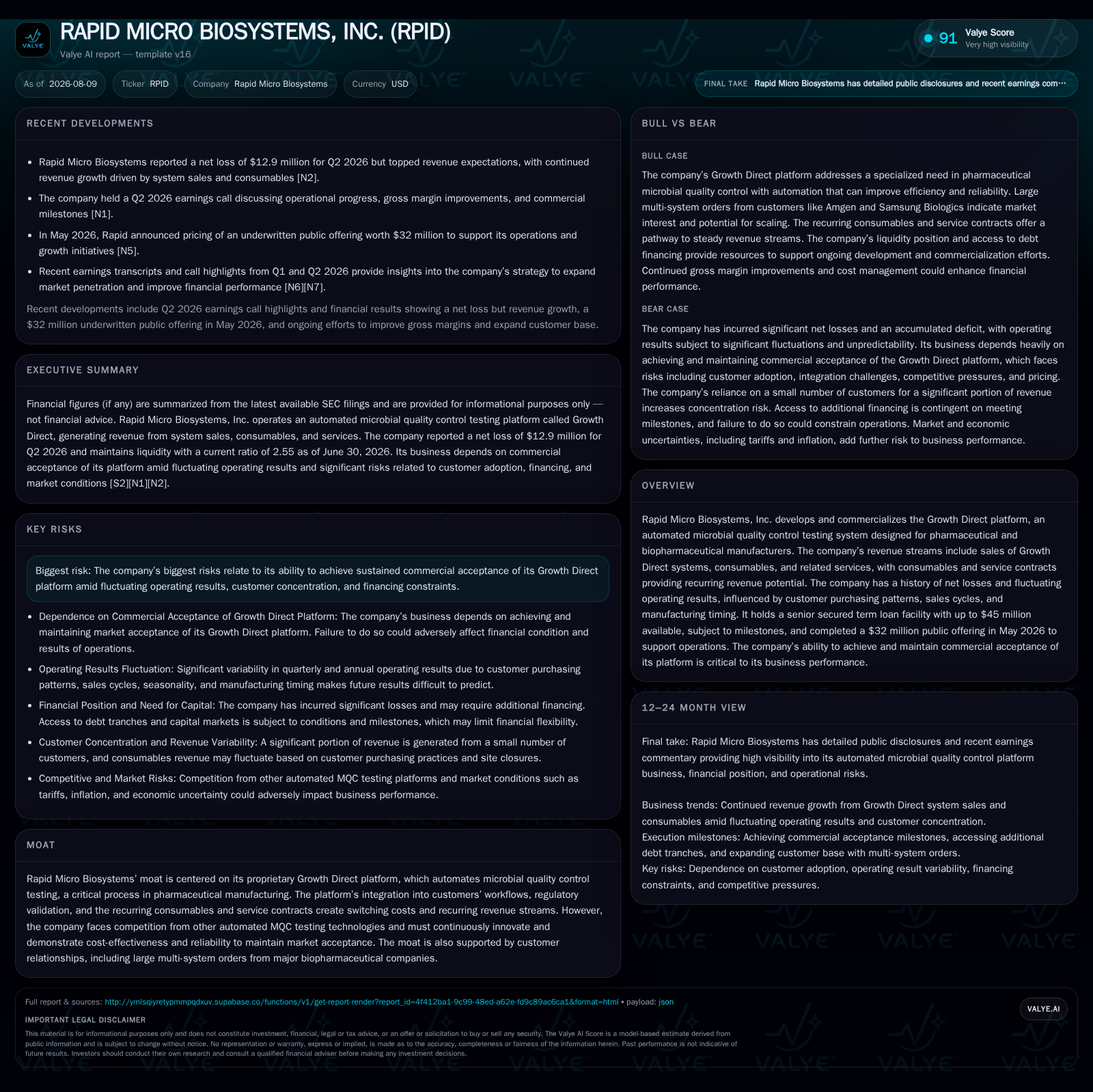
Rapid Micro Biosystems, Inc. continues its commercialization of the Growth Direct automated microbial quality control platform with increasing system placements and validated units in the second quarter of 2026. Despite persistent net losses and a sizeable accumulated deficit, the company benefits from recurring revenue growth driven by consumables and service contracts. Operating results remain affected by variable sales cycles, customer site readiness, and system validation timelines lasting several months. Financially, it holds approximately $19.9 million in cash and has secured up to $45 million in a senior secured term loan facility, with access to tranches contingent on operational milestones. The company’s future depends on accelerating customer adoption, maintaining commercial acceptance in a competitive MQC industry, improving gross margins, and securing stable financing to support R&D and manufacturing scale-up.
Recent Operating Update
In its Q2 2026 filing dated August 7, Rapid Micro Biosystems reported ongoing momentum in its core Growth Direct platform deployment during persistent operating losses [S2], [S3]. System placements during the recent period continued to increase cumulatively, reflecting successful penetration into pharmaceutical quality control workflows despite long sales cycles influenced by end-customer site readiness and construction timing. The company also advanced validations on placed systems—a critical step before customers commence regular use of consumables that generate recurring revenue [S1]. However, net loss for the quarter was $12.9 million, widening the accumulated deficit further to nearly $550 million as of June 30 [S2].
Business Model Insights
Rapid Micro Biosystems operates within the life science instruments sector focused on microbial quality control (MQC). Its flagship Growth Direct platform delivers automation hardware integrated with proprietary consumables and software connecting to customers’ laboratory information management systems (LIMS) [S1]. Revenue is generated initially through systems sales recognized upon transfer to customers—a capital-intensive upfront sale—followed by predictable recurring revenue streams from consumables usage contracts and service agreements essential for ongoing testing operations.
This dual-revenue model hinges critically on rapid adoption rates for system placements followed by thorough installation validation processes that can span three to nine months before full utilization commences [S1]. Once validated, these systems anchor durable consumable consumption backed by regulatory compliance requirements in pharma manufacturing environments where microbial contamination detection speed and precision are imperative.
Margins are influenced by manufacturing efficiencies of complex instruments and cost containment in consumable production; recent annual filings indicate gradual gross margin improvement trends but with potential quarter-to-quarter variability based on production scale and product mix shifts [S1]. The company’s monetization relies heavily not just on winning initial orders but also successfully onboarding clients into recurrent spending cycles rooted in proprietary components that create switching costs.
Industry Structure and Competitive Position
Rapid Micro Biosystems occupies a niche within pharmaceutical manufacturing supply chains as a provider of automated MQC testing technology—a sector traditionally dominated by manual or semi-automated procedures prone to longer testing cycles and labor intensity. The company competes against other laboratory instrument manufacturers offering alternative MQC automation solutions as well as services provided by contract research organizations specializing in quality control.
Compared broadly with peers such as Thermo Fisher Scientific or Agilent Technologies that have more diversified portfolios with analytic capabilities across various lab domains, Rapid Micro’s focus is narrower but specialized. Its moat derives from technological innovation embodied in its Growth Direct platform plus customer integration complexity involving regulatory validation processes that heighten switching costs once systems are installed. Nonetheless, competition includes legacy manual methods favored by entrenched pharmaceutical firms cautious about workflow disruptions.
Additionally, patent infringement claims represent a tangible legal risk given active intellectual property landscapes characterized by multiple claimants seeking dominance over MQC innovations. Litigation threat factors impose operational distraction potential along with financial liabilities if unsuccessful defenses arise [S19], [S20], [S23], [S24], [S25].
Growth Drivers
Several structural industry trends underpin underlying demand for Rapid Micro’s offerings:
- Increasing pharmaceutical regulatory scrutiny globally mandates faster microbial contamination analysis to ensure patient safety.
- Investments in automation aim to reduce testing cycle times and labor costs amid expanding biopharmaceutical manufacturing footprints worldwide.
- Growing preference to replace outdated manual or semi-automated microbiological testing tools accelerates Growth Direct system adoption potential.
- Proprietary consumables drive recurring revenue tied directly to installation base growth—validations serve as leading indicators for such expansion.
- Integration capabilities with digital laboratory management systems enhance platform attractiveness through workflow optimization.
These drivers foster an environment where customer willingness shifts towards innovative automated MQC solutions despite demanding adoption hurdles related to validation timelines [S1], [N1].
Risks / Constraints
Rapid Micro faces several interrelated risks:
- Commercial Acceptance Risk: The extended sales cycle coupled with variable timing in customer site readiness constrains predictability of system placements—resulting quarterly revenues can experience volatility impacting forecast reliability.
- Financing Risk: Dependence on conditional debt tranche releases tied to performance milestones restricts immediate access to capital needed for scaling R&D manufacturing productivity gains; failure to meet these triggers may impair operations [S22].
- Customer Concentration: Major biopharma accounts represent significant portions of orders; any reduction or delay from key customers strains stability.
- Competitive Pressure: Advances from competitors or improved legacy MQC methods could limit market share gains unless Rapid Micro continuously innovates successfully.
- Regulatory/Validation Delays: Validation periods ranging multiple months may slow convertibility from placed systems into recurring consumable revenue streams impacting cash flow profiles.
- Intellectual Property Litigation: Exposure to patent infringement claims entails costly legal defenses which also distract management resources.
These factors collectively will illuminate whether Rapid Micro can pivot from development-stage losses toward consistent positive cash flow achievement as intended per management objectives stated through guidance discussions [N1], [N2], [S1].
Financial Profile Discussion
As of June 30, 2026, Rapid Micro held approximately $14.7 million in cash and equivalents against current liabilities near $18.15 million yielding a current ratio of about 2.55—a reasonable short-term liquidity cushion considering ongoing operating expenses supported partly via senior secured debt facilities capped at $45 million subject to milestone-linked tranche releases [F1], [S6], [S13]. Total debt approximations stand near $26.2 million based on prior benchmarks albeit without definitive recent tranche draw detail disclosed publicly; estimated net debt after cash reserves suggests moderate leverage relative to asset base though with caveats around contingency access conditions which introduce refinancing risk if milestones slip [F1].
Net losses persist with year-end 2025 operating income recorded at negative $47.4 million while net loss totaled approximately negative $47.1 million signifying ongoing investments into product advancement rather than immediate profitability focus reflecting typical life science instrument commercialization trajectories entering scale-up phases especially within niche MQC automation segments where clinical/pharma validation complexity extends time horizons before durable returns emerge [F1], [S1], [S2].
This analysis integrates detailed insights from Rapid Micro Biosystems’ latest filings coupled with seasoned industry understanding highlighting operational nuances relevant for stakeholders monitoring early-stage life science instrument innovators transitioning toward commercial maturity within regulatory-impact-driven microbial quality control automation markets.
DISCLAIMER: This report is for informational purposes only without any investment advice or research views regarding securities mentioned herein.
Disclaimer: This is research-only, informational analysis and not investment advice. It may include AI-generated interpretation and general industry context. Always verify important details using primary sources.

Comments