
Fiserv Faces Operational Headwinds and Margin Pressure in Q2 Amid Strategic Tech Investments
Fiserv's latest quarterly filing reveals margin compression and operational delays driven by increased technology spending, testing the durability of its recurring revenue and goodwill buffers.
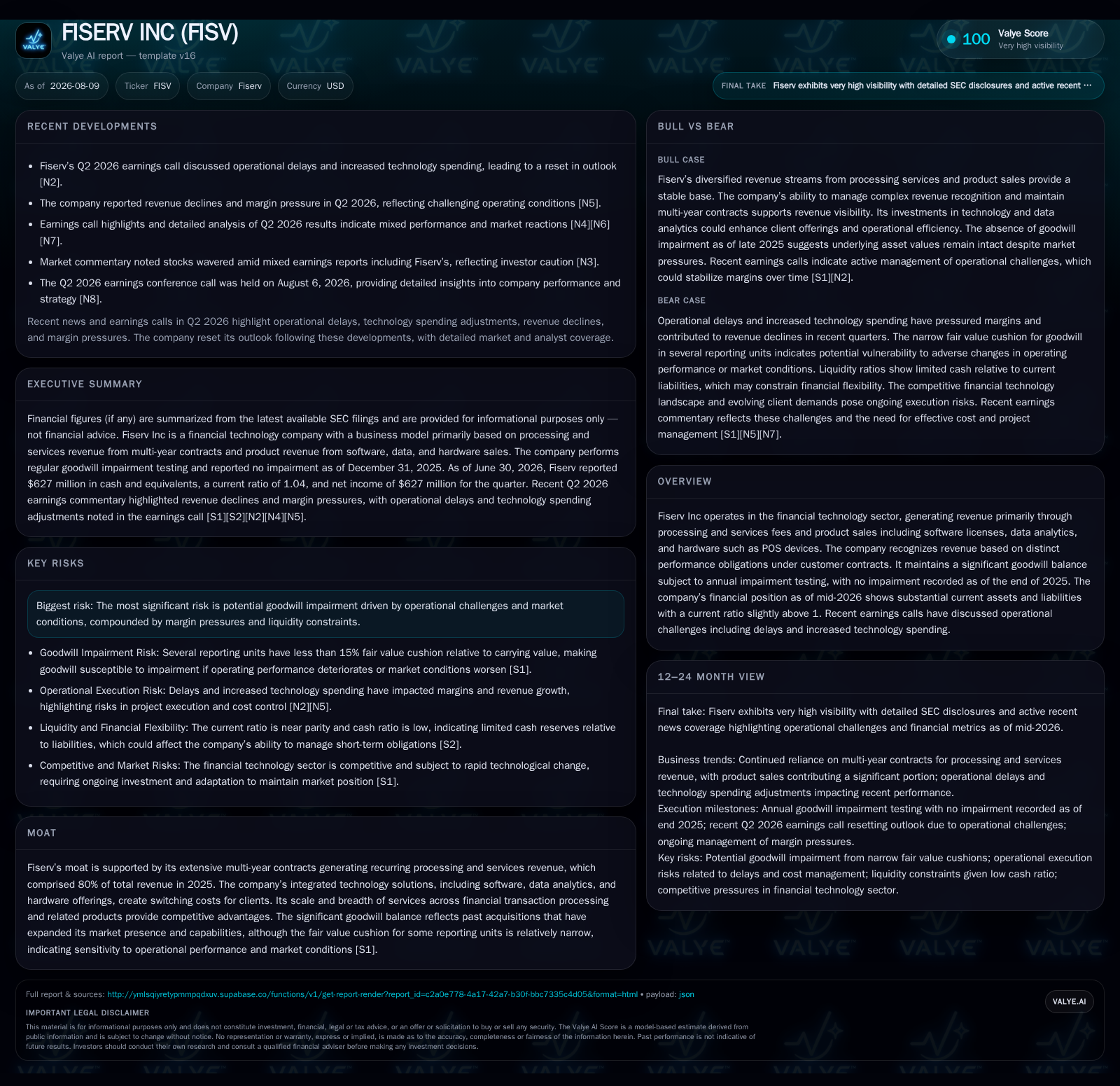
In its 2026 Q2 results, Fiserv Inc. flagged operational execution challenges that pressured margins and delayed strategic initiatives, amidst a significant ramp in technology investment. The company’s core business model relies heavily on multi-year contracts generating recurring processing and services revenue, which constitute roughly 80% of total revenue. However, integration complexities and competitive pressures raise questions about client retention and renewal risks that could affect revenue predictability. Meanwhile, Fiserv’s material goodwill balance faces impairment risk given narrow fair value cushions in key reporting units. Near-term performance hinges on execution of its 'One Fiserv' plan emphasizing AI-driven innovation and embedded finance capabilities.
Q2 Operating Headwinds Reshape Near-Term Margin Expectations
Fiserv’s August 7, 2026 10-Q filing outlines significant operational challenges that have weighed on second-quarter financial performance. The company disclosed delays in executing parts of its transformation initiatives alongside a pronounced increase in technology expenditure aimed at advancing platform innovation and operational excellence [S2]. These factors have exerted downward pressure on operating margins compared to prior expectations and contributed to a reset of near-term earnings outlooks as reported during the contemporaneous earnings call [N2], [N5]. Importantly, this elevated tech spend reflects strategic investments in artificial intelligence (AI) embedding across products and services rather than discretionary cost inflation. However, the timing mismatch between upfront expenses and longer-term benefits challenges margin expansion objectives over the short term.
Integration Complexities Cloud Multi-Year Contract Revenue Stability
At the heart of Fiserv's business model are recurring revenues stemming predominantly from multi-year contracts for payment processing, software-as-a-service (SaaS), and related merchant services. These contracts underpin approximately 80% of total revenue, providing a degree of revenue visibility and stability uncommon in many tech sectors [S1]. Yet recent disclosures reveal ongoing integration complexities post-acquisitions which have introduced execution risks affecting client onboarding timelines and renewal cadence [S1], [S2]. Such delays threaten to disrupt expected cash flow patterns locked in by long-term agreements. Given that contract renewals are critical for sustaining recurring fee streams—and these contracts often embed switching costs via tightly integrated software platforms coupled with POS hardware—any faltering retention or deferral in renewal decisions would meaningfully impair revenue predictability.
Recurring Revenue Base Anchored by Client Retention during Competitive Pressure
Fiserv’s moat is bolstered by its integrated suite combining payment processing (merchant acquiring and card issuer services), SaaS financial software, fraud protection solutions, data analytics offerings, along with hardware sales such as Clover® point-of-sale (POS) devices. This integrated ecosystem enhances stickiness through substantial client switching costs stemming from operational dependencies on multiple interwoven components. Despite this advantage, peer companies like FIS and Global Payments maintain scale parity while newer FinTech entrants focus aggressively on embedded finance innovation targeting niche verticals or smaller enterprise segments.
Furthermore, software license renewal rates—key to SaaS revenue durability—are subject to competitive pressures including pricing dynamics which may compress operating margins if not offset by productivity gains or volume growth [S1]. Fiserv’s emphasis on growing average revenue per client targets mitigation of churn impacts but remains vulnerable to macroeconomic factors influencing client budgets for technology spending
Technology Investment Surge Signals Strategic Pivot Amid Platform Evolution
The company’s recent surge in R&D and technology-related expense is aligned with management's stated intent under the 'One Fiserv' action plan to embed artificial intelligence capabilities throughout product lines and expedite development of omnichannel commerce platforms tailored for small to medium business (SMB) clientele through Clover® enhancements. This pivot aims to tap growing demand for embedded finance solutions that integrate financial services seamlessly into commerce workflows—a trend gaining momentum industry-wide.
While these investments bear meaningful upfront cost burdens contributing to compressed operating margins in Q2 2026, they represent a strategic imperative to modernize platforms in a rapidly evolving competitive landscape integrating AI-driven fraud detection, real-time analytics, and personalized customer engagement tools [S1], [S2]. Execution pace will critically determine whether such expenditures translate into sustainable competitive advantage or merely inflate cost bases.
Goodwill Cushion Vulnerabilities Spotlight Execution Risks
Supporting Fiserv’s market presence is a goodwill balance nearing $38 billion as of late 2025—a reflection of acquisition-driven scaling common across global payment processors. Annual impairment testing revealed no charge at December 31, 2025; however, eight reporting units representing nearly half this goodwill held fair value cushions below 15%, rendering the assets sensitive to deterioration in operating performance or adverse market shifts [S1], [F1]. The narrow valuation buffers highlight the importance of meeting integration milestones and maintaining steady contract renewals to uphold intangible asset valuations.
In an environment punctuated by accelerated technology investment outlays compressing earnings metrics temporarily, monitoring goodwill impairment triggers such as sustained stock price troughs or adverse cash flow variance becomes a key vigilance point.
Growth Trajectory Dependent on Embedded Finance Innovation and AI Adoption
Looking ahead, Fiserv's growth engine hinges on structural industry tailwinds including rising global adoption of digital payments especially across emerging markets; acceleration of e-commerce fueling merchant acquiring demand; burgeoning SMB digital transformation supported via Clover® enhancements; regulatory frameworks encouraging electronic payments; plus rising awareness around fraud protection necessitating advanced analytics solutions—all core competencies for Fiserv’s product portfolio [S1]. Innovation centered on embedded finance platforms leveraging AI for client customization is expected to be a differentiation vector fostering incremental wallet share gains within existing customers while attracting new clients.
Nonetheless, speed-to-market execution risks remain amid complex regulatory landscapes spanning geographies wherein compliance cost volatility can amplify operating expense variability.
Risks Range from Contract Renewal Slippage to Debt-Leverage Constraints
Key risk factors outlined include potential slippage or downgrades in contract renewal rates linked to operational delivery hurdles; margin pressure from both pricing competition and higher-than-anticipated technology spend; regulatory uncertainty across jurisdictions necessitating ongoing compliance investments; goodwill impairment risk tied directly to earnings sensitivity; liquidity pressures due to elevated leverage sustained by acquisition financing; currency exposures from international operations; cybersecurity threats inherent to digital banking ecosystems; as well as integration complexities arising from joint ventures or historical mergers [S1], [S2], [S5].
Debt maturity profiles combined with net debt approximating $20 billion as of mid-2026 against only modest cash reserves underscore the necessity for prudent capital allocation with diligent covenant adherence documented through recent filings confirming compliance status despite rating outlook negative revisions by S&P during late 2025 [F1]
Key Milestones to Monitor: Renewal Outcomes, AI Deployment, Margin Inflection
Investor focus should track upcoming contract renewal announcements for clients under multi-year agreements whose continuation validates recurring revenue stability metrics and average revenue per client trends. Parallelly, tangible rollout progress of AI-enabled feature sets within core product lines offers proxy insights into the success trajectory of strategic investments detailed in Q2 filings.
Operating margin inflection points reflecting absorption of higher technology cost bases balanced against productivity gains will also serve as foundational confirmation signals regarding sustainability beyond isolated quarterly noise elements noted recently [N2], [S2].
Financial Profile Discussion: Liquidity Stability Versus Leverage Burden
Fiserv reported cash & equivalents totaling $627 million as of June 30, 2026 versus current liabilities exceeding $24 billion resulting in a current ratio marginally above unity at approximately 1.04—indicative of tight working capital liquidity but not immediate distress given available revolving credit facilities supporting commercial paper refinancing operations [F1], [S2].
Continued free cash flow generation directed towards debt repayment plus measured capital expenditures on growth initiatives forms a critical balancing act determining solvency risk profiles amid external macroeconomic volatility affecting transaction volumes processed globally.
This analysis synthesizes facts from Fiserv Inc’s recent SEC filings through August 7, 2026 alongside contemporaneous market commentary without offering investment advice or research views. It integrates sector-specific terminology pertinent to financial technology infrastructure providers focusing on payments and SaaS-based service models.
Disclaimer: This is research-only, informational analysis and not investment advice. It may include AI-generated interpretation and general industry context. Always verify important details using primary sources.

Comments