
Cognition Therapeutics Advances Zervimesine Development with Phase 3 Plans Amid Strong Cash Position
The biotech company focuses on a novel sigma-2 receptor targeting therapy for neurodegenerative diseases, advancing clinical and regulatory progression.
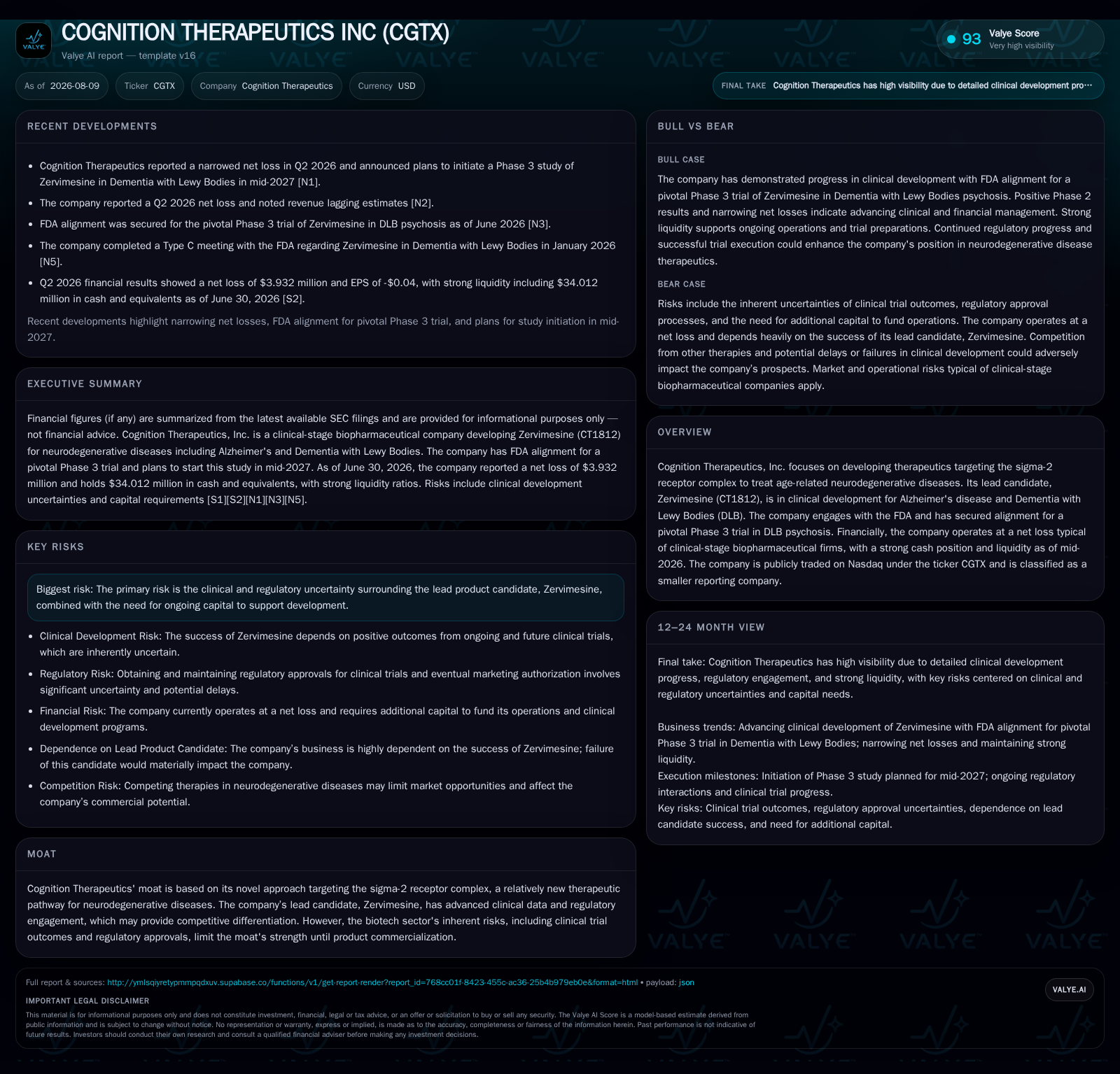
Cognition Therapeutics' latest disclosures highlight continued clinical progress of its lead candidate Zervimesine (CT1812), including planned pivotal Phase 3 trials targeting dementia with Lewy bodies (DLB) psychosis following substantive FDA engagement. The company maintains a robust cash runway supporting ongoing research but remains reliant on successful clinical outcomes and regulatory approvals to mitigate the inherent risks of clinical-stage biopharma. Its novel approach addresses significant unmet needs in Alzheimer's disease and related neurodegenerative disorders, supported by multiple NIH grants and collaborations with specialized clinical trial networks.
Recent Operating Update
Cognition Therapeutics’ latest quarterly filing dated August 7, 2026, provides critical updates on its lead compound Zervimesine (also known as CT1812), advancing the company toward pivotal Phase 3 development in neurodegenerative disorders [S2]. In a closely preceding event filing dated August 6, 2026, the company announced its Q2 results highlighting narrowed net loss margins but lagging revenue estimates consistent with the early clinical-stage profile [S3][N1]. More notably, Cognition disclosed plans for a mid-2027 start of a pivotal Phase 3 trial targeting psychosis associated with dementia with Lewy bodies (DLB), anchored by positive FDA feedback from recent Type C meetings [N2][S1]. This regulatory engagement marks an important milestone providing alignment on trial design and clinically meaningful endpoints critical for approval pathways.
The shift toward DLB psychosis as a primary indication underscores Cognition’s strategic use of its proprietary sigma-2 receptor targeting mechanism demonstrated in preclinical and earlier phase trials. Patient enrollment concluded in the COG0203 START Phase 2 study for mild cognitive impairment (MCI) and early Alzheimer’s disease (AD) back in late 2025 while results are being prepared for further analysis [S1]. The company’s clinical programs remain heavily supported by substantial NIH funding totaling approximately $171 million primarily from the National Institute of Aging (NIA), which is rare among peers and reduces immediate financing stress compared to similarly staged biotechs [S24].
Business Model Specifics
Cognition operates as a clinical-stage biotech firm specializing in small molecule therapeutics that modulate the sigma-2 receptor complex—a novel target implicated in synaptic protection against pathological protein oligomers such as beta-amyloid and alpha-synuclein. Its lead asset Zervimesine is orally administered, aiming to delay neurodegeneration progression by displacing toxic oligomers bound to neuronal receptors.
Revenue generation at this stage derives primarily from grant funding—predominantly NIH NIA awards—and potentially milestone payments if licensing or partnership deals occur. Commercial revenues are not yet present due to lack of approved products.
The company relies heavily on external contract research organizations (CROs) for trial execution and third-party contract manufacturing organizations (CMOs) for producing active pharmaceutical ingredient supplies. Zervimesine has never been manufactured at commercial scale; therefore, any successful approval will require substantial manufacturing scale-up efforts.
Revenue drivers will ultimately depend on successful progression through trial phases, achieving clear efficacy endpoints aligned with regulatory expectations, and securing FDA approval. Margins remain negative given costly R&D expenditure until commercialization.
Industry Structure and Competitive Position
Within the broader CNS drug development industry focused on neurodegenerative diseases such as AD and DLB, Cognition occupies a niche targeting synaptic preservation via sigma-2 receptor modulation. This contrasts with many competitors focusing on amyloid-clearing antibodies or symptomatic therapies. While this mechanistic differentiation could offer competitive advantage if efficacy is validated clinically, this sector is notably high-risk due to historic failure rates.
Peers include other clinical-stage biotechs developing disease-modifying agents for AD or related dementias (e.g., AC Immune, Cassava Sciences). Relative to these peers, Cognition’s ability to secure substantial NIH grants is a strength that validates scientific rigor but does not alleviate execution risk.
Regulatory engagement remains vital; Cognition's FDA meetings establish precedent that can streamline review processes if endpoints prove clinically meaningful. However, patient recruitment challenges common in CNS trials must be monitored carefully given past industry delays.
Growth Drivers
Primary growth drivers include:
- Advancement into Pivotal Trials: Initiation of the Phase 3 DLB psychosis study mid-2027 will represent a key validation step. Successful enrollment rate and endpoint achievement will be critical KPIs.
- Clinical Data Releases: Positive topline results from ongoing analyses of Phase 2 studies in MCI/early AD would broaden potential indications.
- Regulatory Milestones: Additional FDA interactions confirming trial designs or granting designations such as Fast Track could de-risk timelines.
- Strategic Partnerships: Licensing or collaboration agreements could provide non-dilutive capital inflows and commercialization expertise essential for future phases.
- Expansion into Related CNS Indications: Exploring applications beyond AD/DLB may diversify pipeline risk later.
Risks and Growth Constraints
Risks center around:
- Clinical Trial Outcomes: As with all clinical-stage biotechs, pivotal efficacy failures or safety issues could impede advancement dramatically.
- Regulatory Uncertainty: Despite current FDA alignment efforts, emergent data could prompt requests for additional studies or endpoint modifications.
- Capital Requirements: Although NIH funding and cash reserves support near-term needs, longer-term operations require access to capital markets or partnerships.
- Manufacturing Scale-up: Transitioning from laboratory-scale synthesis to commercial-scale production introduces risks typical for small molecule therapeutics including cost overruns or supply chain disruptions.
- Competitive Landscape: Other innovative modalities addressing CNS diseases could capture market attention faster or more conclusively.
- Patient Enrollment Challenges: Recruiting suitable patient populations for rare indications like DLB psychosis may prolong development timelines.
What to Watch Next
Key upcoming milestones include:
- Final analysis releases from ongoing Phase 2 programs around MCI and early AD populations.
- Opening patient enrollment for the planned Phase 3 DLB psychosis trial targeted mid-2027 following continued FDA dialogue.
- Monitoring utilization rates within trials as a measure of patient retention—a crucial operational KPI.
- Further grant awards or partnership announcements that might bolster financial flexibility or commercial preparedness.
- Updates regarding manufacturing process optimization pending transition beyond clinical batches.
Financial Profile Discussion
As of June 30, 2026, Cognition Therapeutics reported cash and equivalents totaling approximately $34 million supported by current assets near $38 million against current liabilities of about $5.45 million—yielding a strong current ratio above 7 [F1]. This liquidity profile signals adequate runway extending into at least mid-term operational horizons without imminent financing requirements under current burn rates.[S2]
Operating losses are typical within this stage of therapeutic development; no product revenues were reported. Sustained R&D expenses underscore commitment toward advancing pivotal studies while general administrative costs reflect baseline corporate infrastructure.[F1]
Looking ahead, liquidity management remains crucial given extended timelines characteristic of CNS drug development—delays in patient enrollment or unanticipated regulatory demands could increase capital needs beyond existing reserves [S9][S11]. The company’s reliance on NIH grant funding mitigates some capital risk but does not eliminate the need for eventual partner engagements or equity raises prior to commercial launch stages.
This analysis is based solely on public SEC filings and associated news releases as of August 2026. It focuses on evaluating operating developments within Cognition Therapeutics against industry dynamics inherent to clinical-stage neurodegenerative disease therapeutic developers. No investment advice or price-related commentary is provided.
Disclaimer: This is research-only, informational analysis and not investment advice. It may include AI-generated interpretation and general industry context. Always verify important details using primary sources.

Comments