
Array Digital Infrastructure’s Tower Leasing Strength and Spectrum Sales Amid Acquisition Proposal
Array Digital Infrastructure reports strong Q2 revenue and spectrum license gains while facing strategic uncertainty from a non-binding acquisition proposal.
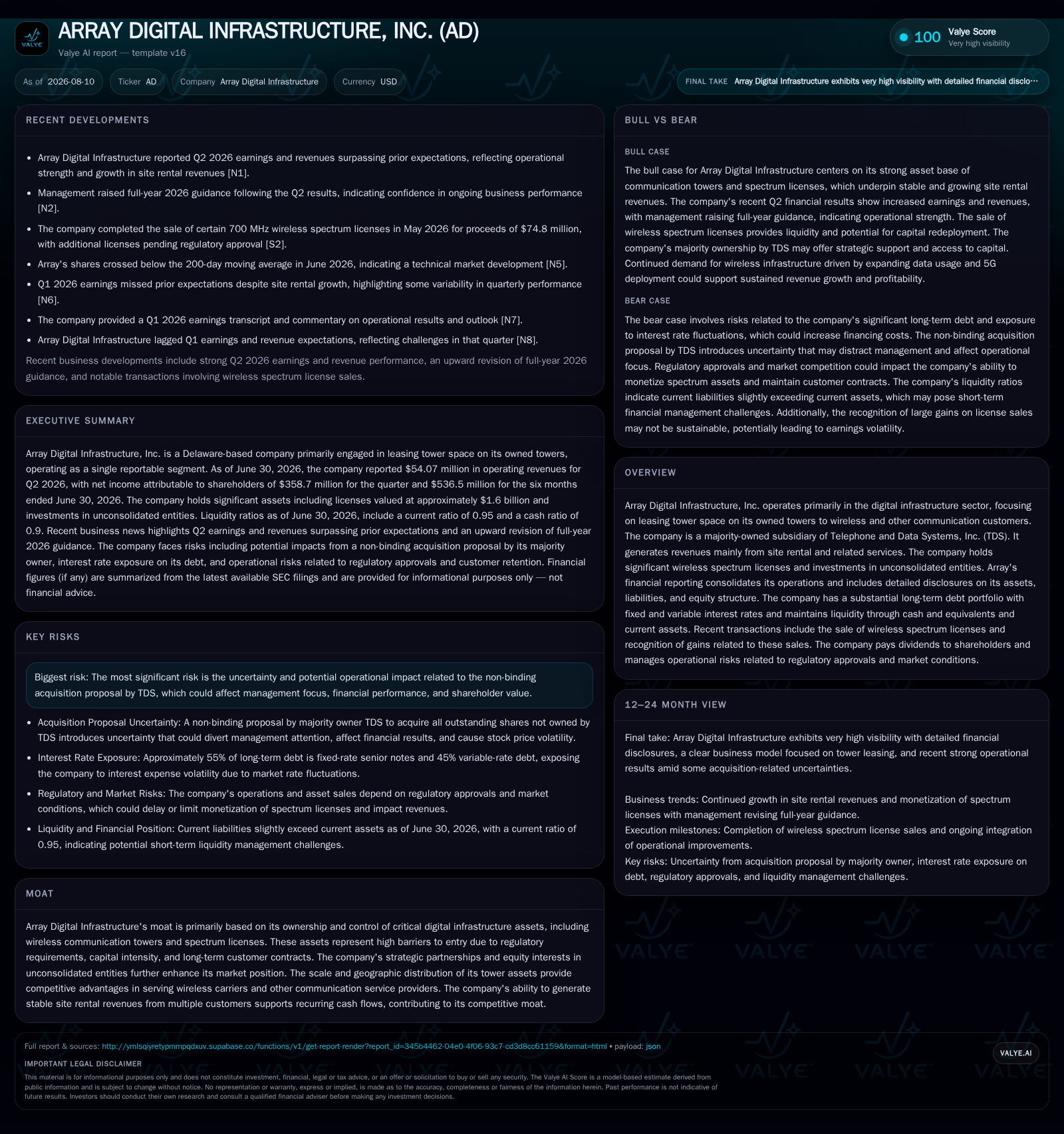
Array Digital Infrastructure, a wireless tower owner and lessor with significant spectrum holdings, reported better-than-expected Q2 results highlighted by site rental revenue growth and gains from recent spectrum sales. The company operates a capital-intensive business model centered on long-term leasing of tower space to wireless carriers, benefiting from high barriers to entry. However, its current strategic focus is clouded by a non-binding acquisition offer from majority owner Telephone and Data Systems (TDS), introducing execution risk. Array’s substantial fixed-rate and variable-rate debt expose it to interest rate sensitivity, but steady tenancy ratios and spectrum asset management remain key operational drivers.
Recent Operating Update
These developments are particularly noteworthy given the ongoing strategic ambiguity related to the non-binding acquisition proposal made by Telephone and Data Systems (TDS), Array’s majority owner, in May 2026 [S2]. The proposal brings execution risk due to management’s potential distraction and market volatility effects but underscores TDS's commitment to consolidating control over Array’s core infrastructure holdings
Business Model Dynamics
Array Digital Infrastructure operates principally as an owner and lessor of digital infrastructure assets — primarily wireless communication towers — serving wireless carriers and other communication providers through multi-tenant leasing arrangements. This model generates virtually stable recurring rents derived from long-term lease agreements underpinned by high switching costs for customers due to network integration dependencies. Towers typically host multiple tenants simultaneously, optimizing revenue per site through elevated tenancy ratios which are a central performance metric in this industry segment.
Additionally, Array maintains a portfolio of wireless spectrum licenses which represent critical intangible assets enabling carriers to deploy services across licensed frequencies. The company has demonstrated active stewardship of these licenses through recent sales that yielded discrete nonrecurring gains reported in the recent quarter [S1][S2]. Such transactions not only supplement core rental income but also reflect strategic asset reallocation enhancing balance sheet flexibility.
Array’s monetization inherently depends on the balance between maintaining tower asset quality through capital expenditures (CapEx) for upkeep and expansion versus maximizing operating margins by controlling expenses. Although detailed CapEx figures are not explicitly disclosed in the latest filings, industry standards suggest ongoing investment is essential given technological evolutions like 5G which drive network densification requirements and higher tenancy potential.
Industry Structure and Competitive Positioning
Array occupies a niche within the broader digital infrastructure sector that encompasses large-scale publicly traded tower operators such as American Tower Corporation (AMT), Crown Castle International (CCI), SBA Communications (SBAC), along with private operators like Vertical Bridge. While these peers often boast thousands of sites across diverse geographies with diversified infrastructure portfolios including small cells or fiber backhaul, Array’s scale is more modest but supported strategically via majority ownership by TDS.
This sector is characterized by substantial capital intensity due to initial tower construction costs, regulatory complexities around siting and zoning approvals, as well as the need for continuous upgrades aligned with wireless technology advances. Barriers to entry are reinforced by regulated spectrum licensing frameworks favoring incumbents holding valuable frequency bands necessary for competitive carrier operations.
Competitive strength accrues from asset specificity—towers colocated in strategically important locations—and strong tenant relationships backed by long-duration contracts with automatic escalators mitigating inflation risks. Array’s recurring site rental revenues thus benefit from predictable cash flows; however, its relative reliance on several major tenants implies customer concentration risk, a common theme across peers.
Growth Drivers
Primary growth catalysts for Array stem from increased global wireless data consumption propelled by smartphone penetration surges, burgeoning IoT ecosystems requiring pervasive connectivity, and rapid 5G network deployments necessitating denser tower arrays. These trends lead carriers to outsource infrastructure ownership to mitigate their own capital outlays, boosting leasing demand.
Rising tenancy ratios—the average number of tenants per tower—are particularly instrumental in driving incremental revenue without proportionate CapEx increase. Additionally, replenishing or augmenting wireless spectrum holdings supports enhanced service capabilities for customers, allowing Array to command premium lease rates over time.
Technological evolutions that enable higher data throughput per site also incentivize carriers towards frequent contract renewals or upgrades thereby stabilizing lease durations—a crucial operational KPI indicating renewal risk mitigation within this long-cycle investment business.
Risks and Watchpoints
The foremost risk factor confronting Array presently arises from the uncertainty tied to TDS’s May 2026 acquisition proposal involving all minority shares outside its existing stake [S2]. Such prospective transactions often introduce distractions at executive levels potentially hindering day-to-day strategy execution while prompting stock price volatility detrimental to shareholder returns. Should negotiations fail or conditions worsen, reputational or operational disruptions may follow.
Regulatory risks persist stemming from zoning restrictions or environmental compliance affecting new tower constructions or modifications. Customer concentration concentrates lease renewal risk should major wireless carriers alter capex budgeting or prefer alternative infrastructure solutions such as small cells or private networks reducing traditional tower dependence.
Lastly, technology shifts bearing on infrastructure substitution or spectrum valuation unpredictability represent latent structural headwinds requiring vigilant asset portfolio management.
What To Watch Next
Upcoming milestones critical for monitoring include quarterly updates on tenancy ratio trends reflecting effective sales strategies amidst network densification cycles. Spectrum license portfolio adjustments—both acquisitions and dispositions—will illuminate management’s tactical repositioning efforts responding to evolving carrier needs.
Progression or resolution regarding the TDS acquisition proposal remains a pivotal catalyst influencing market perception and capital allocation choices internally. Earnings guidance revisions will also signal confidence levels regarding sustainable organic growth against macroeconomic uncertainties.
Finally, comparative analysis vis-à-vis peer infrastructure providers concerning CapEx efficiency or lease contract renewal rates may reveal competitive positioning shifts essential for long-term viability assessment.
Financial Profile Discussion
As of June 30, 2026, Array Digital Infrastructure reported cash and equivalents totaling approximately $416 million against total debt nearing $667 million resulting in net debt around $250 million [F1]. Current assets slightly trail current liabilities yielding a current ratio just below unity at 0.95 which denotes tight near-term liquidity positioning but not an immediate solvency concern [F1].
The company’s long-term debt profile includes fixed-rate senior notes averaging about 6% coupon rates maturing mostly post-2030 and variable-rate borrowings susceptible to interest rate shifts.
Overall operating income metrics show periodic volatility impacted partly by impairment charges or non-cash items while net income remains positive over longer frames signaling profitable core operations despite capital intensity demands [F1]. Expense control focusing on OpEx optimization paired with strategic CapEx deployment will be key determinants shaping gross margin trajectories going forward.
This report synthesizes publicly available SEC filings along with recent corporate disclosures providing an integrated perspective suitable for internal industry analysis purposes. It does not constitute investment advice or research views but aims instead at delivering actionable operational insights within the context of ongoing sector developments affecting Array Digital Infrastructure's business model sustainability and financial outlook.
Disclaimer: This is research-only, informational analysis and not investment advice. It may include AI-generated interpretation and general industry context. Always verify important details using primary sources.

Comments