
Kingstone Companies Leverages Regional Focus and Underwriting Discipline to Manage Growth and Risk
Q2 2026 results confirm steady underwriting trends amid strategic geographic expansion and solid capital management.
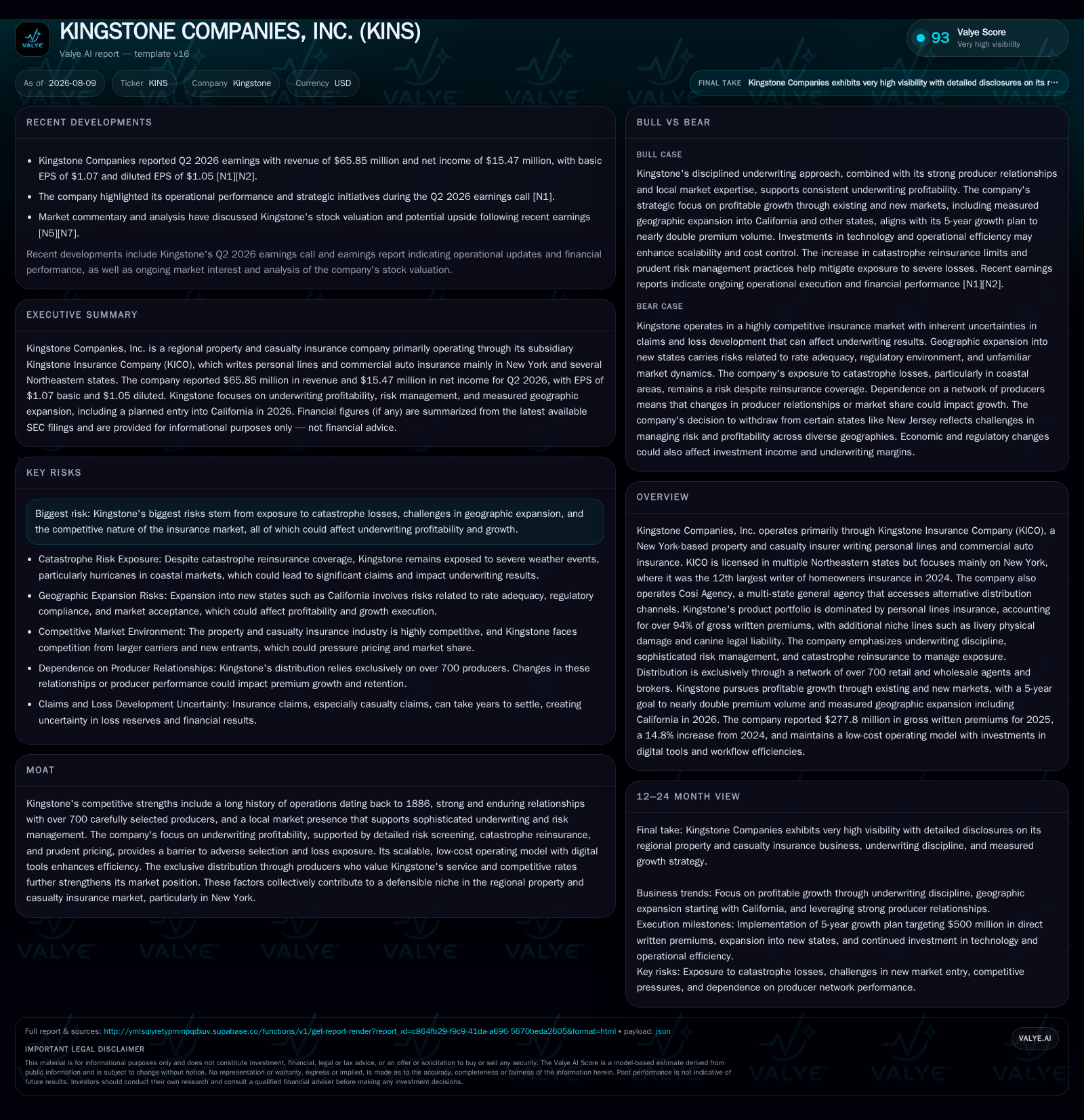
Kingstone Companies, Inc.'s Q2 2026 filing highlights sustained underwriting discipline in its niche New York-centric property and casualty insurance business. Dominated by personal lines, especially homeowners and commercial auto insurance, Kingstone maintains a robust agent-broker distribution network across the Northeast. The company is cautiously expanding into new states with an excess and surplus lines approach while managing exposure through increased catastrophe reinsurance limits. Capital adequacy remains strong, supporting ongoing dividend payments and underwriting stability within competitive regional markets.
Recent Operating Update
Kingstone Companies’ Q2 2026 Form 10-Q filing reveals a stable operating environment characterized by disciplined underwriting performance consistent with prior periods [S2]. There were no material revisions to risk factors or significant adverse developments reported since the last full-year filing in March 2026 [S2], affirming continuity in business conditions.
The company’s press release dated August 6, 2026, echoed confidence in maintaining underwriting profitability through controlled expense growth and effective claims management amidst evolving market dynamics [S12][N1]. An earnings call transcript highlighted that Kingstone’s strategy of focusing on core personal lines insurance paired with calibrated geographic expansion underpinned Q2 results that surpassed analyst estimates for net income [N2].
Business Model
Kingstone conducts its insurance operations primarily through Kingstone Insurance Company (KICO), a property and casualty insurer domiciled in New York State. KICO’s product portfolio is heavily concentrated in personal lines insurance — including homeowners and commercial auto policies — which accounted for more than 94% of gross written premiums as of the latest filings [S1]. This concentration reflects deep expertise in these classes as well as market familiarity in the Northeast.
Distribution constitutes a vital part of Kingstone’s operating model. The company leverages an established network of over 700 retail and wholesale agents and brokers who provide direct interface with policyholders across seven licensed states including New York, New Jersey (recently exited), Rhode Island, Massachusetts, Connecticut, Pennsylvania, New Hampshire, and Maine [S1]. This agent-driven model supports extensive risk screening efforts critical for maintaining underwriting discipline.
Complementing this traditional channel is Kingstone’s Cosi Agency subsidiary — a multi-state general agency that accesses alternative distribution channels by placing policies with other carriers. Cosi generates commission revenue offsetting commission expenses on third-party placements; its operating costs are excluded from combined ratio calculations to isolate underwriting business performance [S1]
Underwriting profitability is tightly managed through sophisticated risk assessment methodologies enabled by detailed actuarial analysis focusing on loss ratios, expense control, and prudent premium pricing strategies. The company targets a combined ratio that balances loss experience against operating costs while emphasizing catastrophe risk management.
Industry Structure and Competitive Position
Kingstone operates within the highly regulated regional property and casualty insurance industry dominated by numerous carriers competing primarily on localized underwriting expertise, pricing accuracy, and distribution strength [S1]. Its market positioning as the 12th largest writer of homeowners insurance in New York underscores notable scale within a fragmented state market where underwriting specialization matters
This local-market focus differentiates Kingstone from larger national multiline insurers such as Chubb or American Family Insurance that compete broadly but may lack granular regional insight. Additionally, Kingstone’s commitment to underwriting discipline supported by increased catastrophe reinsurance coverage places it alongside peers like The Hartford that stress capital protection from natural disasters common in Northeastern states.
Catastrophe reinsurance strategy is particularly important given the cyclical impact of hurricanes or severe weather events on loss ratios. By raising its top limit coverage from $280 million to $440 million effective July 2025—modeled for a 1-in-100 year storm—Kingstone materially mitigates potential capital hits from single catastrophic events [S18]. This commitment supports balance sheet resilience crucial for regulatory compliance under New York’s Risk-Based Capital requirements.
Growth Drivers
Primary growth vectors center on increasing policy count within existing territories through retention improvements driven by strong agent relationships versus price-led premium hikes given competitive market dynamics [S1]. Product innovation efforts appear modest but include niche lines such as livery physical damage and canine legal liability designed to diversify risk pool composition gradually
The company has also signaled intent to selectively expand geographically starting with California on an excess and surplus lines basis launched in Q2 2026—a strategic choice allowing entry without the regulatory complexities of admitted market licensing upfront [S18][N1]. This measured approach aims at enhancing premium volume while limiting immediate regulatory burden or capital strain.
Operationally, investments in enhanced digital quoting systems and paperless workflows are expected to improve efficiency in policy processing, reducing expense ratios over time. Online platforms allowing producers to access policy information and manage payments digitally strengthen customer service capability which is increasingly vital for retention in today’s tech-embedded buying environment [S1]
Risks / Watchpoints / Growth Constraints
Most prominent risks include exposure to severe weather catastrophes predominant in its Northeast footprint. Despite catastrophe reinsurance protections at modeled thresholds, an accumulation of multiple severe events could erode underwriting profits unexpectedly.
Geographic concentration risk remains material as nearly all direct written premiums derive from New York—98% in recent years—which exposes Kingstone to state-specific regulatory changes or adverse economic cycles impacting homeowner demand or claims trends [S1]. Efforts at geographic diversification thus merit close monitoring.
Competitive pressures are intense locally as multiple regional insurers vie for homeowners personal lines policies where price elasticity can be high. Maintaining disciplined risk selection without sacrificing growth poses ongoing challenges especially if broader industry cycles shift towards aggressive pricing.
Distribution channel dependency represents another potential constraint; reliance on third-party agents means retention rates hinge heavily on producer satisfaction with commissions programs, service quality, bandwidth constraints, or entry by larger carriers targeting agent loyalty.
Finally, evolving regulatory frameworks such as modifications removing "anti-arson" application laws create shifting compliance landscapes that might affect underwriting protocols or cancellation rights relevant to claims management [S25].
What to Watch Next
Upcoming milestones include tracking Q3 earnings releases for confirmation of maintained combined ratios amid new market exposures and any commentary on expanded geographic penetration effectiveness. Incremental data on policy retention rates within both traditional New York markets and newly entered California territory will be key KPIs indicating sustainable growth capacity.
Further improvements or investments announced regarding digital infrastructure will shed light on how much operational leverage management can extract going forward. Monitoring changes to catastrophe loss experience given weather patterns will also directly influence capital deployment decisions around reinsurance renewal terms or pricing adjustments.
Regulatory filings concerning dividend capacity from KICO will provide insight into capital return potential versus reinvestment needs given emerging risks or expansion plans.
Financial Profile Discussion
Risk-Based Capital compliance remains robust with a TAC-to-ACL ratio exceeding regulatory minimums ensuring solvency margin buffers mandated by New York DFS regulations [S27]. This strength affirms ability to absorb moderate claim volatility while maintaining authorized operating capacity.
Overall, Kingstone exhibits consistent earnings quality derived principally from underwriting profits rather than volatile investment income trends common among peers exposed more heavily to financial market gyrations.
Conclusion
Kingstone Companies continues executing a focused property-casualty insurance strategy centered on disciplined underwriting of personal lines chiefly in New York State supported by a scalable agent-broker network. Its recent geographical extension into California via non-admitted lines reflects prudent testing of new revenue sources without major capital commitment buildup initially. Enhanced catastrophe reinsurance arrangements reduce tail-risk exposures crucial for long-term balance sheet integrity.
While regional concentration poses ongoing risks amplified by natural disaster potential and competitive pricing pressures prevail locally, Kingstone's demonstrated operating consistency along with measured technological improvements establishes a defensible niche position among Northeast regional insurers specializing in homeowners products. Monitoring upcoming quarters for sustained combined ratio maintenance amid expansion efforts alongside evolving regulatory factors will be central to assessing the durability of current performance trends.
Disclaimer: This is research-only, informational analysis and not investment advice. It may include AI-generated interpretation and general industry context. Always verify important details using primary sources.

Comments