
Somnigroup Struggles With Mattress Firm Sales and Margin Pressures in Q2 2026
Latest quarterly results reveal drag from Mattress Firm retail softness amid broad macro and supply challenges.
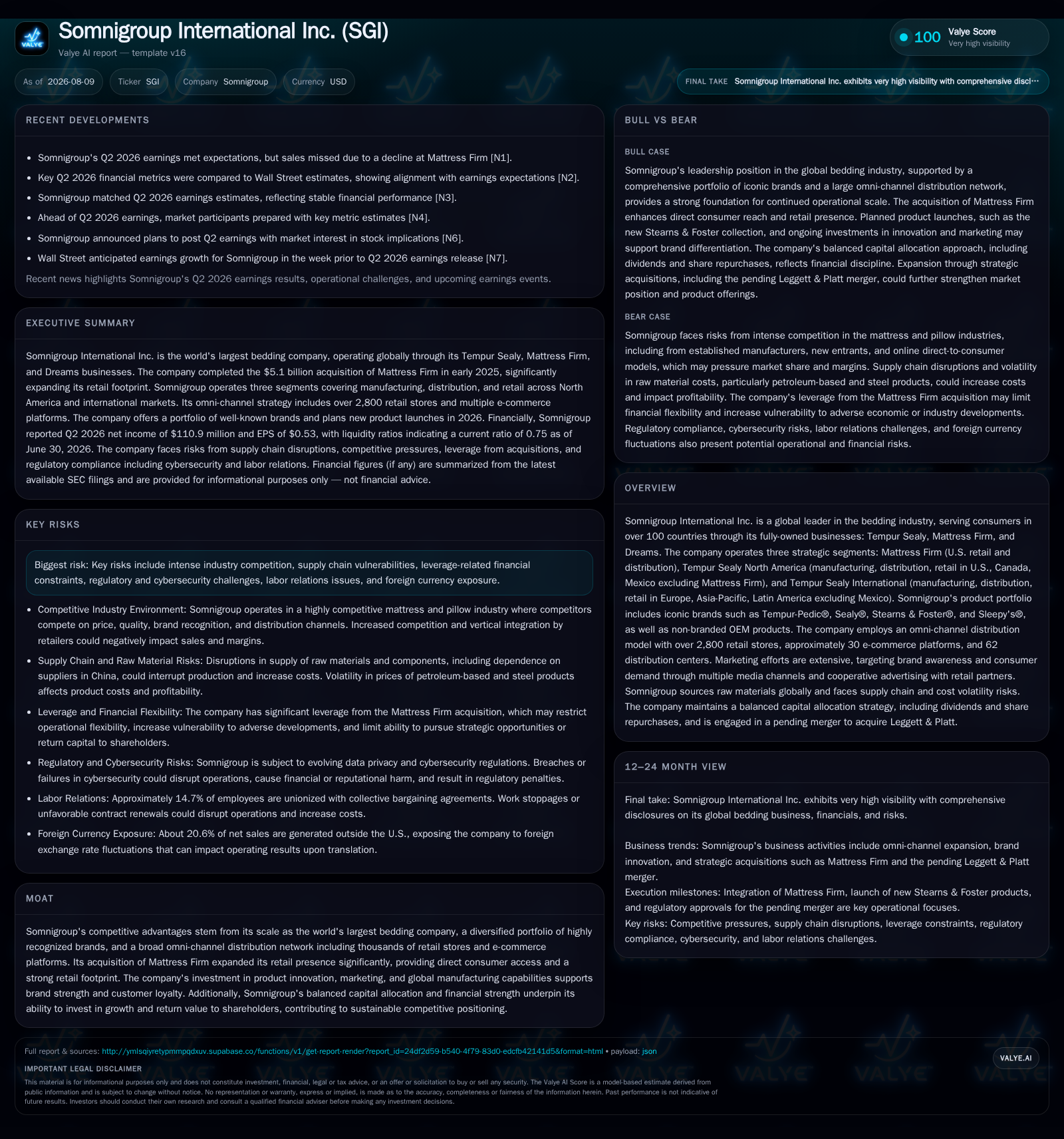
Somnigroup International remains the world's preeminent bedding company with a vast global footprint spanning manufacturing, distribution, and retail, anchored by brands like Tempur-Pedic and Sealy. However, its Q2 2026 earnings revealed a sales shortfall primarily tied to declining revenues at Mattress Firm, its specialty mattress retail segment, reflecting both operational headwinds and shifting consumer behaviors. Margins also contracted under continued raw material cost inflation and competitive pricing pressure. The company’s omni-channel distribution model and brand portfolio provide a durable market position but near-term growth hinges on stabilizing Mattress Firm sales and navigating supply chain volatility. Financial leverage remains elevated, limiting capital allocation flexibility while the recently announced dividend increase signals confidence in underlying cash flow generation.
Recent Operating Update
Further context provided by the investor presentation issued August 6 highlights the company's ongoing commitment to its omni-channel strategy encompassing over 2,800 retail stores globally, roughly 30 dedicated e-commerce platforms, and expansive distribution centers facilitating integrated logistics [S3]. This breadth enables Somnigroup to engage consumers across multiple touchpoints but also demands continual adaptation given shifting buying behaviors favoring direct-to-consumer models popularized by some peers.
Business Model Specifics
Somnigroup generates revenue primarily through three strategic business segments: (1) Mattress Firm (U.S. retail and distribution), (2) Tempur Sealy North America (manufacturing/distribution/retail excluding Mattress Firm locations in U.S., Canada, Mexico), and (3) Tempur Sealy International (manufacturing/distribution/retail across Europe, Asia-Pacific, Latin America except Mexico) [S1]. This tripartite segmentation supports vertical integration from product design through retail execution.
The company's product portfolio features globally recognized bedding brands like Tempur-Pedic®, Sealy®, Stearns & Foster®, uniquely positioning it in the premium segment where consumers prioritize quality and innovation over price alone. Revenue mechanics blend wholesale distribution agreements with direct-to-consumer sales via company-owned stores and digital platforms. Mattress Firm acts as both retailer and distributor within the U.S., offering valuable downstream access for market feedback but also exposing Somnigroup to retail-level sales volatility.
Gross margins in manufacturing units are sensitive to raw material costs—especially petroleum-based foams and steel innersprings—and are moderated by production productivity initiatives and product mix shifts toward higher-margin premium lines [S1][S2]. Retail margins hinge on same-store sales trends, merchandising plans requiring third-party premium placements at certain percentages within Mattress Firm stores (43% floor slots for third-party premium mattresses) which influences category dynamics within stores [S1][S9].
Industry Structure and Competitive Position
The bedding industry is marked by entrenched competition involving legacy manufacturers like Leggett & Platt alongside emergent direct-to-consumer disruptors such as Casper Sleep. Somnigroup occupies a dominant position globally anchored by its broad brand portfolio that offers scale advantages difficult for smaller rivals to replicate. Its fully owned operations allow control over quality consistency essential for maintaining brand equity in premium segments.
However, the industry faces structural shifts with increasing e-commerce penetration altering consumer shopping habits away from large brick-and-mortar retailers — a challenge directly impacting Mattress Firm's traditional specialty mattress retail model. Competitors invest heavily in innovative sleep-tech products emphasizing ergonomics or smart features appealing to health-conscious demographics—a trend driving product development priorities at Somnigroup.
Supply chain complexities pose continued risk given global sourcing of raw materials vulnerable to geopolitical events, tariff changes, labor shortages, and climate-related disruptions affecting production continuity and input pricing volatility [S1][S6]. Efficient inventory turnover and robust distribution network throughput metrics are critical operating targets illustrating resilience against these macro pressures.
Growth Drivers
Consumer awareness around holistic wellness accelerates demand growth for premium sleep products incorporating advanced materials or health benefits—markets where Somnigroup’s R&D investments aim to capture incremental share. Expansion into emerging international regions with rising disposable incomes offers additional runway for growth outside mature North American markets.
The company’s investment strategy prioritizes innovation pipelines supported by four R&D centers globally fostering next-generation materials and ergonomic designs aligned with shifting consumer preferences toward smart sleep solutions. Omni-channel expansion enhances accessibility via blending physical store experiences with seamless digital commerce.
Strategic acquisitions remain part of long-term growth considerations to bolster retail footprint or complement existing brand offerings; however, integration risks require careful management [S1].
Risks and Constraints
Key challenges include intensifying price competition driven both by new entrants leveraging online models reducing costs versus traditional retailer overheads, as well as pressure on promotional spending subject to regulatory scrutiny over pricing policies potentially inviting antitrust investigations [S6]
Foreign currency exchange rate fluctuations affect profitability in international segments since approximately one-fifth of net sales derive outside the U.S., imposing translation risk not fully hedged except for some transactional exposures managed via forward contracts [S14]. Labor relations issues—particularly unionized multi-employer pension underfunding—could impose additional cash obligations constraining operational flexibility [S23].
Cybersecurity risks threaten digital platform integrity essential for e-commerce revenue streams while supply chain disruptions could exacerbate raw material shortages or inflationary spikes adversely impacting gross margins [F1][S13][S19]. Balance sheet leverage stemming from the $5+ billion Mattress Firm acquisition limits capital deployment options especially if adverse operating trends continue without swift margin recovery.
What To Watch Next
Monitoring near-term performance of Mattress Firm same-store sales will be pivotal; stabilization or recovery there would validate management's omnichannel rebalancing efforts amid broader industry headwinds. Gross margin trends relative to raw material cost pass-through efficacy remain key profitability indicators.
Additional milestones include progress on innovation product launches reflecting R&D pipeline success rates, geographic expansion outcomes particularly in Asia-Pacific markets fueling Tempur Sealy International growth segment results.
Capital allocation decisions—especially any adjustment in share repurchase programs given existing debt levels—and adherence to merchandising commitments for third-party premium mattresses within Mattress Firm stores are important governance signals affirming disciplined management execution [S27][S9]
Financial Profile Discussion
As of mid-2026 second quarter end, Somnigroup exhibited a constrained liquidity posture with a current ratio approximately 0.75 (current assets at $1.289 billion against current liabilities of $1.723 billion), signaling short-term obligations exceeding readily available resources which raises working capital management importance [F1]
This analysis is based solely on publicly filed information from SEC disclosures dated through August 2026 alongside contemporaneous market news reports. It does not constitute investment advice or research views.
Disclaimer: This is research-only, informational analysis and not investment advice. It may include AI-generated interpretation and general industry context. Always verify important details using primary sources.

Comments