
Mobility Global Charts Independent Growth After Spin-Off
Mobility Global’s initial post-spin quarterly results showcase its transition to a standalone automotive data analytics provider focusing on subscription revenue and operational independence.
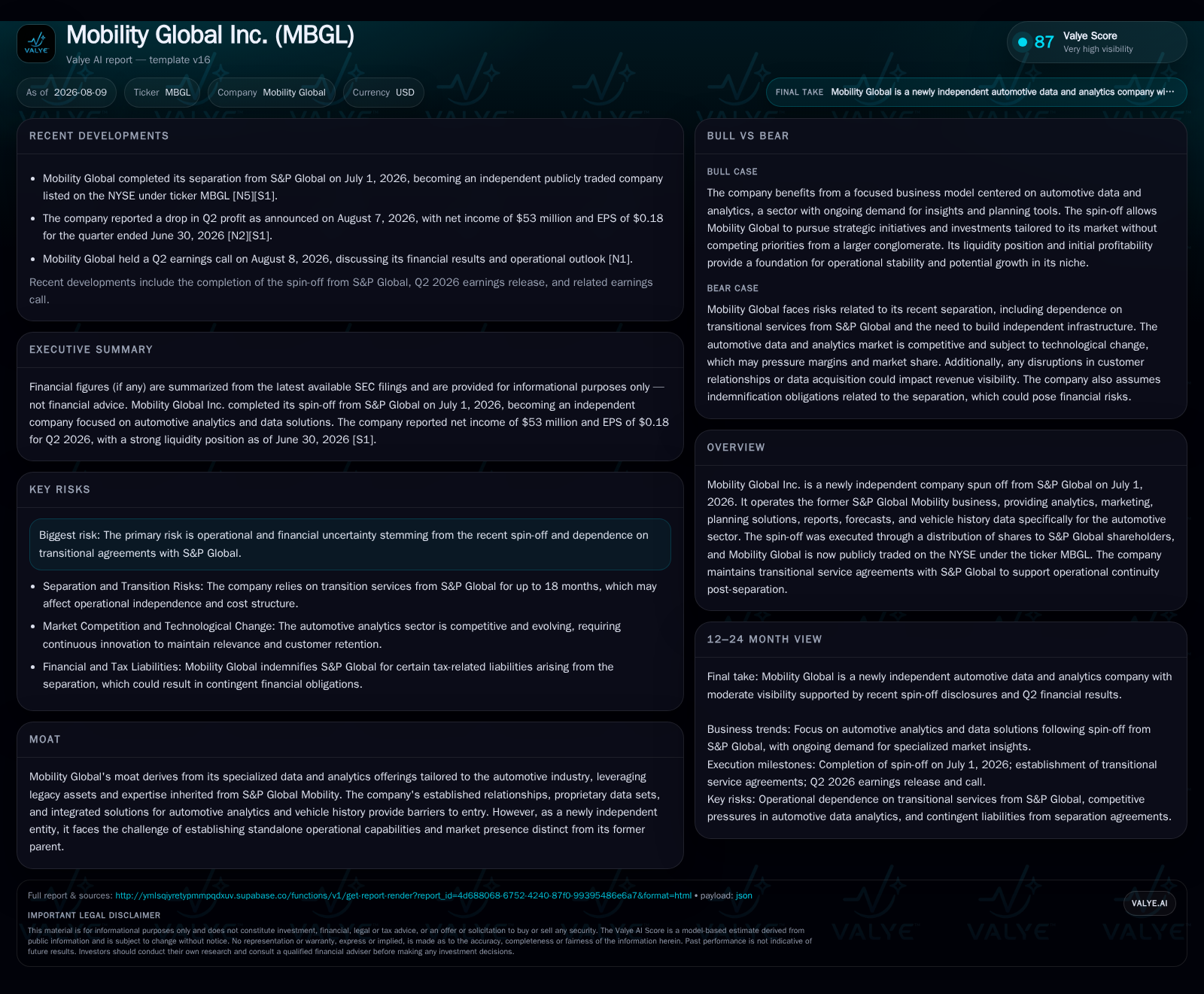
Mobility Global Inc., newly independent after its July 1, 2026 spin-off from S&P Global, reported its first quarterly results as a standalone public company. The firm continues to monetize proprietary vehicle history data and automotive analytics through subscription and licensing models targeting OEMs, insurers, and dealers. While legacy relationships and transitional service agreements enable operational stability, margin pressures and high leverage characterize the early independent phase. Growth opportunities center on expanding connected vehicle telematics offerings and insurance analytics applications amid rising data-driven demand in the automotive sector.
Recent Quarter Signals Shift to Independent Execution
Mobility Global reported its inaugural quarterly results as a publicly traded independent entity following the July 1st, 2026 spin-off from S&P Global. Operating income stood at $82 million with net income of $53 million for Q2 ended June 30, marking a baseline profitability profile distinct from the former parent reporting structure [F1],[S2]. This period is significant as it reflects operational execution under standalone cost structures alongside the initial impact of maintaining transitional service agreements (TSAs) with S&P Global. These TSAs underpin critical functions such as IT infrastructure maintenance, finance administration, and human resources support — enabling continuity but also adding complexity to expense management during early independence [S11]. Margin pressure reported in Q2 highlights challenges in fully internalizing operations while staying competitive on pricing. The earnings call also previewed cautious guidance reflective of this transition phase [N1],[S3].
Subscription-Centric Automotive Data Model Defines Revenue Profile
Mobility Global's core business model remains focused on subscription-based monetization of comprehensive automotive data products inherited from S&P Global Mobility. The firm licenses access to proprietary vehicle history reports essential for used car market participants like dealerships and insurers. Additionally, it offers OEM analytics encompassing market forecasting and competitive intelligence subscriptions plus risk assessment tools utilized by financial institutions underwriting automotive loans or insurance policies. Revenue generation depends critically on maintaining high contract renewal rates and expanding active subscriber bases across these verticals. Average revenue per user (ARPU) is influenced by product bundle mix depth — deeper integrations or premium analytical add-ons typically command higher fees. Client retention rates serve as a pivotal KPI here since recurring revenue dominance ensures stable cash flow conversion from existing contracts while minimizing acquisition costs over time. Data set freshness remains vital given the real-time nature of vehicular transactions and telematics feed updates driving pricing dynamics within used car valuation models.
Legacy Relationships and Competition Shape Industry Landscape
The company’s competitive position leverages inherited long-term relationships cultivated under S&P Global Mobility’s brand coupled with proprietary dataset exclusivity anchored in vehicle history aggregation. However, Mobility Global now contends with specialized niche players such as Carfax in historical vehicle reporting focused markets as well as full-spectrum automotive data providers like IHS Markit that combine forecasting analytics with expansive telematics integration capabilities. Barriers to entry exist via significant technological integration costs necessary to maintain accurate used vehicle databases along with rigorously engineered risk assessment algorithms required by insurers underwriting automotive policies. Switching costs can deter clients considering alternative sources given the operational dependency on timely data delivery embedded within core transactional processes. Nevertheless, evolving technology frontiers including broader adoption of connected vehicle telematics present avenues where nimble entrants might challenge incumbents if product innovation lags or platform reliability declines.
Expanding Footprint Through Data Innovation and Customer Retention
Emerging growth drivers are notably tied to the continued explosion of telematics-generated connected car data which creates new layers of insight demand by insurers seeking granular risk profiles and OEMs expanding predictive maintenance services. Mobility Global is positioned to capitalize by enhancing its subscription analytics offerings integrating fleet management data alongside traditional vehicle history information streams. Furthermore, digital transformation in automotive retail financing—favoring real-time creditworthiness scoring—opens new cross-sell opportunities into financial services segments adjacent to core subscribers. Efficient delivery pipelines reducing time-to-insight reinforce stickiness while encouraging up-sell ratios via modular platform expansions,. The company’s capacity to innovate in these segments will be critical to offset any softness from legacy revenue leakages post-transition.
Navigating Transitional Service Agreement Risks Post-Spin-Off
A salient risk lies in Mobility Global’s dependence on TSAs with S&P Global guaranteed only through an 18-month horizon post-distribution. These agreements involve fee structures based on apportioned overhead plus administrative charges likely subject to escalation over time impacting cost predictability [S11],[S10]. The inability or reluctance to internalize these services promptly may constrain gross margin expansion targets. Moreover, any disruptions or delays transitioning these services could degrade platform uptime reliability—a key operational KPI for client satisfaction given the mission-critical nature of these data feeds. Management has stated TSA termination plans are underway but timing remains uncertain which forms a watchpoint against unanticipated incremental expenses or strategic autonomy limitations during this period.
Emerging Opportunities in Connected Vehicle and Insurance Analytics
Beyond traditional automotive sectors served at spin-off inception, Mobility Global could extend into expanding connected vehicle telematics territories including underwriting analytics tailored for commercial fleet insurance markets. Regulatory trends mandating greater transparency in vehicle data dissemination enhance prospects for data monetization aligned with privacy compliance frameworks sought by insurers and financial institutions alike. Developing scalable predictive risk assessment models using deep AI-driven telemetry inputs can offer differentiated value propositions distinct from competitors reliant primarily on static vehicle histories.
Financial Foundation Underlines Capacity for Growth Capital Deployment
As of June 30, 2026, Mobility Global held cash reserves of approximately $186 million against total debt nearing $1.98 billion resulting in net debt close to $1.8 billion [F1]. Current assets of $466 million and current liabilities of $248 million imply a current ratio near 1.88x for 2026-06-30 [F1]. Operating income margins hovering near the mid-teens provide moderate profitability buffers; however free cash flow generation must sustainably cover interest obligations while funding organic product development initiatives or potential strategic acquisitions aimed at broadening analytic scope or enriching proprietary datasets [F1],[S2]. Management’s ability to sharpen working capital management post spin-off will factor heavily into near-term financial flexibility.
'What To Watch': Benchmarking Growth Against Key Adoption Metrics
Looking forward into late 2026 and early 2027 horizons, investors should closely monitor active subscriber growth rates especially within ramping telematics-linked products alongside contract renewal percentages that indicate customer retention health post-separation [N1],[S3]. The pace at which transitional service agreements are phased out without operational disruption remains crucial against stated strategic independence goals. Additional signals will emerge through updated guidance reflecting scaling efficiencies or margin improvements correlated with platform uptime reliability improvements integral for premium pricing justification. Disclosures regarding roadmap milestones targeting AI-enhanced risk modeling innovations may provide incremental confidence in capturing adjacent growth sectors beyond historical legacy footprints.
In sum, Mobility Global is navigating foundational establishment as an autonomous automotive data analytics provider emphasizing recurring subscriptions supplemented by long-standing industry relationships.
Disclaimer: This is research-only, informational analysis and not investment advice. It may include AI-generated interpretation and general industry context. Always verify important details using primary sources.

Comments