
Abundia Global Impact Group Builds Renewable Fuels Platform Amid Execution and Financial Challenges
AGIG advances renewable crude and waste-to-fuel projects integrating technology licensing and engineering services but faces execution risks and liquidity constraints.
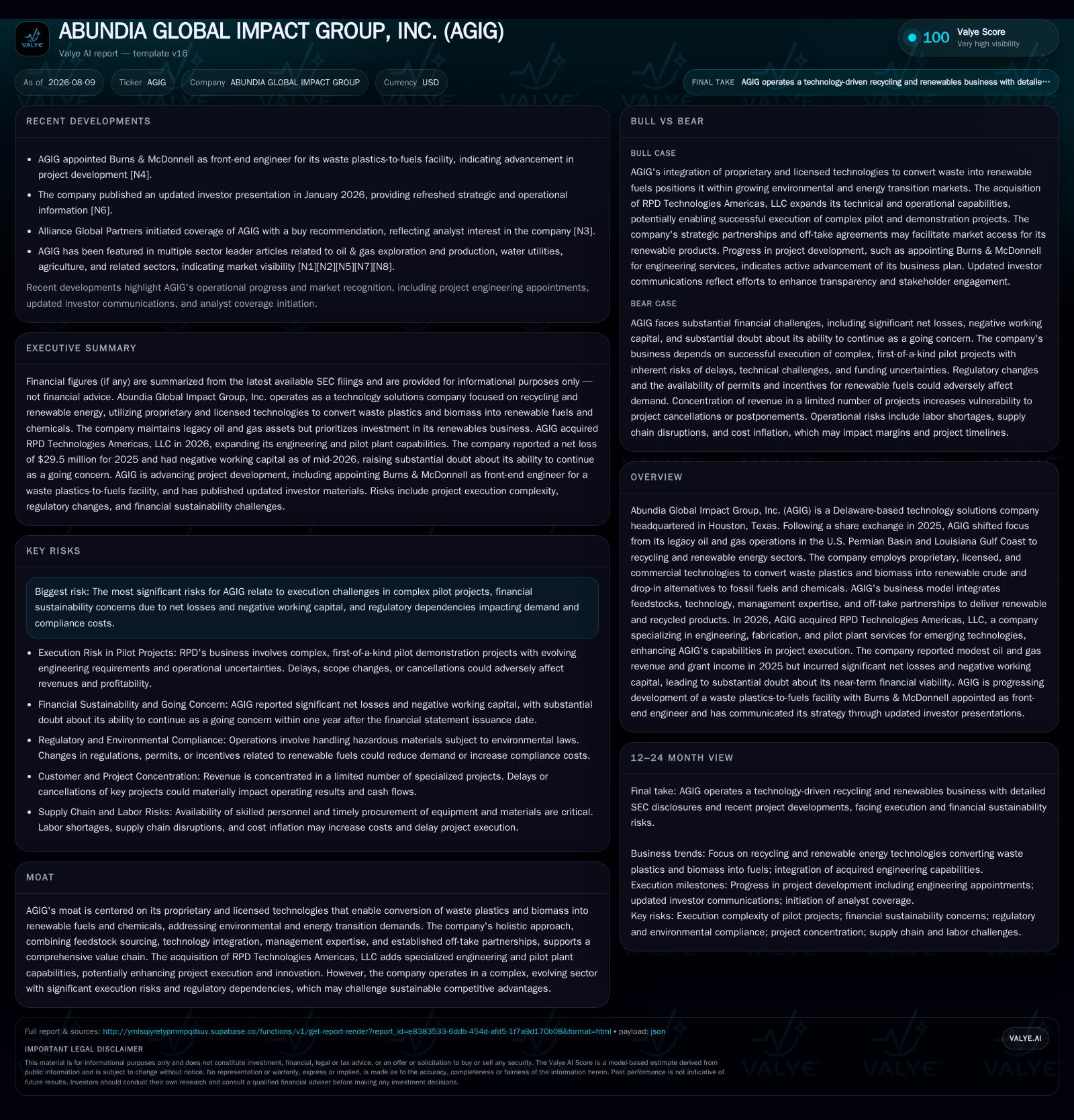
Abundia Global Impact Group, Inc. (AGIG) has strategically shifted its business from legacy oil and gas to focus on renewable fuels and recycling technologies following a 2025 share exchange. The company acquired RPD Technologies Americas to bolster engineering and pilot plant capabilities essential for commercializing its proprietary waste-to-fuels technology. A new long-term feedstock supply agreement aims to underpin operations at its Cedar Port facility. However, AGIG operates in a capital-intensive, complex sector with substantial project execution risks and currently reports a weak liquidity profile and persistent net losses. Monitoring successful project delivery and improved financial sustainability will be critical milestones.
Recent Operating Update
Abundia Global Impact Group (AGIG) delivered its latest quarterly filing on August 7, 2026, which underscores its ongoing evolution into a renewable energy technology solutions company focused on converting waste plastics and biomass into renewable crude and drop-in fuel alternatives [S2]. This transformation followed a July 2025 corporate share exchange transitioning the firm away from its previous oil and gas-centric operations primarily located in the U.S. Permian Basin toward a technology-led recycling and renewables business model [S1].
The most salient near-term development reported is the acquisition completed on April 1, 2026, of RPD Technologies Americas LLC, a specialist engineering services firm whose scope encompasses design, engineering fabrication, commissioning, operation of pilot plants, process validation programs, and other services for emerging energy technologies [S6], [S2]. This move is strategically significant because RPD’s expertise is critical to reliably execute the complex demonstration projects that validate AGIG’s proprietary processes in waste-to-fuels production — an industry where replicable scale-up is one of the toughest execution hurdles.
Additionally, on June 9, 2026, AGIG announced a long-term strategic feedstock supply agreement with Frankfort Plastics Inc., securing an annual intake of approximately 40,000 tons of polyolefin plastic waste destined for processing at the Cedar Port Waste to Fuels facility [S3], [S16]. This volume commitment provides foundational throughput potential essential for downstream conversion economics.
Business Model: Technology-Driven Renewable Fuels and Engineering Services
AGIG’s business architecture rests upon an integrated model combining technology licensing (proprietary plus licensed platforms), feedstock sourcing agreements (e.g., plastics waste), project management of complex pilot-scale setups (through RPD), and off-take partnerships aimed at selling renewable crude or low-carbon chemicals as fossil fuel substitutes. The conversion process targets both polyolefin plastic waste streams and biomass sources to generate drop-in fuels compatible with existing refining infrastructure.
Revenue streams are expected from multiple sources: license fees associated with proprietary technology use; direct sales or production-sharing from waste-to-fuels plants; engineering service contracts through RPD Technologies; and long-term off-take agreements providing predictable product demand. However, as of mid-2026 filings, recognized revenue largely reflects grants rather than substantial product sales or licensing income [F1], highlighting that commercial-scale operations remain nascent.
Margins in such models depend heavily on achieving continuous feedstock throughput with high conversion yields while controlling capex during plant construction phases. Engineering service revenue tends to be project-based with volatile timing linked to customer R&D budgets.
Industry Structure and Competitive Positioning
AGIG operates within the broader renewable energy sector focused on waste-to-fuels technologies—a segment characterized by numerous first-of-a-kind pilot demonstrations transitioning to early commercial rollouts globally. Key competitors or comparable peers include firms like Enerkem and Fulcrum BioEnergy that operate modular waste feedstock conversion plants producing biofuels; LanzaTech specializing in proprietary fermentation technologies; plus engineering firms offering pilot plant fabrication expertise.
Unlike pure production peers whose revenue primarily flows from product sales backed by long-term off-takes, AGIG combines this asset-light licensing with asset-heavy engineering services via RPD. This dual approach diversifies revenue channels but creates dependency on complex project execution skills.
Crucially, AGIG has secured clear value chain leverage by locking feedstock supply agreements (Frankfort Plastics) well ahead of scaling production facilities—a key competitive barrier given variability in plastic waste availability across regions.
Growth Drivers
- Feedstock Expansion: The agreement underpinning 40k tons/year assures base capacity utilization at Cedar Port—a metric pivotal for optimizing operating costs per barrel or ton processed.
- Pilot Plant Commercialization: Successful execution of demonstration projects by RPD will validate process yields increasing confidence among prospective licensees or off-take buyers.
- Technology Licensing Potential: As licensors usually command attractive recurring revenues with high gross margins once processes prove scalable, technology maturation can drive sustainable cash flows over time.
- Regulatory Tailwinds: Increasing mandates for carbon intensity reduction compel chemical and fuel markets towards circular economy inputs creating structural demand uplift.
- Strategic Partnerships: Off-take contracts with established distributors or chemical firms provide revenue visibility beyond project completion uncertainties.
Monitoring KPIs such as conversion yield rates (%), pilot plant utilization rate (%), backlog of contracted engineering projects at RPD, volume under active off-take contracts (tons/barrels per year), as well as shifts toward positive operating margins will be vital indicators of progress.
Risks and Constraints
Despite strategic moves towards scale-up readiness, AGIG faces pronounced risks:
- Execution Complexity: First-of-a-kind pilot plants entail unknown technical challenges requiring substantial iteration; cost overruns or timeline slips impact contract profitability sharply given fixed scope terms at RPD [S2], [S14].
- Customer Dependency & Spending Volatility: Engineering service demand hinges on broader energy transition investment cycles—any slowdown in capital deployment among customers drafting demo projects threatens revenue consistency.
- Labor & Supply Chain Issues: Specialized technical personnel shortage combined with material procurement delays elevate operational risk exposures pressing margins negatively [S12].
- Financial Sustainability: The company reported an accumulated deficit surpassing $46 million as of year-end 2025 alongside net losses exceeding $29 million reflecting high burn rates relative to trivial legacy oil/gas income (~$410k). Working capital analysis reveals stress; with approximately $11.2 million cash versus $19.9 million current liabilities producing a current ratio around 0.59 indicative of looming short-term funding gaps absent fresh capital inflows [F1],[S1],[S2].
- Regulatory Environment Sensitivity: Changes to government incentives for renewable fuels or shifts in permitting processes could reduce project economics affecting demand for AGIG’s licensed tech or engineering services profoundly [S11], [S12].
What To Watch Next
Several developments will shape the trajectory of AGIG’s ambitions:
- Successful completion milestones of pilot plants engineered by RPD validating process reliability within budgeted timelines.
- Progression from grant-based income toward recognizable recurring revenue streams from off-take agreements or licensing fees.
- Expansion announcements related to additional feedstock supply contracts beyond Frankfort Plastics signaling scalability.
- Quarterly cash burn profiles coupled with financing activities revealing pathways toward liquidity stability.
- Regulatory updates influencing low-carbon fuel standards or subsidy frameworks impacting market demand.
- Backlog growth at RPD Technologies reflecting strengthened client commitment levels amid industry investment cycles.
Financial Profile Discussion
As of June 30, 2026, AGIG held approximately $11.2 million in cash against $19.9 million in current liabilities producing a current ratio below unity at around 0.59—a shortfall signaling tight near-term liquidity conditions which could impair operational flexibility unless supplemented by equity or debt raises [F1]
This financial profile highlights the capital-intensive nature typical for early-stage renewable technology commercialization companies where operating margins remain negative until consistent production scale is reached and licensing revenues materialize robustly.
Disclaimer: This is research-only, informational analysis and not investment advice. It may include AI-generated interpretation and general industry context. Always verify important details using primary sources.

Comments