
SANUWAVE Health’s Commercial Growth Amid Regulatory and Financial Complexities
SANUWAVE Health advances its wound care market presence with improving revenue metrics while managing tax restatements and cybersecurity risks.
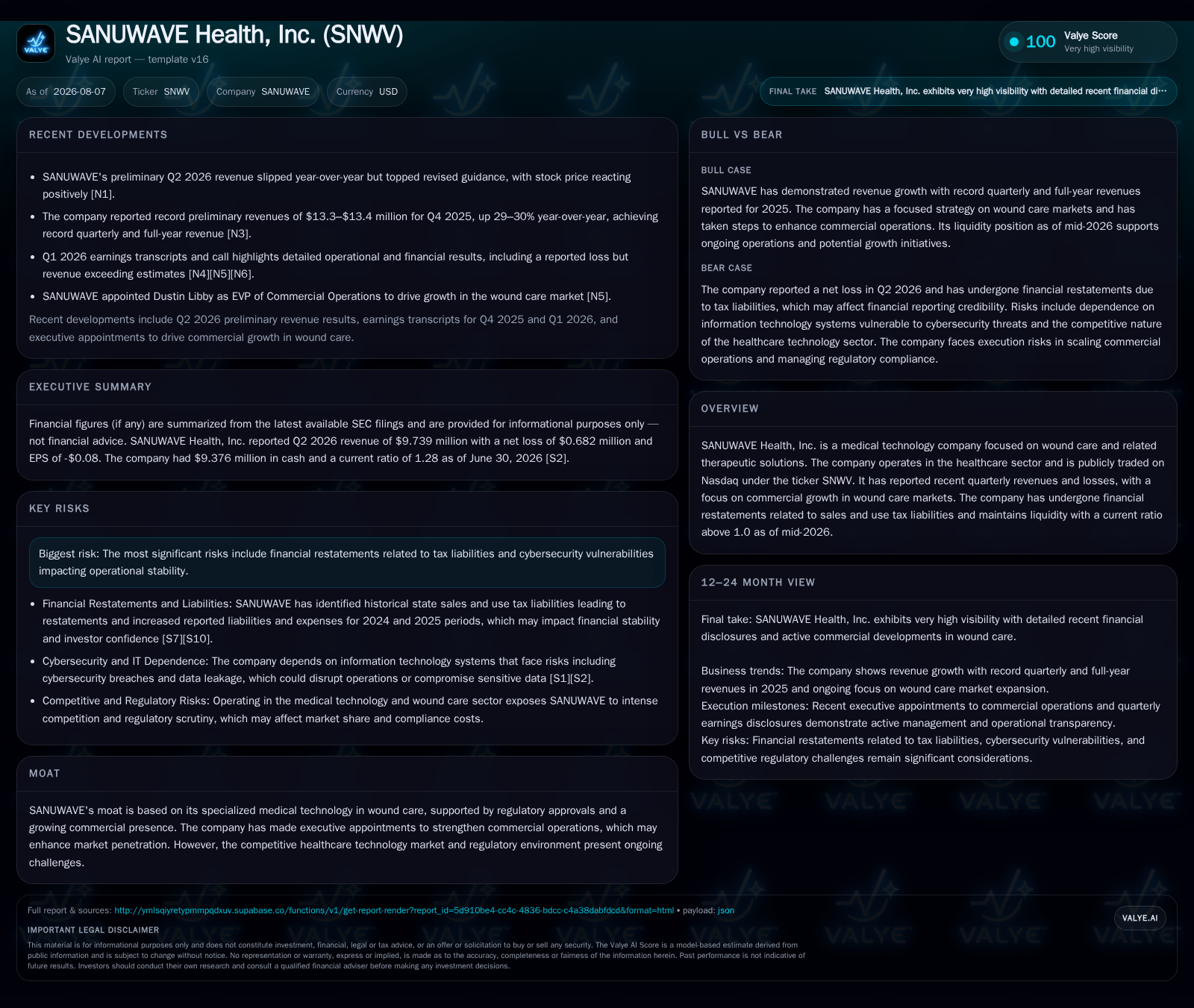
SANUWAVE Health posted second quarter 2026 revenue that exceeded revised guidance but slightly declined year-over-year, reflecting gradual commercial gains in shockwave therapy devices amid challenging reimbursement dynamics. The company’s ongoing financial restatement related to state sales and use tax liabilities signals past accounting issues but appears contained, as liquidity remains adequate. SANUWAVE’s market position depends heavily on healthcare provider adoption of its wound healing technology, regulatory approvals, and reimbursement coverage, with cybersecurity vulnerabilities posing operational risks. Close monitoring of device sales momentum and regulatory milestones will be critical for assessing the sustainability of growth.
Recent Quarterly Performance Highlights: Revenue Beats during Restatement Challenges
Complicating the near-term narrative is an ongoing restatement related to state sales and use tax liabilities spanning multiple prior periods. The company expects an increase of approximately $5 million in reported liabilities alongside additional recorded expenses reaching nearly $4 million combined over recent years, signaling internal control weaknesses uncovered during a nexus study [S23]. Although the impact appears largely historical and non-recurring from an operational standpoint, it accentuates risk around financial reporting integrity that investors should track carefully.
Wound Care Commercialization: Leveraging Shockwave Therapy within a Competitive Market
SANUWAVE's business model centers on developing and commercializing specialized medical devices employing shockwave therapy technology designed to promote wound healing of chronic injuries such as diabetic ulcers or pressure sores [S1]. The company generates revenue primarily through direct sale deployments of these therapeutic ultrasound devices to hospitals, clinics, and wound care centers. Additionally, device leasing or service contracts may supplement income streams but are less emphasized compared to outright sales.
FDA clearance underpins SANUWAVE’s ability to commercialize its technology within the U.S., serving as an essential gatekeeper for provider acceptance and payer reimbursement eligibility — both key hurdles in medical device commercialization. Shockwave therapy positions SANUWAVE within a specialized subset of advanced wound care treatments that differentiate it from other modalities like negative pressure wound therapy (NPWT) popularized by peers such as Acelity/KCI.
Healthcare provider adoption hinges on demonstrated clinical efficacy and practitioner familiarity with this therapeutic approach, factors which govern device utilization rates and ultimately drive recurring treatment-related revenues. Sales cycle length remains extended compared to acute care devices due to the need for clinical validation and institutional budgeting approvals.
Industry Dynamics: Navigating Regulatory Approvals and Reimbursement Barriers
Operating within the highly regulated medical device sector focused on wound care, SANUWAVE faces typical challenges related to securing ongoing regulatory approvals across geographies as well as navigating complex reimbursement frameworks that critically influence pricing power and market access [S1][S2]. While FDA clearance facilitates initial U.S. entry, reimbursement status by insurance payers often lags or is fragmented across regions, constraining broad adoption especially among cost-sensitive healthcare providers.
Relative to larger peers like Smith & Nephew who offer diversified wound care portfolios combining consumables with hardware and enjoy deeper payer relationships, SANUWAVE must advance reimbursement coverage aggressively to enhance commercial scalability. The competitive environment includes companies offering negative pressure wound therapies or bioengineered materials that command entrenched clinical usage patterns.
SANUWAVE’s Positioning versus Peers: Technology Adoption and Market Penetration Trajectory
Compared with Shockwave Medical — a structural peer leveraging similar shockwave modalities — SANUWAVE trails in scale with fewer devices deployed across clinical settings though it benefits from focused regulatory clearances facilitating targeted chronic wound segments. This limited footprint impacts customer retention rates; greater penetration into existing accounts will be key alongside acquisition of new healthcare providers to build sustainable revenue ramp.
Peer comparisons further highlight that broader product portfolios allowing bundled solutions or recurring disposable supplies tend to support higher gross margins and stickier customer relationships. SANUWAVE's narrower product base accentuates dependency on clinical efficacy data translating into repeat usage decisions by providers.
Growth Catalysts: Demographic Tailwinds, Reimbursement Expansion, and Portfolio Initiatives
Robust demographic tailwinds underpin demand for SANUWAVE’s therapies — notably the increasing prevalence of diabetes globally drives chronic wound incidence requiring innovative treatment approaches. Such structural factors offer durable addressable market expansion opportunities if clinical adoption can accelerate.
Strategic initiatives focused on expanding reimbursement coverage would materially improve SANUWAVE’s pricing leverage and commercial attractiveness relative to competitors with more established payer networks. Additionally, any pipeline advancements or partnerships broadening the product portfolio could enhance differentiation and foster ecosystem integration within provider workflows.
Risks to Watch: Regulatory Compliance, Cybersecurity, and Financial Reporting Integrity
Key risks facing SANUWAVE extend beyond commercial execution into regulatory compliance consistency given periodic approvals required for new indications or geographies [S6][S25]. Any delays or setbacks here could stall growth momentum.
Cybersecurity vulnerabilities identified as material risks point toward potential operational disruptions or data integrity threats affecting clinical device performance or patient safety – critical concerns particularly as medical devices become increasingly networked. Strengthening IT infrastructure remains imperative.
Financial reporting has come under scrutiny due to tax liability restatements revealing historical internal control deficiencies which could undermine investor confidence until fully resolved both procedurally and through transparent disclosures [S23][S25].
"Next Steps" Watchlist: Milestones for Clinical Adoption, Regulatory Filings, and Operational Execution
Monitoring upcoming quarterly filings will be crucial to assess whether Q2’s positive revenue surprise signals sustained momentum in device sales rather than isolated gains [S2][S3]
Additional clarity on completion of financial restatements will help resolve outstanding governance issues impacting capital markets perception.
Regulatory milestones including submission or approval announcements for expanded indications or international markets would mark important catalysts confirming strategic progress.
Tracking customer acquisition velocity alongside retention metrics will reveal whether healthcare provider uptake is expanding sufficiently against reimbursement headwinds.
Financial Profile Discussion: Liquidity Status Supports Continued Commercial Investment
As of June 30, 2026, SANUWAVE reported cash and cash equivalents totaling $9.4 million against current liabilities of approximately $18.2 million resulting in a current ratio of 1.28 — a level indicative of moderate balance sheet strength sufficient to support ongoing R&D investment and commercialization efforts over the short-to-medium term [F1]
Total debt stood near $20.8 million at end-March 2026 producing net debt around $11.4 million after adjusting for cash buffers. This leverage ratio demands prudent cash flow management especially given operating losses typical at this stage of commercialization.
This analysis synthesizes public SEC filings through mid-2026 alongside industry context without providing investment advice or speculative projections. It highlights SANUWAVE Health’s dual trajectory of progressing commercial adoption amid challenges in financial controls and sector-specific headwinds such as reimbursement complexity and cybersecurity risks.
Disclaimer: This is research-only, informational analysis and not investment advice. It may include AI-generated interpretation and general industry context. Always verify important details using primary sources.

Comments