
KeyCorp Boosts Net Interest Margin with Strategic Asset Mix Shifts Amid Steady Credit and Deposit Dynamics
KeyCorp's Q2 2026 update highlights improved net interest income through proactive deposit cost management and loan portfolio rebalancing, supported by robust capital ratios and controlled credit risk.
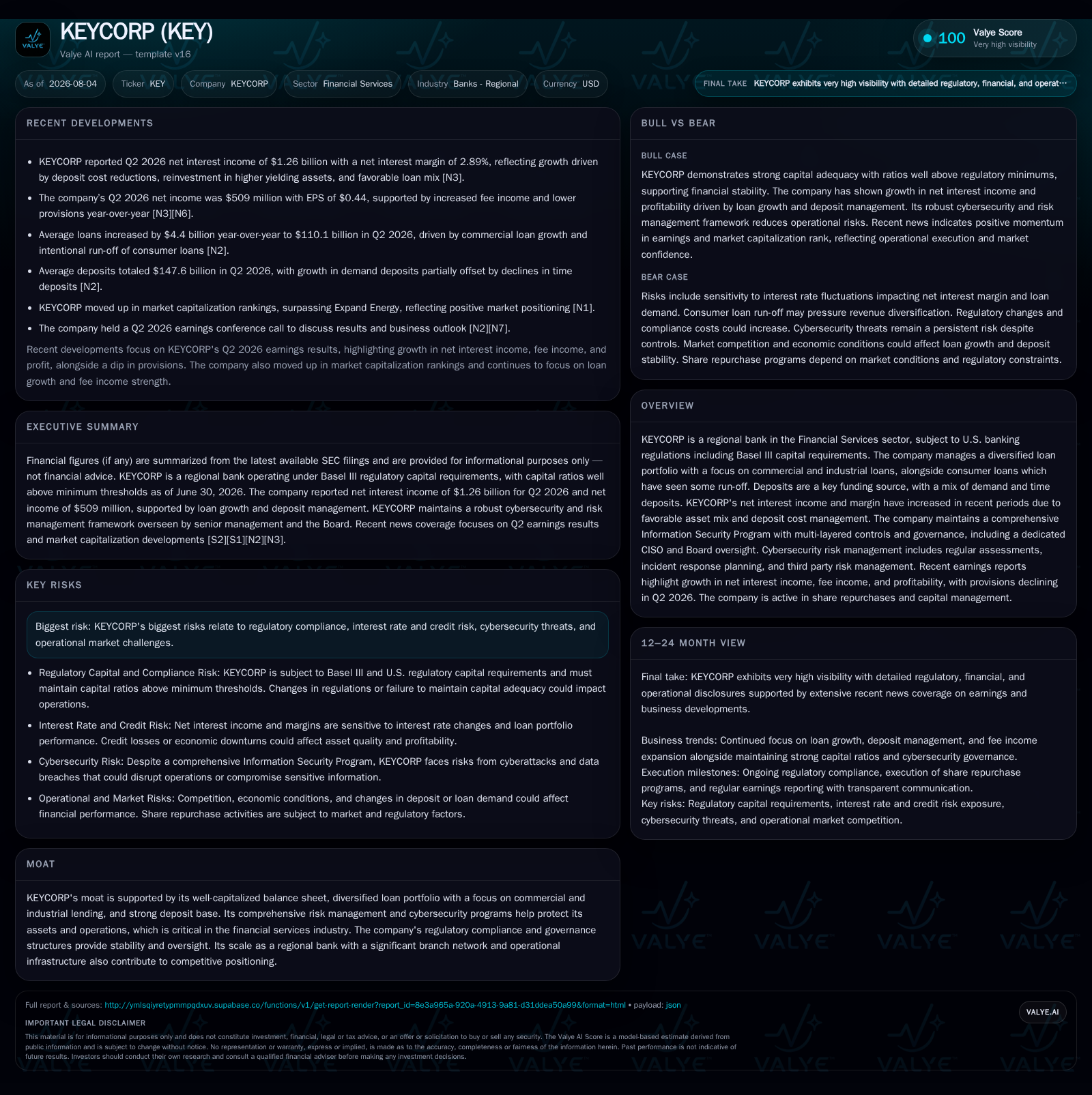
KeyCorp's latest quarterly results reveal a $108 million rise in net interest income and a 23 basis point expansion in net interest margin, driven by lower deposit costs and a favorable shift toward higher-yielding commercial loans. Despite modest loan growth, the bank exhibits disciplined credit risk management with stable provisions and non-performing asset levels. Regulatory capital remains comfortably above Basel III minimums, supporting ongoing liquidity and operational resilience. Cybersecurity governance continues as a key operational pillar amid increased digital banking adoption. Challenges include interest rate volatility and competitive pressure on deposit pricing, while growth prospects hinge on fee-income diversification and digital channel expansions.
Recent Operating Update
In Q2 2026, KeyCorp reported taxable-equivalent net interest income of $1.26 billion alongside a net interest margin (NIM) of 2.89%, marking an increase of $108 million and 23 basis points respectively compared to the same period in 2025 [S20]. This improvement was primarily driven by proactive management of deposit beta which reduced overall funding costs amidst declining interest rates. Additionally, proceeds from maturing low-yielding securities were reinvested into higher yielding instruments while the loan portfolio composition shifted favorably towards commercial and industrial loans that typically carry higher yields than consumer loans experiencing some run-off [S20].
Sustained low-cost deposits have proven critical in enhancing NIM as funding pressures ease regionally. Confirmation of deposit cost control effectiveness would be observed if the company maintains or further reduces its cost of funds over subsequent quarters during volatile market rates.
Business Model Overview
KeyCorp operates within the regional banking model emphasizing middle-market commercial lending complemented by diversified retail banking activities. Its revenue primarily derives from net interest income—the spread between yields earned on loans/assets and costs borne on deposits/funding liabilities. Fee income contributes via wealth management, payment processing, and ancillary financial services such as card-related charges [S10], enabling incremental top-line stability independent of interest rate swings.
The loan portfolio's strategic tilt towards commercial and industrial sectors reflects higher returns offsetting shrinking consumer loan balances aligning with broader industry trends favoring corporate credit as economies mature regionally. KeyCorp’s deposit base constitutes a stable funding source critical for capital deployment flexibility; managing the mix between demand and time deposits influences both liquidity management and NIM optimization [S4], [S6].
Capital adequacy is maintained through Basel III compliant buffers with explicit stress capital reserves interconnected with prudent risk appetites necessitated by complex regulatory frameworks. Cybersecurity governance underpins operational continuity—a necessity given rising threats across financial institutions—with multi-tiered controls led by an enterprise-wide CISO function that integrates business units’ security responsibilities with risk management oversight at board level [S1].
Industry Structure & Competitive Positioning
As a Category IV banking organization, KeyCorp competes among mid-scale regional banks such as Fifth Third Bancorp, PNC Financial Services, and Regions Financial but lacks the national scale of giants like JPMorgan Chase or Bank of America. This positioning offers balanced market focus but limits breadth in product scope relative to national peers.
Competitively, it leverages localized client relationships supported by branch network infrastructure combined with an expanding digital channel strategy catering to shifting consumer preferences for online banking solutions. Its diversified loan portfolio breadth provides resilience against sector-specific downturns although it remains sensitive to moderate economic cycles impacting commercial borrowing capacity.
Funding strategy centers on maintaining a core deposit franchise complemented by access to wholesale markets to preserve liquidity under stress scenarios—a standard practice across peers constrained by similar regulatory capital mandates and liquidity coverage ratios imposed post-2008 financial reforms [S4], [S6].
Well-managed execution across these dimensions will reinforce KeyCorp’s competitive advantage in the regional banking landscape while mitigating external uncertainties effectively.
Financial Profile Discussion
Liquidity is principally secured through a stable core deposit base complemented by access to medium-term note programs enabling flexible debt issuances without restrictive financial covenants [S4], reflective of efficient treasury management practices calibrated to balance cost versus availability risks. Share repurchase initiatives authorized since early 2025 demonstrate confidence in operating cash flow generation along with prudent capital allocation aligned with shareholder return objectives while preserving necessary buffers [S7].
Operational expenses reflect incremental rises consistent with personnel investments supporting growth initiatives alongside manageable FDIC assessment fluctuations; maintaining efficiency ratio improvements will be essential for profitability enhancement under competitive pressures common in regional banks [S1], [N1].
Disclaimer: This analysis is intended solely as an impartial industry and company examination based on publicly available information as of August 2026. It does not constitute investment advice or research views.
Disclaimer: This is research-only, informational analysis and not investment advice. It may include AI-generated interpretation and general industry context. Always verify important details using primary sources.

Comments