
L3Harris Technologies Strengthens Backlog and Margin Through LHX NeXt Program Execution
L3Harris’ Q2 2026 results reflect solid revenue growth, backlog expansion, and margin improvements driven by the LHX NeXt cost-efficiency initiative amid a stable defense spending environment.
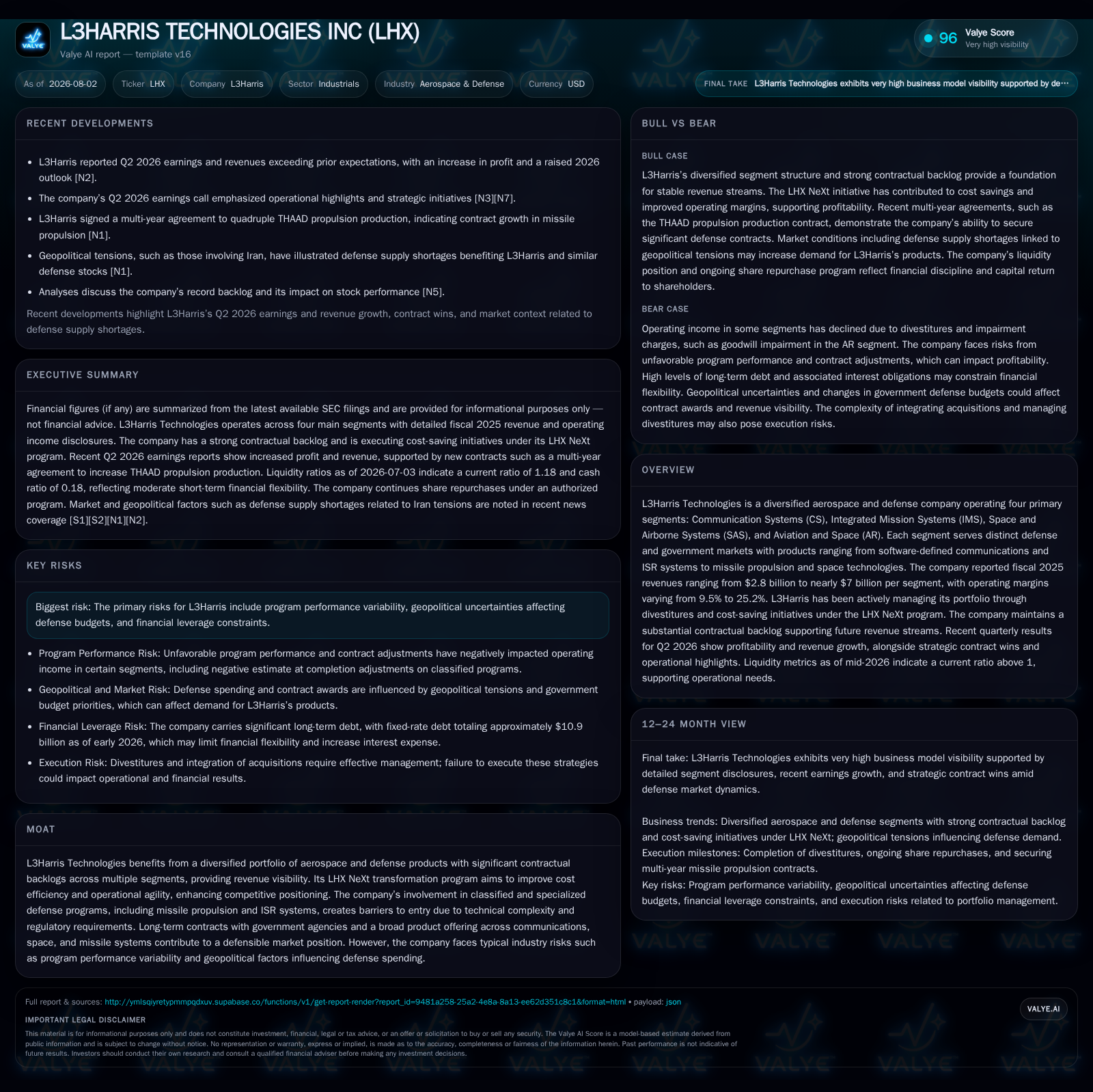
In Q2 2026, L3Harris delivered organic revenue growth supported by tactical communications ramp-ups and maintained a robust contractual backlog providing significant revenue visibility. Segment-level performance was led by Communications Systems, which registered both top-line and operating margin gains through international deliveries and effective cost-saving measures under the LHX NeXt program. The company’s integrated systems approach across ISR, missile propulsion, and space technologies offers flexible go-to-market options as both prime contractor and subcontractor. However, program performance variability and geopolitical factors remain watchpoints in an evolving defense budget landscape. L3Harris’ financial profile features moderate leverage balanced by sound liquidity supporting ongoing capital returns.
Q2 2026 Operating Momentum Bolstered by Backlog Growth
Q2’s revenue beat versus consensus was attributed largely to accelerated deliveries within tactical communications internationally and steady progress on broadband communications platforms. Importantly, this growth was achieved amid a stable defense budget environment following reconciliation package appropriations that bolstered department-of-defense funding through mid-2026 [N1][S1]. The ability to realize topline improvements without significant risk deterioration underscores disciplined contract execution supported by operational initiatives.
Segment Focus: Communications Divisions Leading Margin Expansion
The Communications Systems segment stands out as a driver of both top-line growth and margin expansion. Fiscal 2025 data show CS revenues increasing by roughly 4% year-over-year to $5.67 billion with operating margins inching upward beyond 25%, buoyed by international software-defined communications deployments and broadband communications ramps including Next Generation Jammer electronic warfare programs [S1]. The rise in CS operating income reflects successful cost reductions courtesy of the LHX NeXt program—a targeted operational efficiency initiative launched to improve agility and reduce overhead costs enterprise-wide.
These cost-saving efforts align with broader industry trends where prime contractors seek to counter balance-of-system pricing pressures via leaner operations while investing selectively in high-margin capabilities such as resilient communications solutions favored by allied nations. The incremental margin pickup within CS amidst dynamic government budget allocations indicates L3Harris’ ability to translate tactical program wins into sustainable profitability gains.
Structural Advantages: Integrated Systems Providing Market Agility
L3Harris operates with a flexible business model allowing it to assume roles as prime contractor or subcontractor depending on customer requirements. This platform-agnostic approach leverages integrated systems capabilities spanning intelligence, surveillance and reconnaissance (ISR), missile propulsion technologies, space systems engineering, and software-defined communications hardware/software [S1].
Such diversification permits adaptation across shifting government acquisition frameworks—from direct federal procurement through major defense primes to foreign military sales—granting L3Harris unique agility relative to peers focused narrowly on single domains. The breadth of product offerings coupled with technical complexity inherent to classified ISR or missile programs creates entry barriers sustaining defensible market share while driving operational scale synergies leveraged in initiatives like LHX NeXt.
Competitive Context: Positioning Among Large Primes and Specialist Peers
Against large aerospace & defense primes such as Lockheed Martin—which commands vast scale across fighter aircraft, missiles, and space—the mid-tier diversified portfolio of L3Harris positions it advantageously in select niche segments demanding rapid innovation cycles or integrated electronics solutions. By contrast, Raytheon Technologies emphasizes highly specialized missile propulsion and aerospace component innovation, while Northrop Grumman focuses deeply on ISR and space system domains.
L3Harris’ hybrid role balancing prime opportunities with merchant supplier flexibility enables competitive participation in high-growth markets like electronic warfare communications but also constrains bargaining leverage due to relatively smaller contract volumes compared with top-tier primes. Nonetheless, its broad footprint supports collaboration with larger primes as well as direct sales to defense agencies seeking integrated solutions.
Growth Catalysts: Innovation Pipeline and Defense Budget Tailwinds
Fiscal 2025 R&D investment approximated $536 million (~2% of revenue), targeting breakthroughs in autonomous communications platforms, ISR enhancements, electronic warfare advancements, and missile propulsion technologies aligned with Department of Defense modernization initiatives [S1]. This pipeline is complemented by recent multi-year production agreements such as the THAAD missile propulsion quadrupling deal that promises substantial revenue ramp opportunities over subsequent years [N14].
Reconciliation-driven defense budget boosts channel capital toward priority areas including munitions manufacturing capacity expansion and next-gen electronic warfare suite development—all playing to L3Harris’ capabilities across CS and IMS segments. These tailwinds support sustained bookings momentum enhancing backlog quality.
Challenges Ahead: Program Risks & Geopolitical Sensitivities
Despite encouraging topline momentum, program execution risks persist notably within IMS where fiscal 2025 margins contracted slightly owing in part to negative EAC adjustments aggregating $63 million related to classified Maritime ISR programs nearing completion and utilization shortfalls on Canadian Maritime Helicopter contracts [S1]. Such adjustments illustrate inherent difficulties managing complex classified contracts which can exhibit volatile cost profiles due to evolving technical demand or operational delays.
Geopolitical uncertainties impacting U.S. government procurement priorities could disrupt award timing or shift funding toward emergent threat domains not fully penetrated by L3Harris offerings. Supply chain challenges remain a latent risk factor given reliance on specialized components subject to tariffs or shortages globally. Regulatory compliance including export controls further complicate program delivery timelines.
These represent typical aerospace & defense risk vectors warranting continuous monitoring but do not currently appear impairing backlog conversion or cash flow generation materially [S1]
Upcoming Milestones: Contract Wins and Execution Benchmarks
Near-term execution will be shaped by contract awards outcomes verifying the order intake/book-to-bill ratios essential for sustained backlog replenishment. High utilization rates on core programs like THAAD propulsion production will serve as leading indicators for throughput efficiency translating into operating leverage gains.
Further milestones include successful delivery progress on classified ISR programs pending authorization milestones alongside potential new foreign military sales strengthening international footprint [N14][S3][N5]. The cadence of these developmental benchmarks will offer critical insights into forward margin stability beyond cyclical government appropriation effects.
Financial Profile Discussion: Leverage, Liquidity, and Capital Deployment
L3Harris enters the second half of fiscal 2026 maintaining a financial posture typical for aerospace & defense contractors engaged in long-dated government contracts requiring working capital investments subsidized by debt facilities [F1][S2]
This moderate leverage level supports ongoing share repurchases evidenced during Q2 under an active buyback program authorized up to $3 billion, necessitating disciplined free cash flow management amid sector-wide capital intensity pressures [S2]
Overall the financial structure complements operational metrics preserving flexibility for continued R&D expenditure aligned with strategic growth objectives without compromising risk appetite.
This analysis consolidates insights from L3Harris Technologies' latest SEC filings combined with industry context to evaluate recent developments shaping its competitive positioning within aerospace & defense sectors. It integrates segment-level performance nuances alongside financial health considerations absent speculative forecasts beyond disclosed evidence.
Disclaimer: This is research-only, informational analysis and not investment advice. It may include AI-generated interpretation and general industry context. Always verify important details using primary sources.

Comments