
Masonglory’s Project Backlog Doubles but Margin Pressure Deepens Amid Strategic Restructuring
Masonglory Ltd expands contract backlog through new infrastructure projects but faces sharp gross margin contraction and rising administrative costs in a competitive Hong Kong wet trades market.
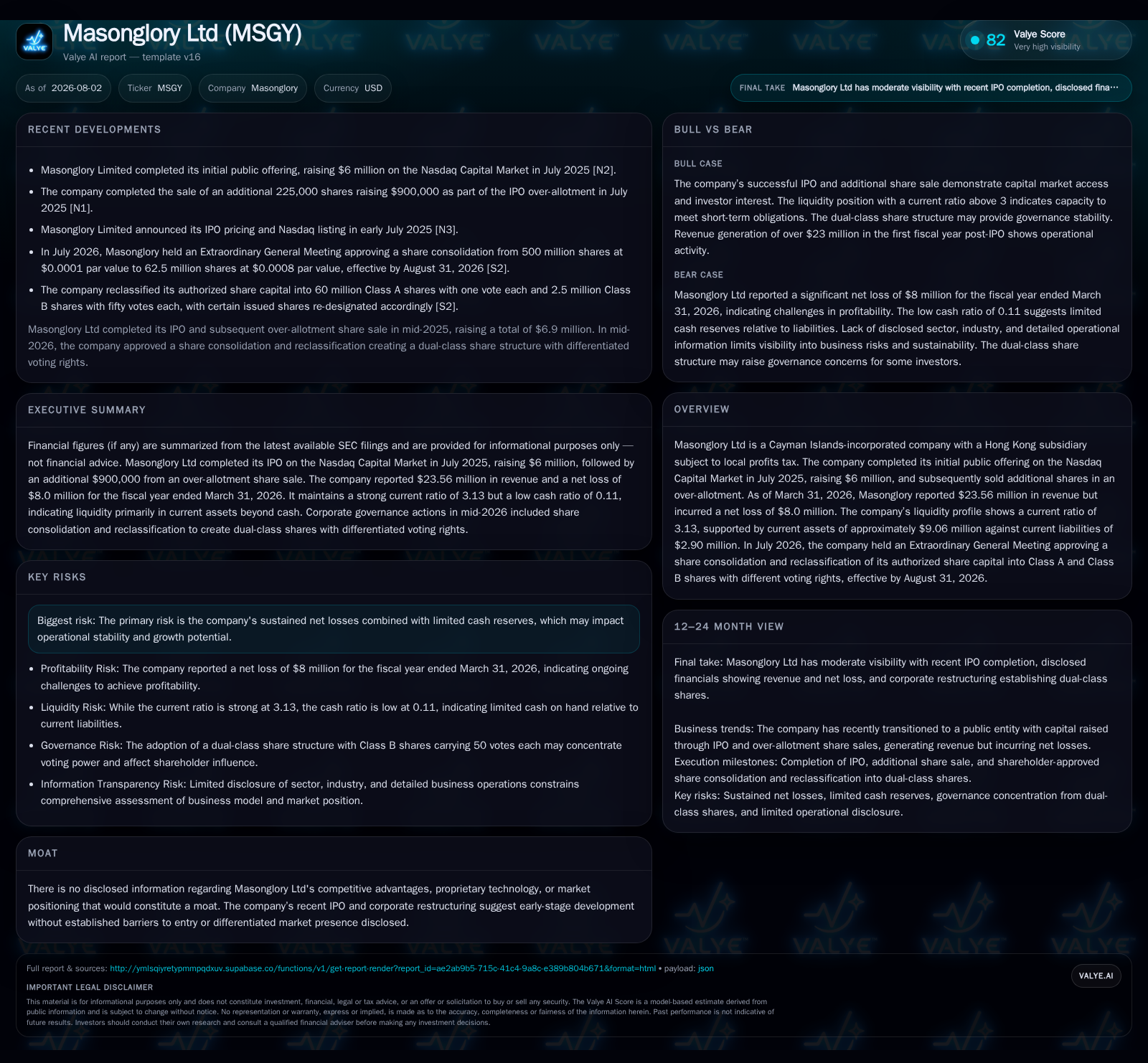
Masonglory Ltd, a Hong Kong-focused wet trades subcontractor listed on Nasdaq since mid-2025, reported a marginal revenue increase to $23.56 million for FY2026 but swung to a net loss of $8.0 million largely due to substantial share-based compensation and margin compression. The company’s project backlog more than doubled to $31.4 million, driven by new infrastructure and residential contracts, signaling strong tendering success. However, growing material costs, project delays, and intense competition are eroding gross profit margins, particularly in public sector works. Concurrently, Masonglory approved a share consolidation and equity reclassification to restructure its capital base by August 2026, highlighting its early-stage growth and governance evolution.
Recent Operating Update
Masonglory Ltd disclosed in its latest quarterly filing dated July 31, 2026 [S2] that it successfully held an Extraordinary General Meeting authorizing a share consolidation affecting its capital structure — specifically consolidating every eight issued shares into one and reclassifying the authorized shares into Class A and Class B with differing voting rights effective August 31, 2026. This move reflects the company’s efforts to streamline its equity base following its IPO on Nasdaq just over one year ago.
The company’s administrative expenses exploded by over twelvefold to nearly $8.85 million in FY2026 from under $670k previously—a spike overwhelmingly related to a non-cash share-based compensation charge accounting for around $7.8 million of this total [S22]. Excluding this non-cash element reveals an underlying rise in operating costs attributable to the listing compliance burden and expanded advisory fees [S22]. These costs weigh heavily on operational liquidity narratives common for companies transitioning from private to public status.
Business Model
Masonglory operates primarily as a wet trades subcontractor based in Hong Kong through its subsidiary Masontech Limited [S1]. Its service scope encompasses plastering (floors, walls, ceilings), tile laying both internally and externally, brick laying, floor screeding, and marble works—all integral finishing tasks within larger construction projects.
Revenue generation depends on winning bids via a competitive tendering process where the company submits price quotations underpinned by detailed cost estimates plus mark-ups [S1]. These contracts are inherently non-recurring; therefore, sustaining growth relies heavily on continuously replenishing project backlog through successful tender wins.
Profitability hotspots hinge on accurately forecasting direct labor needs and material costs alongside controlling project timelines since delays increase overhead absorption per unit of work performed [S22]. Furthermore, Masonglory must manage subcontractor workforce availability—a key risk given Hong Kong’s tight labor market conditions for construction trades [S1]. Customers are typically general contractors or developers seeking specialty trade expertise offered at scale through companies like Masonglory.
Industry Structure & Competitive Position
Masonglory sits firmly within the subcontracted wet trades segment of Hong Kong’s construction services industry characterized by intense competition among specialty trade providers offering similar plastering, tiling, brick laying services. Margins generally face compression due to multiple bidders driving down mark-ups during tender phases.
The firm competes against other local contractors as well as subsidiaries or divisions of larger general contractors with in-house wet trade capabilities. This landscape creates persistent pricing pressures requiring efficient project management capabilities.
Regulatory oversight is considerable; recent political uncertainties tied to Hong Kong’s governance arrangements under "one country, two systems" could unpredictably influence economic activity levels impacting tender availability [S1][S8]. The company must also navigate PRC oversight as cross-jurisdictional regulations extend reach into Hong Kong business practices.
Growth Drivers
Additional growth levers include diversification within adjacent wet trades disciplines or geographic markets should Masonglory pursue expansion beyond current territories. Operational enhancements aimed at improving labor utilization rates and reducing cost overruns also directly support margin restoration goals.
Moreover, the ongoing urbanization trend combined with government stimulus boosting infrastructure projects underpins medium-term demand fundamentals for experienced subcontractors capable of delivering quality finishes compliantly.
Risks & Watchpoints
Key risks revolve around sustained net losses reflecting cash burn exacerbated by increasing administrative expenses related mostly to equity compensation programs initiated post-IPO [S22]. Such non-cash charges impair reported profitability metrics though do not affect immediate liquidity but signal dilution concerns.
Labor market tightness poses operational continuity risk through potential workforce instability or wage inflation that may erode already thin gross margins caused by heightened raw material input costs and project execution delays [S1].
The company’s dependence on the politically sensitive Hong Kong market exposes it to geopolitical developments potentially disrupting construction starts or regulatory approvals impacting contract flow [S1][S8]. Additionally, the non-recurring project volume inherent in its business model subjects revenue streams to cyclicality with uneven cash flow timing due mainly to milestone-payment structures common in construction subcontracting.
These markers will collectively indicate whether Masonglory can leverage recent contract gains into profitable scaling while managing inherent volatility associated with its subcontracted wet trades niche.
Financial Profile Discussion
Capital expenditure outlays rose significantly in FY2026 (~$2M) invested in equipment acquisitions supporting operations such as forklifts and aerial platforms [S24]. Financing activities during the fiscal year reflect net cash generated mainly through proceeds from equity issuance related subsequently explained by IPO fundraising efforts totaling nearly $6.9 million gross before fees [S24].
Working capital dynamics notably shifted cash flows negatively due primarily to increases in accounts receivable ($3.86 million) indicating slower collections from milestone payments juxtaposed with accounts payable increases which provide some offsetting cash inflow relief [S14]. Such timing mismatches characterize typical milestone-driven payment cycles weighing utilizable cash flow figures periodically.
In sum, financial positioning showcases adequate liquidity alongside operating cash outflow pressures stemming from rapid scaling phase following IPO capitalization combined with cost structure evolution driven by public company status demands.
This analysis relies solely on publicly filed documents without offering investment advice or research views regarding any securities mentioned herein.
Disclaimer: This is research-only, informational analysis and not investment advice. It may include AI-generated interpretation and general industry context. Always verify important details using primary sources.

Comments