
CBIZ Faces Merger Transition While Leveraging Multi-Service Model to Sustain Growth
CBIZ's latest quarter highlights steady operations amid a pending merger, driven by integrated financial and benefits services with disciplined capital deployment.
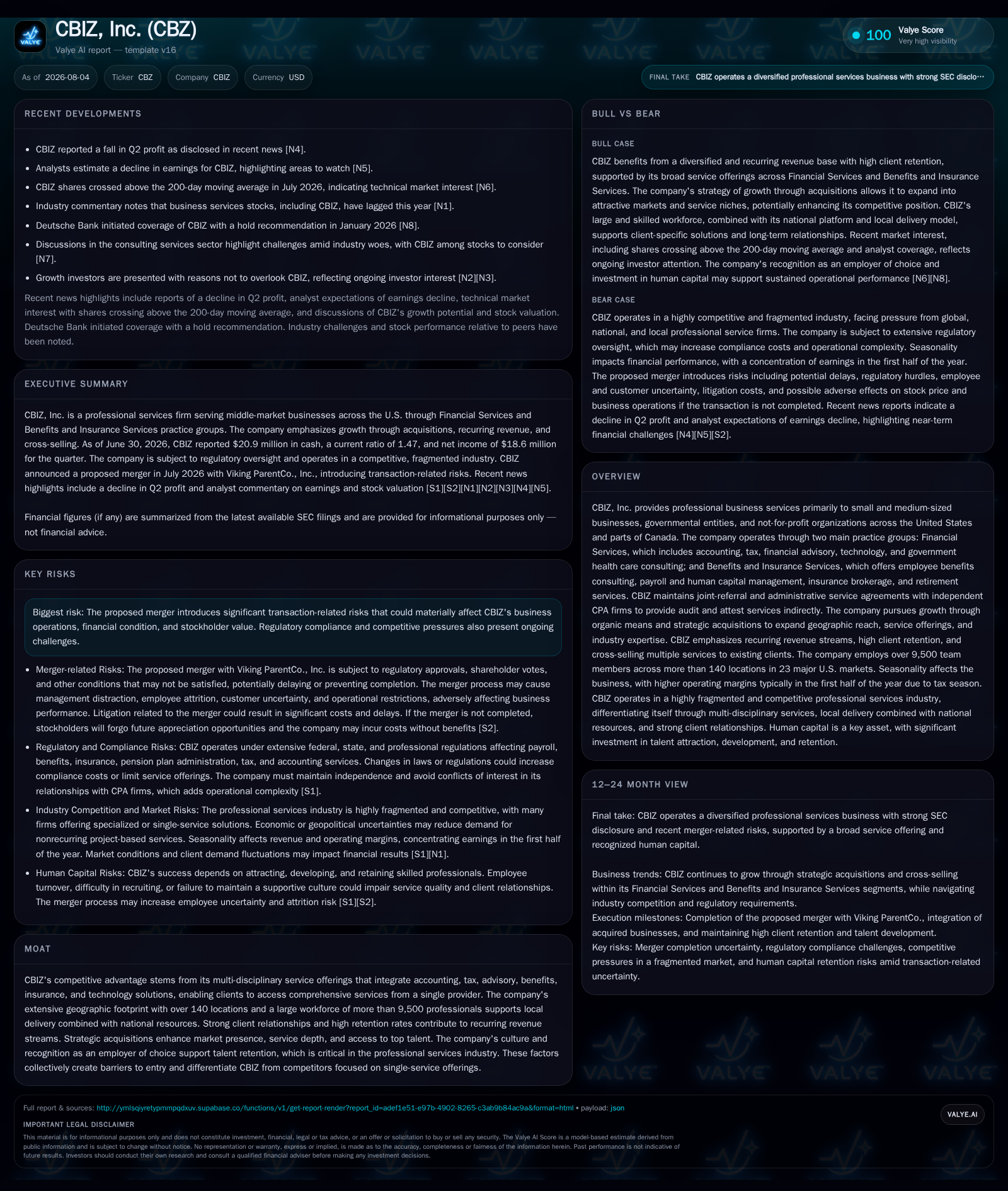
CBIZ, Inc.’s Q2 2026 results reflect ongoing solid performance within its two-practice group business model—Financial Services and Benefits & Insurance Services—focused on middle-market clients. The company announced a definitive agreement for a $55-per-share cash merger, introducing near-term transaction risks and operational uncertainties. CBIZ maintains competitive advantages through diversified service offerings, strong client retention, and an extensive national footprint reinforced by acquisitions. Despite some cyclical softness in project-based demand and elevated net leverage around $1.44 billion, CBIZ continues to prioritize organic growth, strategic acquisitions, debt reduction, and talent retention. Key watchpoints include integration execution post-merger, ability to sustain recurring revenue streams, and managing working capital amid DSO fluctuations.
Recent Operating Update: Merger Announcement Shapes Near-Term Outlook
In its Q2 2026 filing dated August 4, CBIZ disclosed steady operational performance within its two primary reporting segments following an internal reorganization that merged its National Practices into the Financial Services practice group [S2]. However, the dominant corporate event is the announcement of a definitive merger agreement on July 28 with Viking ParentCo., under which CBIZ shareholders will receive $55 per share in cash consideration upon deal completion [S3][S21]. This transaction imposes uncertainties including regulatory approval dependencies, shareholder vote requirements, potential delays arising from litigation risks, and operational constraints due to contractual obligations stipulated in the Merger Agreement [S1]. Management also highlights risks associated with employee attrition triggered by deal-related uncertainty and possible deferral of client engagements during transition periods.
This merger context frames the latest quarterly operating disclosure as the company balances business-as-usual progression against strategic considerations. Longer-term value propositions are consequently tied to successful closure and integration execution.
Business Model: Integrated Professional Services Targeting Mid-Market Clients
CBIZ operates primarily through two practice groups: Financial Services and Benefits & Insurance Services [S1]. The Financial Services segment includes traditional accounting and tax compliance work; financial advisory such as transaction and risk consulting; national technology consulting services covering cloud solutions and cybersecurity; as well as government healthcare consulting. The Benefits & Insurance segment covers employee benefits strategy and consulting; payroll/human capital management services; property & casualty insurance brokerage; retirement planning; along with managed network hardware services.
Revenue generation flows from fee-based contracts serving predominantly small to medium-sized businesses alongside governmental entities and nonprofits throughout the U.S. and parts of Canada [S1][S2]. CBIZ monetizes through recurring consulting fees (e.g., employee benefits plans), commissions (insurance brokerage), project-based advisory work (transaction deal support), subscription-like managed IT service contracts, and payroll processing volumes.
The firm emphasizes cross-selling bundled services to deepen client engagement across multiple disciplines. Its extensive geographic footprint (140+ locations in over 23 major U.S. markets) facilitates local delivery paired with national resources and technical specialization—an important differentiation in meeting complex mid-market needs [S1]. Independence regulations restrict CBIZ from directly performing audit attest services but it leverages joint-referral agreements with independent CPA firms to complement offerings indirectly.
Client relationships exhibit high stickiness benefiting multiple recurring revenue lines—a key stability driver in a sector exposed to economic cycle swings affecting one-time projects.
Industry Structure and Competitive Position
Within the professional business services landscape—which encompasses accounting firms, employee benefits brokers like Gallagher or Willis Towers Watson, technology consultants, CPA partnerships, healthcare advisors, and insurance intermediaries—CBIZ positions itself as an integrated platform combining financial advisory with benefits/insurance expertise backed by technology consulting capabilities.
This multi-disciplinary approach creates barriers for specialized competitors focusing solely on one service line by offering holistic solutions that reduce switching for clients seeking end-to-end advisory support. Furthermore, CBIZ's strategy of growth through selective acquisitions enhances scale benefits alongside service breadth expansion into higher-growth industries or untapped geographies [S1]. Their cultural emphasis on talent retention—validated by over 120 workplace awards in 2025—bolsters capacity to attract seasoned professionals critical for delivering specialized advice [S1].
Risks remain inherent in regulatory compliance shifts impacting tax codes or healthcare legislation which affect demand patterns. Client concentration remains manageable though long-tailed receivables had resulted in trailing twelve-month DSO moving between mid-70s days up to nearly 100 days historically depending on seasonal billing cycles [S17][S18][S19]. Effective working capital management will be a differentiator here given high utilization rates typical for professional firms are coupled with lumpy payment timing.
Growth Drivers
Several demand tailwinds underpin CBIZ’s growth prospects:
- Increasing Complexity of Regulatory Environments: Tax reforms, healthcare mandates, retirement plan rules create ongoing needs for expert advisory support driving sustained demand for CBIZ’s Financial Services as well as Benefits consulting lines.
- Outsourcing Trends: Small/mid-market companies increasingly outsource finance functions such as payrolling/HCM to reduce overheads, benefiting CBIZ’s integrated offerings.
- Cross-Selling Opportunities: Expanding existing client penetration across multiple services enhances revenue per client which is less sensitive to macro downturns compared to standalone project engagements.
- Strategic Acquisitions: The company actively pursues bolt-on deals that add new geographies or specialized capabilities enhancing differentiation while maintaining cultural alignment—a recurring theme at CBIZ [S1][S14].
- Technology Adoption: Increasing adoption of cloud infrastructure security consulting within Financial Services aligns well with steady secular demand for cybersecurity solutions.
- Middle-Market Expansion: Growth in this segment overall from entrepreneurial activity increases addressable market size over time.
Risks and Watchpoints
The most immediate risk is merger execution uncertainty encompassing regulatory clearance timelines plus potential litigation costs that could delay or derail the transaction [S1]. Beyond deal-specific hazard:
- Employee Retention/Recruiting: Deal-related uncertainty may cause attrition among key professionals jeopardizing capacity or quality delivery.
- Client Deferrals: Some customers might postpone decisions fearing service disruptions post-merger affecting revenue visibility.
- Accounts Receivable Risk: DSO variability poses liquidity risk if collections slow further given current net leverage near $1.44 billion [F1][S2].
- Economic Sensitivity: Although recurring revenue cushions volatility some project-based advisory lines face cyclical declines during macroeconomic slowdowns impacting near-term margins.
- Competitive Pressure: Fragmented industry structure means continued pressure from niche players or larger firms expanding into core service areas remains relevant.
- Regulatory Changes: Shifts in tax law or healthcare regulations can unpredictably alter demand dynamics requiring ongoing adaptation.
What To Watch Next
Key milestones over coming quarters center first on:
- Completion timing of the Viking ParentCo. merger including receipt of all regulatory approvals and shareholder votes [S3][S21].
- Post-merger integration effectiveness especially regarding cultural cohesion and retention of top talent that drive client trust pipelines.
- Quarterly updates on organic growth trends within Financial Services versus Benefits & Insurance segments highlighting resilience given macroeconomic headwinds.[S2]
- Trends in Days Sales Outstanding as a proxy for working capital health impacting cash flow convertibility.[S17]
- Progress on strategic acquisitions post-merger indicating sustained M&A momentum aligned with stated priorities.[S14]
- Any commentary around shifts in pricing power or cross-selling penetration metrics reflecting competitive positioning gains.
Financial Profile Discussion
At quarter-end June 30, 2026, CBIZ reported approximately $20.9 million in cash equivalents against total debt near $1.46 billion resulting in net debt around $1.44 billion [F1]. Liquidity appears sufficient with current assets totaling approximately $1 billion compared to current liabilities near $684 million yielding a current ratio of roughly 1.47—indicative of short-term coverage albeit modestly leveraged [F1].
Operating activities frequently show seasonal working capital absorption during first fiscal quarter driven by billing cycles primarily for Financial Services accounting/tax practices before reversing into positive cash flows later quarters—a pattern observed historically [S17][S18][S24]. Interest expenses hover above 6% reflecting market rates applicable under their credit agreements but have been partially offset historically by contingent earnout adjustments related to prior acquisitions [S15][S18].
Capital allocation prioritizes funding organic growth initiatives including technology investments alongside strategic acquisitions aimed at expanding geographic/service reach while balancing gradual deleveraging ambitions over time post-merger closure [S14][S16]. Modest share repurchase activity continues selectively via ROFR agreements representing efficient capital deployment rather than signaling surplus liquidity given net debt levels [S13].
In summary, CBIZ maintains a financial profile characteristic of acquisitive professional services firms combining moderate leverage leveraged prudently against recurring cash flows though sensitivity remains towards macroeconomic conditions impacting working capital cycles.
This analysis is based solely on publicly available SEC filings dated up to August 4th, 2026 ([S1] through [S22]) supplemented by validated company fact data ([F1]) without speculative assumptions or forward-looking forecasts beyond statements disclosed by management. It does not represent investment advice or research views but provides an informed industry-level perspective grounded in documented disclosures.
Disclaimer: This is research-only, informational analysis and not investment advice. It may include AI-generated interpretation and general industry context. Always verify important details using primary sources.

Comments