
Black Stone Minerals Expands Shelby Trough Holdings Amid Stable Drilling Activity and Hedging Pressures
BSM’s latest quarter reveals steady production growth supported by key development agreements and active mineral asset acquisitions.
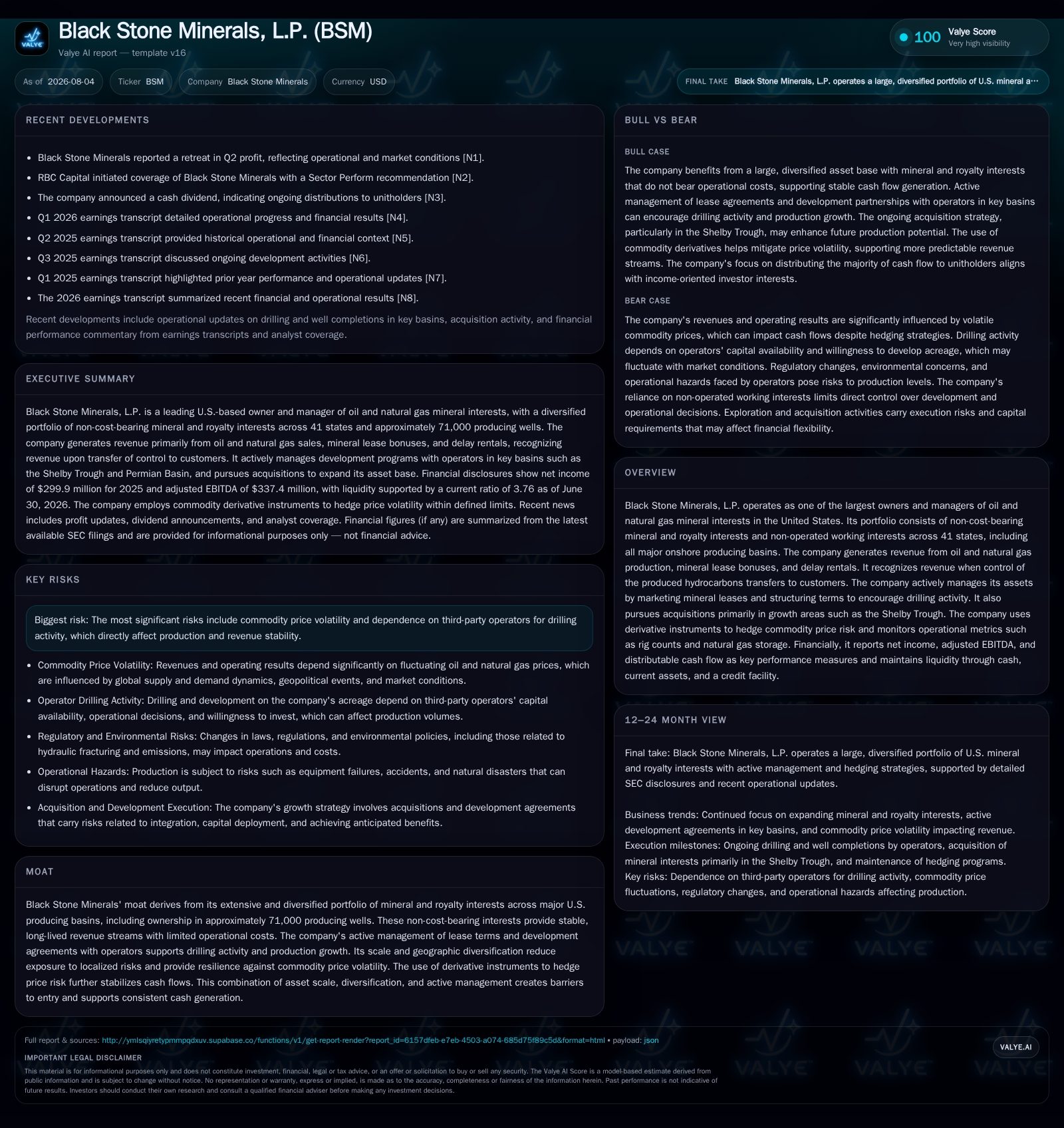
In Q2 2026, Black Stone Minerals, L.P. maintained consistent operating momentum with notable activity in the Shelby Trough, where partner operators continue to meet escalating drilling commitments. The company’s business model centers on managing a vast portfolio of non-cost-bearing mineral and royalty interests across major U.S. basins, structurally providing stable revenue from production royalties, lease bonuses, and delay rentals. Despite commodity price volatility and increased hedge settlements pressuring income recognition, BSM’s disciplined acquisition strategy in growth areas like the Shelby Trough supports reserve expansion and production upside. Their geographically diversified asset base and strong credit facility compliance sustain financial flexibility for continued capital deployment.
Recent Operating Update: Q2 2026 Highlights
Alongside Adamas’ drilling activity, BSM expanded its strategic partnerships through joint exploration agreements (JEAs) with Caturus Energy and Revenant in late 2025. The Caturus agreement covers more than 220,000 gross acres with escalating lateral footage commitments rising to over 25,000 net lateral feet annually by program year six (2031 onward), reflecting a shift from fixed well counts to lateral footage targets to accommodate longer laterals—a prevalent industry trend enabling enhanced reservoir contact per well [S15]. Revenant’s obligation maintains a minimum of six wells drilled in calendar year 2026, increasing toward an annual goal of at least 25 wells by 2030, supporting predictable drilling cadence on roughly 270,000 gross acres under contract [S1], [S15]. These arrangements incentivize operators to drill consistently while aligning with BSM's objective of maximizing production from its mineral footprint.
BSM also reported acquisitions amounting to $37.2 million in mineral and royalty interests during Q2 alone, primarily targeting unproved properties in East Texas surrounding core drilling areas [S22]. This acquisition momentum complements prior purchases totaling approximately $239.5 million since September 2023 focused mainly on the Shelby Trough expansion zone [S1], reinforcing BSM’s commitment to enhancing its high-potential inventory.
Business Model Perspective
BSM functions predominantly as an upstream mineral and royalty interest owner holding non-operated positions across 41 U.S. states encompassing all significant onshore producing basins [S22], [S26]. Its portfolio includes approximately 71,000 producing wells generating revenues passively via several monetization channels:
- Production Royalties: BSM receives a defined percentage share (net revenue interest) of oil and natural gas produced and sold from its owned mineral interests without bearing direct operational costs or capital expenditures for drilling or production activities.
- Lease Bonuses: Revenue derived from upfront payments granted by operators for leasing rights on undeveloped acreage.
- Delay Rentals: Payments received when operators defer drilling obligations under lease terms.
- Non-Operated Working Interests: While limited relative to mineral holdings, these interests expose BSM to operational costs but provide additional upside through working interest participation.
Revenue generation depends closely on several operating variables: production volumes driven by continued rig activity; realized commodity prices influenced by market dynamics; timing of lease bonuses related to leasing refresh cycles; and mix effects between oil versus natural gas output [S1], [S22]. By limiting direct cost burden through owning non-cost-bearing interests, BSM sustains high operating leverage while focusing capital allocation toward accretive acquisitions that bolster future cash flows.
Commodity price volatility remains a critical uncertainty; hence BSM employs derivative instruments—primarily NYMEX-based swaps—to partially hedge price exposure for oil and natural gas revenues. Unlike companies adopting hedge accounting treatment, changes in fair value associated with these derivatives impact net income immediately as unrealized gains or losses, adding earnings volatility despite smoother cash flows [S7], [S17].
Industry Structure and Competitive Position
Within the mineral and royalty interest ownership segment—positioned upstream but non-operational—BSM ranks among the largest U.S.-based holders owing to scale (~71,000 producing wells), geographic breadth (41 states), and concentration in prolific basins such as the Permian and Haynesville/Shelby Trough regions [S1], [S26]. This diversification mitigates localized geological or policy risks compared with peers more concentrated in single basin exposures like Magnolia Oil & Gas or Sabine Royalty Trust.
The company actively manages its portfolio via marketing strategies that structure lease terms encouraging operator drilling acceleration—a competitive lever against peers who may take more passive stances. Development agreements requiring minimum well counts or lateral footage commitments underline this proactive approach fostering predictable operator engagement critical for sustaining production volumes amidst fluctuating capital markets affecting E&P spending patterns [S15]
Moreover, the management's disciplined acquisition strategy targets contiguous acreage near ongoing development programs improving economies of scale for operators—a potential inducement for more intensive drilling—and prospects expanding reserves supporting long-term distributable cash flow.
Growth Drivers
BSM’s key growth vectors center on:
- Operator Drilling Activity: Ongoing rig operations by Adamas/others drive incremental production volume increases translating directly into royalty income.
- Acquisition Expansion: Strategic purchase of adjacent mineral interests enlarges net acreage footprint enhancing future cash flows while maintaining proximity benefits.
- Development Agreements’ Commitments: Formalized minimum spud counts or lateral footage targets underpin predictable reserve additions across multi-year horizons.
- Commodity Price Movements: Elevated oil prices notably increase per-unit revenue; hedging strategies mitigate downside but cap some upside volatility.
- Technological Advances: Longer laterals enabled by fracturing technology allow each new well to extract greater hydrocarbons thus maximizing value per drill bit within commitment limits.
Monitoring rig count fluctuations provides a proximate leading indicator influencing short-term production trends due to lagged well completion cycles typical in unconventional plays [S22]
Risks and Watchpoints
Key risks constraining growth include:
- Commodity Price Volatility: Sharp price declines can diminish realized revenues notwithstanding derivative overlays; extended downturns potentially reduce operator drilling budgets lowering production growth.
- Operator Capital Access: Dependence on third-party developers’ ability to finance costly multi-well programs introduces execution risk potentially delaying well spuds beneath contractual minima.
- Regulatory Environment: Legislative/regulatory shifts targeting hydraulic fracturing operations can restrict permits or increase compliance costs impacting operational tempo.
- Title & Ownership Issues: Legal disputes over mineral ownership could impair unencumbered revenue collection or restrict leasing opportunities.
- Pipeline & Transportation Constraints: Bottlenecks limiting takeaway capacity risk local price discounts reducing realized pricing above benchmark levels.
- Hedge Accounting Absence: Lack of formal hedge accounting subjects earnings to swings from fair value changes potentially affecting valuations despite stable cash distributions.
Routine assessment of operator spud rates vis-à-vis agreement thresholds alongside commodity market outlooks is critical for anticipating changes in production trajectories and valuation implications.
What To Watch Next
Investors should prioritize tracking:
- Operator compliance with escalating drilling/lateral footage commitments under JEAs—confirmation via spud milestones and sales timing impacts near-term production volumes.
- Quarterly updates on lease bonus auction activity signaling renewed leasing interest supporting future development pipelines.
- Production volumes disaggregated by basin providing insight into localized activity shifts.
- Changes in average realized prices inclusive of deductibles compared against derivative settlement effects illustrating true cash flow stability versus earnings variability.
- Next scheduled borrowing base redetermination (October 2026) affecting credit facility availability for acquisitions or distributions.
- Additional acquisition announcements particularly within evolving growth corridors such as Shelby Trough reflecting portfolio enhancement priorities.
Financial Profile Discussion
As of June 30, 2026, BSM held cash and equivalents totaling approximately $1.67 million alongside current assets near $89 million with current liabilities around $23.7 million yielding a solid current ratio of 3.76 indicating comfortable short-term liquidity [F1]
Capital expenditures focus predominantly on inorganic buildup through acquisitions of non-producing mineral interests complementing organic growth via operator development rather than direct capital-intensive drilling operations; associated operating expenses remain limited given asset ownership model minimizing operational cost burden relative to full-cycle producers [S17], [S23]. General administrative expenses rose moderately tied primarily to increased headcount including performance-oriented remuneration enhancing organizational capacity for asset management activities [S23], [S27].
All numeric statements are cited per documented sources. Readers should consider industry cyclicality inherent in upstream energy sectors when evaluating forward-looking assumptions referenced herein.
Disclaimer: This is research-only, informational analysis and not investment advice. It may include AI-generated interpretation and general industry context. Always verify important details using primary sources.

Comments