
Trade Desk Faces Growth Challenges but Leverages AI and Omnichannel Strength in Q2 2026
Recent Q2 results show consumer advertising spend pressure, yet Trade Desk’s AI-powered platform and omnichannel footprint sustain competitive positioning.
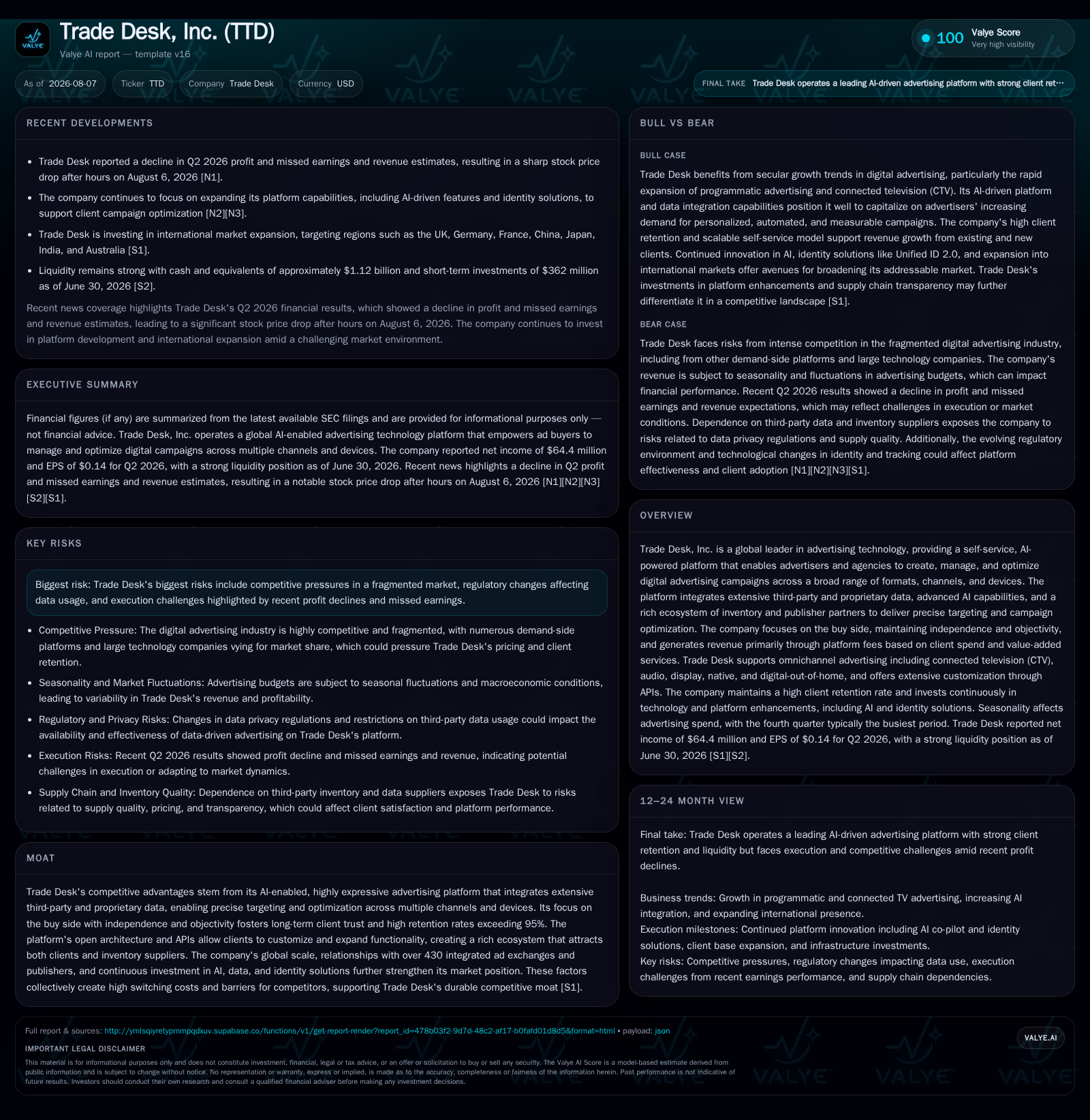
Trade Desk’s Q2 2026 results revealed a miss on both earnings and revenue, driving a notable share price decline [S2][N1][N2]. Client retention remains strong, but total platform spend growth decelerated amid macroeconomic headwinds and heightened industry competition [S2]. The company’s core strength lies in its advanced AI-driven demand-side platform that enables advertisers and agencies to optimize programmatic campaigns across multiple digital channels including CTV, audio, and display [S1]. Despite near-term revenue softness, Trade Desk continues investing strategically in infrastructure and AI capabilities, especially to capitalize on the fast-growing connected television advertising segment and privacy-compliant data innovation. Persistent risks include competitive pricing pressures, regulatory changes impacting data use, and client concentration exposure [S2][S26]. Key metrics to watch next include client spend trends, adoption of new offerings, and gross margin stability.
Recent Operating Update Highlights
In its latest quarterly filing dated August 6, 2026, Trade Desk reported disappointing Q2 results characterized by both earnings and revenue misses relative to market expectations. This near-term softness triggered a significant share price decline in after-hours trading [S2][N1][N2]. Management cited a slowing growth trajectory in advertising spend processed through its platform amid persistent macroeconomic headwinds and intensifying competitive dynamics within the digital advertising ecosystem. While overall client retention remained robust above 95%, the company flagged concerns about achieving sustained expansion given relatively modest incremental media spend growth from existing customers plus challenges securing new clients under competitive pricing pressure [S2]. These operative dynamics materially shape the near-to-medium term outlook considering Trade Desk’s revenue model is heavily dependent on client budget allocations flowing through its platform.
Business Model Overview
Trade Desk operates a self-service demand-side platform (DSP) primarily serving institutional advertisers and agencies that purchase programmatic digital media inventory. The company generates revenues predominantly via platform fees that are calculated as a percentage of total advertising spend processed through its technology stack. This spend-based fee structure inherently links Trade Desk's top-line to advertiser budgets which are allocated dynamically across an expanding range of digital formats including connected television (CTV), audio streaming, display ads, native ads, and increasingly digital-out-of-home inventory [S1].
Platform clients enter into master services agreements (MSAs) generally spanning one-year terms with automatic renewals but without exclusivity provisions—meaning clients can shift or reduce spend with relative ease. To mitigate volatility risks inherent in non-exclusive relationships, Trade Desk invests heavily in AI-driven campaign optimization tools that enhance audience targeting precision by leveraging extensive third-party data integrations combined with proprietary identity solutions. These capabilities foster stickiness by creating high switching costs for clients who rely on the platform's predictive analytics for efficient media buying decisions. For clients able to customize offerings further, enterprise-level APIs expand functionality enabling bespoke workflows or integration into broader marketing stacks.
The company's expansive ecosystem includes over 430 integrated ad exchanges and publisher partners worldwide. This breadth facilitates access to diverse advertising inventory pools crucial for delivering omnichannel reach while maintaining real-time bidding (RTB) efficiencies at scale. Continuous investment in hosting infrastructure supports scaling AI workloads central to campaign personalization and automation.
Industry Structure and Competitive Positioning
Trade Desk sits firmly on the buy side of the digital advertising value chain where it interfaces between advertiser demand and seller supply through marketplaces such as ad exchanges. Its core competitors comprise other DSPs including MediaMath and Amobee as well as integrated in-house platforms operated by major tech companies like Google Marketing Platform or Amazon Advertising which combine both DSP and SSP functionalities internally.
Despite this crowded landscape marked by fragmentation and rapid innovation cycles, Trade Desk’s moat rests on several structural advantages: advanced machine learning capabilities driving superior campaign ROI; an open-platform architecture encouraging ecosystem partner contributions; high customer retention rates surpassing industry averages; plus geographic diversification with growing footprints outside the US especially in Europe and Asia which represent large untapped TAM pockets [S1][S20]
These factors elevate switching costs for clients wary of losing performance benefits tied closely to Trade Desk's AI models or fragmented integration benefits derived from proprietary datasets. Nonetheless, competitive intensity remains acute especially given ongoing consolidation tendencies among tech players bundling media buying with publisher monetization or data management functions.
Growth Drivers
Several secular trends underpin Trade Desk’s medium- to long-term growth prospects:
- Programmatic Advertising Expansion: As advertisers progressively allocate more budgets toward automated media buying methods enabled by data-driven decision making, the overall industry TAM surpassed $1 trillion globally in 2024 with continued double-digit expected expansion.
- Connected Television (CTV) Migration: The shift from traditional linear TV viewing to internet-streamed video content represents one of the fastest-growing segments due to higher engagement rates plus valuable audience targeting opportunities. Trade Desk has been a first-mover enabling programmatic CTV access supporting advertisers’ desire for measurable outcomes beyond broad reach.
- Artificial Intelligence Advancements: Enhanced AI models driving personalization at scale improve campaign effectiveness translating directly into higher incremental budgets processed through Trade Desk's platform.
- Privacy-Conscious Data Approaches: With increased regulation (e.g., GDPR/CCPA) limiting third-party cookie usage, there is accelerated adoption of privacy-compliant identity frameworks like Unified ID 2.0 which Trade Desk supports actively empowering clients while complying with evolving laws.
- International Market Penetration: Investments focused on localized operations in several key global regions including UK, Germany, France, China, Japan, India & Australia aim to tap burgeoning programmatic adoption abroad.
Risks and Watchpoints
Core risks warrant continued monitoring:
- Competitive Pressures: As alternatives from integrated tech behemoths offering bundled advertising services evolve rapidly with potential pricing advantages or superior cross-channel insights, sustaining Trade Desk’s premium pricing becomes challenging.
- Regulatory Environment: Any tightening of data privacy rules could constrain availability or granularity of targetable consumer signals impacting effectiveness or monetization opportunities for programmatic platforms.
- Customer Concentration & Contract Flexibility: Two holding companies represented nearly 30% of gross billings in 2025—a non-trivial customer concentration exposing some revenue volatility risk especially given MSAs permit termination with short notice [S20].
- Technology Execution Risks: Maintaining platform uptime amidst growing complexity plus successfully scaling AI infrastructures are vital operational imperatives.
- Macroeconomic Influences: Advertising budgets remain susceptible to economic cycles influencing discretionary marketing spends globally which have already manifested in softening Q2 trends [N1][N2].
What to Watch Next
Investors should focus on key operating markers validating recovery or further weakness:
- Trends in total advertising spend funneled through the platform particularly from large agency clients transitioning budgets back into digital channels post-macro shocks.
- Uptake rates of new AI-based features or expanded API capabilities quantifying clients’ deeper engagement.
- Gross margin trends reflecting revenue mix shifts between high-margin platform fees versus lower-margin pass-through costs tied to inventory sourcing.
- Progress against international growth targets signaling successful market diversifications.
- Seasonal amplification entering Q4 holiday advertising period historically strongest in agency spends across media.
Financial Profile Discussion
As of June 30, 2026 quarter-end, Trade Desk reported healthy liquidity levels with cash & equivalents totaling approximately $1.12 billion alongside current assets standing near $4.82 billion versus current liabilities around $2.79 billion yielding a comfortable current ratio of approximately 1.72 consistent with strong short-term financial flexibility [F1]. Capital allocation remains focused on investing heavily in technology infrastructure supporting AI workflows plus strategic international expansion initiatives while also executing active share repurchase programs designed to mitigate dilution risks from employee stock issuances [$500 million available for repurchases authorized early 2026] [S9][S15]. The company generated substantive free cash flow reflecting operational leverage despite some margin compression pressures noted during quarterly commentary. Continued balance sheet strength underpins ability to fund growth investments during volatile macro conditions without relying on external funding sources currently.
This analysis is based solely on publicly filed SEC documents dated through August 6, 2026; recent market news; and established industry knowledge frameworks relevant to advertising technology service providers operating demand-side platforms.
Disclaimer: This is research-only, informational analysis and not investment advice. It may include AI-generated interpretation and general industry context. Always verify important details using primary sources.

Comments